
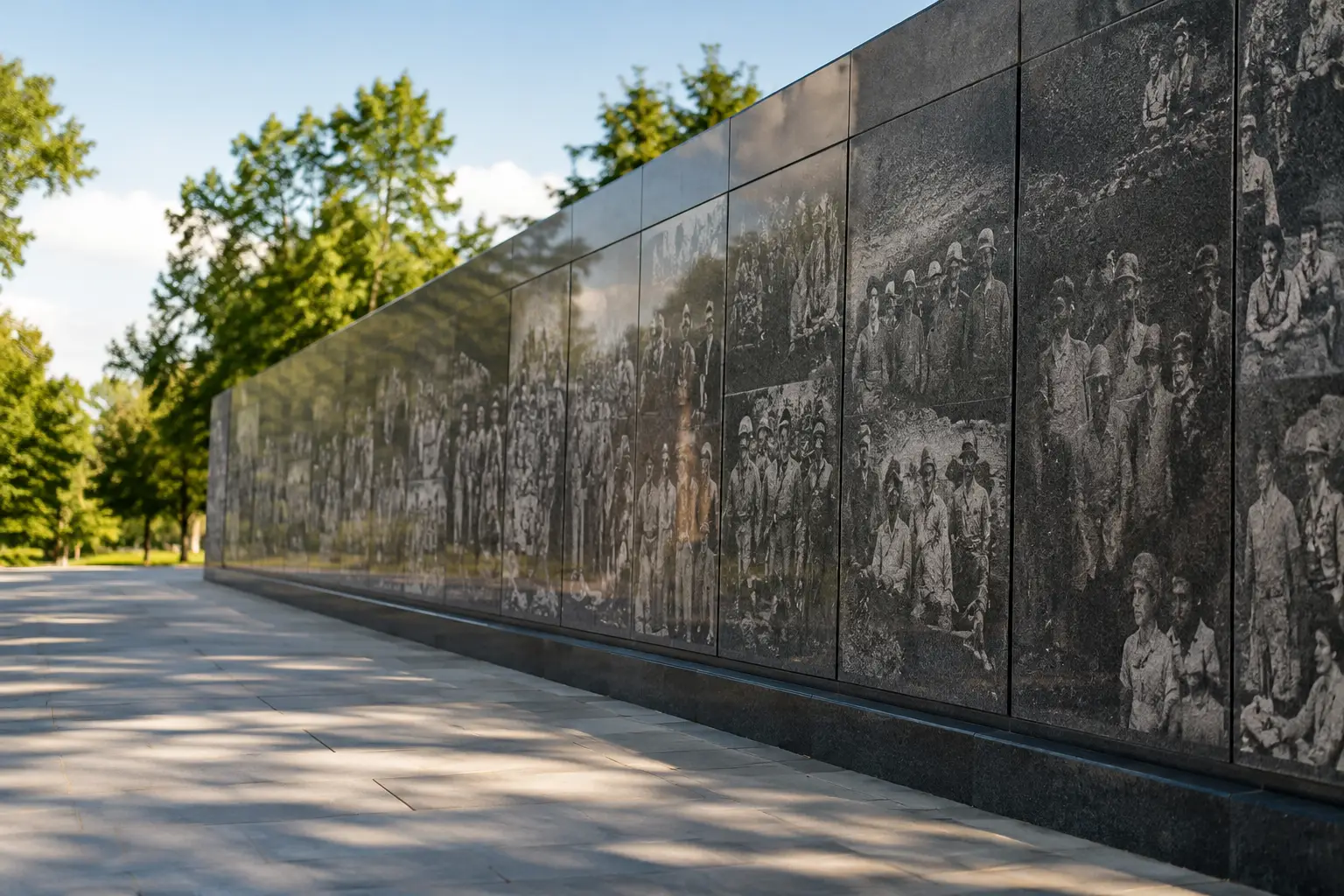
A commemorative wall project is entrusted with more than names, dates or dedications. It gives a shared memory a physical place: a quiet point of recognition in a cemetery, a sacred precinct, a civic garden, a school, a private estate or a restored historic setting. For that reason, it must be conceived not as a surface for text, but as an architectural work whose material, proportion and workmanship will carry meaning for generations.
Natural stone has long been the material of this responsibility. Its permanence is not merely practical. Marble, granite, travertine and selected natural stones possess depth, movement and character that allow a memorial to feel considered rather than manufactured. Yet no stone alone guarantees endurance. The most moving commemorative walls are created where design sensitivity, technical understanding and respect for place meet.
A commemorative wall project begins with purpose
Before selecting a slab or drawing a line of lettering, establish what the wall is meant to hold. A municipal memorial may need to honour many lives over time, allowing room for future inscriptions without losing compositional harmony. A religious memorial may call for a more contemplative language, with symbols integrated discreetly into the stone. A family wall may be intimate and highly personal, shaped by a particular landscape, residence or burial ground.
Purpose determines scale, visibility and rhythm. It also affects the visitor’s experience. Is the wall intended to be read from a distance, approached slowly along a path, or encountered within an enclosed chapel? Is it a destination in its own right, or one element within a wider architectural composition? These questions influence the height of the stone, the size of the lettering, the finish of the surface and the way light moves across it.
A memorial should never compete unnecessarily with its setting. In a formal historic cemetery, restraint may be the highest expression of dignity. In a contemporary civic landscape, a long, low wall of finely honed granite may establish a powerful and accessible presence. The right answer depends on context, not fashion.
Choosing stone for permanence and expression
Material selection is both an aesthetic and technical decision. Marble offers luminosity and a classical richness that has made it central to sacred and commemorative art for centuries. Its veining can bring a singular, almost painterly quality, particularly in protected or carefully managed environments. However, some marbles are more susceptible to atmospheric staining, acidic conditions and weathering than denser stones, so their use outdoors requires informed specification and appropriate care.
Granite is often chosen for exposed memorial walls because of its exceptional density and resistance to frost, rain and urban pollution. Dark granites can provide a dramatic field for engraved lettering, while pale or richly crystalline varieties give a different sense of light and texture. The trade-off is expressive rather than functional: a highly reflective polished surface can appear formal and monumental, but may complicate legibility in strong sunlight. A honed or finely textured finish can offer a softer, more contemplative result.
Travertine brings warmth and a distinctive Italian architectural tradition. It can be especially fitting where a wall belongs to a courtyard, cloister, garden or civic composition. Because its natural pores and tonal variation are integral to its beauty, detailing must be handled with precision. The intended exposure, chosen finish and maintenance programme matter greatly.
Other natural stones may be ideal where local geology, a heritage palette or a specific colour relationship guides the project. Matching an existing historic stone can be essential in restoration contexts. In contemporary work, contrast may be deliberate: a charcoal granite inscription panel set within pale limestone, for example, can establish clarity without becoming visually harsh.
The most suitable material is rarely selected from a small sample alone. It should be assessed at a meaningful scale, in relation to the site’s light, adjacent architecture and seasonal weather. Natural stone is never entirely uniform, and that individuality is part of its value.
Surface finish shapes the act of remembrance
Polish, honing, brushing, bush-hammering and hand-worked textures each alter how a wall is perceived. A polished face reflects surroundings and can lend ceremonial gravity. A honed finish absorbs light more quietly. A textured surface introduces shadow and tactility, but may require deeper lettering or a contrasting insert to retain clear reading.
The same consideration applies to joints, returns and coping stones. Fine, accurately aligned joints can make a substantial wall feel calm and continuous. A projecting coping may protect vulnerable upper edges from water, while also giving the composition a distinct profile. These details are not secondary: they are where longevity becomes visible.
Lettering must belong to the architecture
Names are the heart of many commemorative walls, and typography deserves the same care as the stone itself. An inscription should be proportioned for the viewer’s distance and for the available light. Letterforms that appear graceful on a drawing can become too delicate when cut into a textured surface, while overly heavy letters can diminish a refined composition.
Incised lettering remains one of the most enduring approaches. Its shadow gives words presence, even without added colour. Depending on the design, letters may be left natural, gilded, painted or filled with a carefully selected compound. Bronze lettering can offer a dignified contrast and allow individual elements to be renewed if necessary, although it introduces its own fixing, patination and maintenance considerations.
There is also a question of permanence in language. Dates, names and formal dedications generally age well. More extensive text can be deeply meaningful, but it requires generous spacing and a disciplined hierarchy so that the wall remains legible rather than crowded. If future names are expected, the original design should anticipate them from the beginning. Retrofitting inscriptions onto a completed wall often produces an uneasy result.
Engineering should protect the quietness of the design
A wall that appears effortless has usually been carefully engineered. Ground conditions, substrate preparation, structural support, drainage, movement joints, stone thickness and fixing methods must all be resolved before fabrication begins. A memorial wall is often expected to last far beyond ordinary architectural finishes; shortcuts beneath or behind the stone can compromise that promise.
External installations require particular attention to water. Moisture entering behind cladding or beneath coping stones can lead to staining, frost damage or failure over time. Correct falls, drips, ventilation where required and compatible bedding or mechanical fixing systems are essential. In some settings, a freestanding solid-stone construction is appropriate; in others, stone cladding over a designed support structure offers greater flexibility. Neither method is inherently superior. The decision rests on scale, budget, site constraints and the desired visual depth.
Accessibility should be addressed with equal care. A public memorial must welcome different visitors, including those using wheelchairs or approaching with limited mobility. Paths, thresholds, viewing distances and the height of inscriptions all contribute to whether remembrance is genuinely shared.
Restoration demands restraint and evidence
When a commemorative wall already exists, restoration is not an opportunity to make it look new. It is an act of stewardship. The aim is to stabilise, clean and repair while preserving the marks of age that belong to the work’s history.
This begins with close examination: identifying the original stone, previous repairs, salt damage, structural movement, biological growth and unsuitable past treatments. Harsh cleaning or inappropriate sealants can cause permanent harm, especially to porous or historic stone. Repairs should be compatible in material, colour, texture and behaviour, allowing the original fabric to remain the principal voice.
With a heritage of stone craftsmanship dating to 1860, Torchio Marmi approaches this balance with the understanding that a monument’s patina is often part of its truth. The work must honour both the people remembered and the hands that made the original memorial possible.
A lasting wall needs a considered future
Even the finest stone benefits from a realistic care plan. This does not mean constant intervention. It means periodic inspection, gentle cleaning where appropriate, prompt attention to damaged joints or fixings, and a clear record of materials and methods for those who will care for the wall later.
The best commemorative walls invite this long view. They do not rely on novelty to be noticed. Through measured proportions, enduring materials and inscriptions cut with conviction, they become part of a place’s life - a monument to memory that continues to speak quietly, long after the moment that first called it into being.