
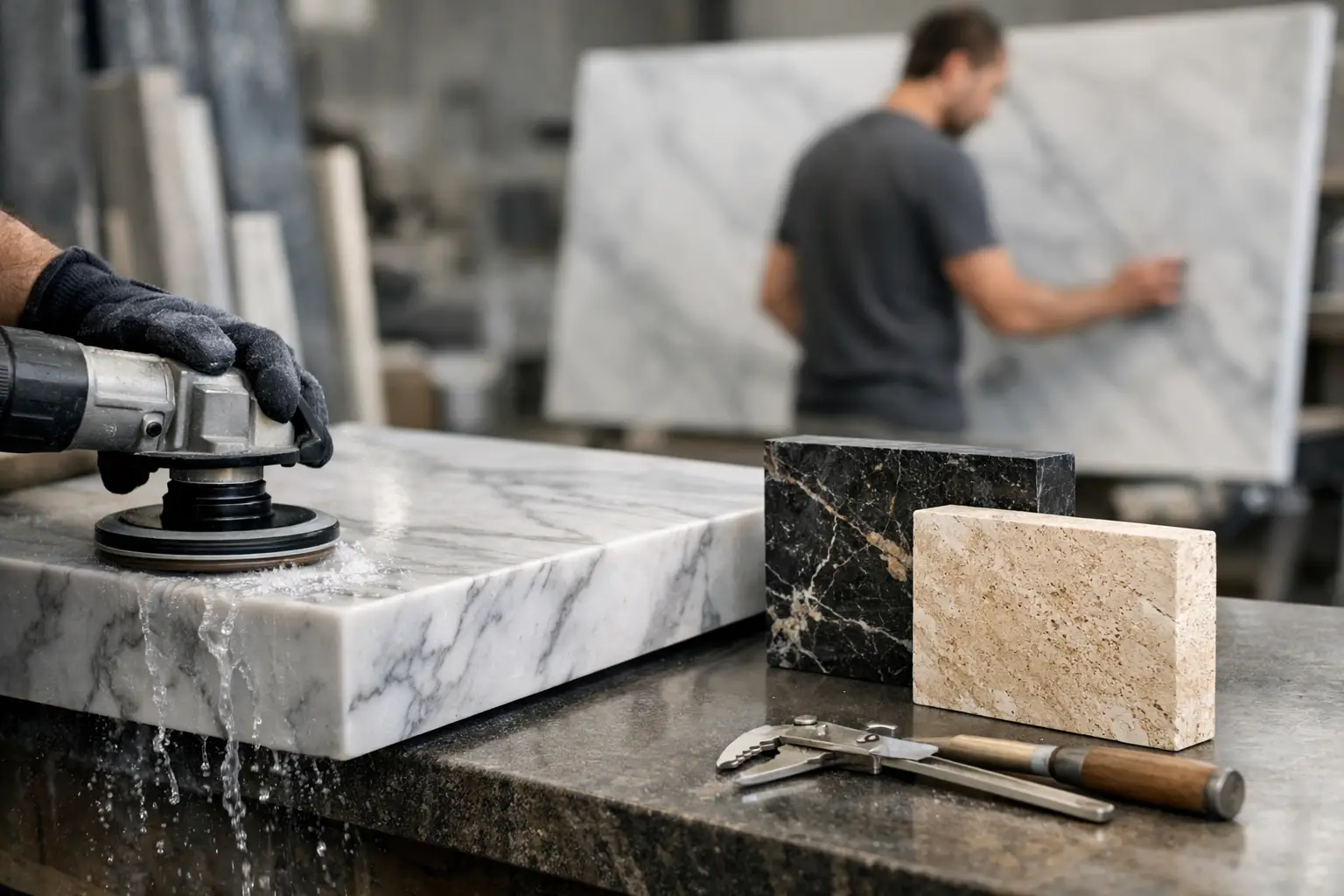
A stone surface is never merely a surface. In a private residence, a hotel entrance, a chapel or a historic square, it sets the temperature of a room, catches changing light and records the touch of daily life. Bespoke stone fabrication services begin with this understanding: that marble, granite, onyx and travertine are not interchangeable finishes, but natural materials with their own character, limits and expressive possibilities.
For more than a decorative choice, a commissioned stonework project must resolve proportion, structure, use and atmosphere at once. The finest results are born where material knowledge meets a precise reading of place.
What Makes Stonework Truly Bespoke?
Bespoke does not mean selecting a standard slab and changing its dimensions. It means shaping the entire process around a specific architectural intention. The stone must be chosen for the project, the project must be measured with care, and every edge, joint, vein direction and finish must be considered in relation to the space it will inhabit.
A book-matched onyx wall may be conceived as a luminous centrepiece for an entrance hall. A restrained limestone floor may need to bring calm to a contemporary country house. In a period interior, a fireplace surround may require an exact dialogue with existing mouldings, timber and natural light. Each calls for a different balance of visual effect and technical judgement.
This is why bespoke work begins before fabrication. It begins in the quarry, the slab yard and the design conversation. The most appropriate material is not always the rarest or most dramatic one. A stone with a quieter grain may serve the architecture more faithfully, while a richly veined marble may deserve a composition that allows its movement to be seen without interruption.
From Raw Block to Architectural Presence
Natural stone has a history measured in geological time. Fabrication gives that history a new purpose, but it should never erase the material's identity. Veining, fossil traces, tonal shifts and crystalline depth are qualities to be composed with, rather than defects to be concealed.
The work proceeds through a sequence of decisions. Slabs are selected for colour, structure and continuity. Templates and detailed drawings establish dimensions, openings and tolerances. Cutting and machining create the required forms, while hand finishing gives refinement to profiles, corners and visible surfaces. Finally, dry laying and installation bring the separate elements into a coherent whole.
At every stage, accuracy matters. A kitchen island in marble must accommodate appliances, supports and service openings without compromising the beauty of the slab. A large-format wall cladding must align across corners and returns. A stair must feel visually light while meeting the requirements of weight, fixing and daily use. The detail that seems almost invisible is often the one that determines whether stonework feels effortless.
The Importance of Vein Direction and Finish
Vein direction is among the most consequential decisions in a stone project. It can lengthen a corridor, draw the eye upwards, bring order to an expansive floor or create a striking focal point behind a bath or reception desk. Where several slabs are used, the relationship between them must be planned deliberately: book-matched, vein-matched, open-booked or arranged in a quieter sequence.
Finish changes the character of the same stone just as profoundly. A polished surface heightens depth and reflection, making it particularly suited to formal interiors and decorative applications. Honed stone is softer and more contemporary, with a gentle, low-sheen appearance. Brushed, flamed or textured treatments can offer grip and visual ease in exterior settings. There is no universally superior finish. The right choice depends on location, light, maintenance expectations and the desired emotional register.
Bespoke Stone Fabrication Services for Distinctive Spaces
The value of bespoke stone fabrication services lies in their range as much as their precision. A single commission may include flooring, wall linings, staircases, bathroom surfaces, fireplaces, kitchen worktops, tables and bespoke furnishings. In larger schemes, stone can create a continuous language between interior and exterior architecture.
For residential clients, this offers a way to make a home unmistakably personal. A vanity top can follow an unusual wall geometry; a shower enclosure can be composed around a single dramatic slab; a dining table can become an heirloom object rather than a piece of furniture chosen for convenience. The permanence of stone gives these spaces a sense of settlement and care.
For architects and interior designers, custom fabrication permits a more exact response to the brief. It allows junctions to be resolved rather than disguised, proportions to be adjusted on site, and selected materials to perform as integral parts of the architecture. This is particularly valuable where a project includes curved forms, oversized panels, intricate inlays or transitions between different materials.
For commercial and hospitality settings, durability must sit alongside distinction. Reception counters, bar tops, lift lobbies and public washrooms face constant contact. A carefully selected granite or compact stone may be the wiser choice where resistance is paramount, while marble or onyx can be reserved for protected focal areas. Luxury does not require ignoring practical realities. It requires placing beauty where it can endure.
Material Choice Is a Technical Decision
Stone should be selected with both the eye and the hand. Marble offers extraordinary variation, richness and historical resonance, but some varieties are more susceptible to etching or staining than granite. This need not exclude marble from kitchens or bathrooms, but it does call for an honest understanding of use and maintenance. For many owners, the gentle patina of a lived-in marble is part of its appeal. For others, a more resistant material may better suit the household.
Granite is valued for hardness, consistency of performance and suitability for demanding surfaces. Travertine brings warmth, depth and a distinctive porous texture that can feel especially natural in architectural settings. Onyx is prized for translucency and visual drama, often becoming exceptional when backlit, though it requires considered detailing and a setting that protects its delicate beauty.
Exterior applications introduce further questions. Frost resistance, drainage, slip performance, fixing systems and exposure to pollution or salt must all inform the choice. A beautiful stone used in the wrong conditions can become a costly compromise. The craft lies partly in knowing when to say yes to an ambitious idea, and when a different material or construction method will protect it for the future.
Restoration: Respecting What Time Has Made Valuable
Historic stonework asks for a different kind of confidence. Restoration is not an opportunity to make the old appear new. It is a disciplined act of preservation, guided by close observation of original materials, tool marks, construction methods and accumulated patina.
Where a façade, monument, church interior or memorial has suffered damage, the intervention should be proportionate. Cleaning, consolidation, careful replacement of failed elements and compatible repair materials can preserve both the physical fabric and the dignity of the work. New stone must be chosen with sensitivity to colour, grain, porosity and ageing behaviour, not simply for an immediate visual match.
This approach is equally meaningful in funerary work. A memorial is a monument to memory, and its form must hold both personal emotion and the passage of time. Marble, granite, bronze and steel can be brought together with restraint, allowing inscription, silhouette and material presence to speak without excess.
A Partnership Built Around Detail
The most successful stone projects depend on early collaboration. When fabricators are involved while a design is still developing, they can help establish realistic slab sizes, suitable thicknesses, fixing strategies and tolerances before these become site problems. They can also advise on where a natural joint may be necessary and how it can become part of the composition rather than an unwanted interruption.
Clients should expect a bespoke maker to ask searching questions: How will the room be used? What light falls across the surface? Is visual continuity more important than minimal maintenance? Does the stone need to match an existing historic fabric? Which details will be touched every day, and which will be viewed from a distance?
At Torchio Marmi, this dialogue is informed by a craft tradition begun in 1860 and by the belief that design should be at the service of dreams. Yet the dream is made credible through measurement, material discipline and experienced hands.
A well-made stonework commission does not ask for attention at every moment. It simply belongs: cool beneath the hand, balanced within its setting, and increasingly beautiful as the years give it a life of its own.