
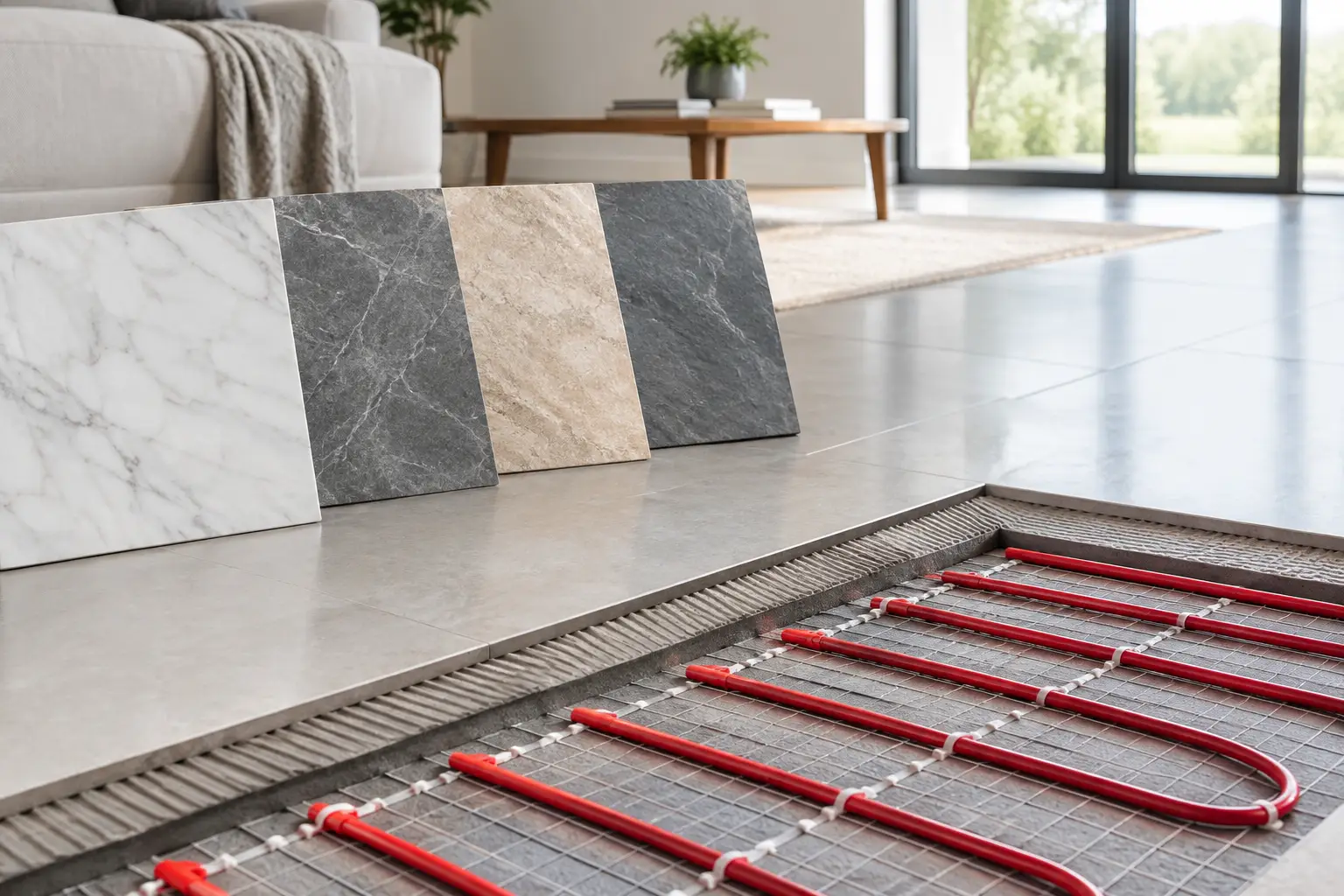
A stone floor should feel cool only when the architecture asks it to. Beneath bare feet on a winter morning, the question of which stone suits underfloor heating becomes less about fashion and more about atmosphere: how a room receives warmth, holds it and gives it back with quiet elegance. The right material turns a floor into a gentle, even source of comfort while preserving the presence, depth and individuality that only natural stone can offer.
Natural stone has an enduring affinity with radiant heating. Its density allows it to conduct warmth efficiently, while its thermal mass helps stabilise the temperature of a room over time. Yet there is no single answer for every interior. The ideal stone depends on the architecture, the intended use of the room, the chosen heating system, the finish underfoot and the character the project is intended to express.
Which Stone Suits Underfloor Heating in a Bespoke Interior?
In purely thermal terms, dense natural stones are among the most suitable floor finishes for underfloor heating. Marble, granite, limestone, travertine, slate and quartzite all conduct heat far more effectively than insulating finishes such as deep-pile carpet or thick timber. The differences between them matter, but not as much as the quality of the whole floor construction.
A well-designed stone floor needs a stable, properly cured screed or substrate, an adhesive formulated for heated floors and careful installation that avoids voids beneath the slabs or tiles. Voids can reduce heat transfer and place uneven stress on the stone. Movement joints must also be planned with precision, particularly across large rooms, long sightlines and areas exposed to strong sunlight.
For this reason, the best choice is rarely made from a sample alone. A honed limestone may be perfect for a calm country house kitchen, while a polished marble may bring a formal reception space to life. Both can perform beautifully over underfloor heating when their thickness, layout, substrate and fixing method are considered together.
Marble: Elegant Warmth With Lasting Presence
Marble is a natural choice for interiors where the floor is intended to be part of the composition rather than a neutral backdrop. Its crystalline structure conducts heat effectively, and its surface responds quickly to a low-temperature radiant system. Once warmed, it contributes a gentle, balanced feeling that suits bathrooms, entrance halls, drawing rooms and refined open-plan spaces.
The visual strength of marble lies in its variation. A pale Calacatta or Statuario can amplify daylight and lend an almost luminous quality to a room. Darker marbles, with deep veining or richly mineral colour, create drama without sacrificing thermal comfort. The choice between a polished and honed finish should be guided by use as much as appearance. Polished marble reflects light magnificently, while a honed finish offers a softer, more contemporary tactility and can be more forgiving in busy family settings.
Marble does require informed care. It is sensitive to acidic spills and can show etching, especially in kitchens and dining areas. This is not a reason to avoid it, but a reason to select the right variety, finish and protective treatment for the life of the room. In a home designed for living rather than display, the subtle patina of use can become part of marble's beauty.
Limestone and Travertine: Softly Textured, Naturally Timeless
Limestone and travertine have a quieter visual language. Their warm neutrals, fossils, clouding and natural pores lend themselves to interiors where material honesty is central to the design. They work particularly well with underfloor heating because they temper the traditional association of stone with coolness, making relaxed, tactile rooms possible throughout the year.
Limestone is particularly suited to generous kitchens, garden rooms and calm, architectural living spaces. It is available in a wide range of densities and tones, from pale cream to soft grey and deeper earthy shades. Denser limestones generally offer greater resistance to wear, while softer varieties may be better reserved for lower-traffic areas or projects where a gently aged surface is welcome.
Travertine brings distinctive movement and a heritage character. Its naturally occurring voids are usually filled for floor use, creating a surface that remains expressive while being practical to maintain. A carefully chosen fill and finish are essential, especially in areas subject to frequent moisture or heavy use. Honed travertine over underfloor heating is especially compelling in bathrooms and spa-like interiors, where warmth underfoot heightens the material's quiet luxury.
Neither limestone nor travertine should be chosen without considering porosity, sealing requirements and the household's expectations. These are materials that reward stewardship. Their appeal is not sterile perfection, but a surface that gains depth as it becomes part of everyday life.
Granite, Slate and Quartzite: Strength for Demanding Spaces
Where durability is paramount, granite, slate and quartzite deserve close attention. These denser stones are highly capable heat conductors and offer excellent performance in entrance areas, kitchens, busy family homes and commercial settings. Their strength also makes them suitable for larger-format pieces, subject to the engineering of the floor build-up and the practicalities of handling and installation.
Granite brings a composed, architectural appearance, from finely grained pale surfaces to dramatic dark varieties. It has a low porosity compared with many sedimentary stones and is highly resistant to everyday wear. Slate offers a more textured, cleft character and can introduce a grounded, elemental quality, although its riven surface must be selected with comfort and cleaning in mind. Quartzite often combines the visual movement associated with marble with formidable hardness, making it a compelling option where the brief calls for both expressive pattern and resilience.
These materials may feel more contemporary or more elemental than classic marble, depending on the finish and detailing. A flamed or heavily textured surface can be beautiful, but it is not always appropriate for bare feet. Honed, brushed or lightly textured finishes often provide a more balanced answer in residential interiors.
What Matters Beyond the Stone Itself
A beautiful stone can only perform as well as the system beneath it. Hydronic underfloor heating is often particularly well suited to stone because it can operate efficiently at relatively low water temperatures. Electric systems can also work effectively, especially in smaller spaces such as bathrooms, but their specification should be coordinated carefully with the floor build-up and intended use.
The thickness of the stone affects response time. Thicker slabs hold more heat and release it more gradually, creating a stable, enveloping warmth. Thinner tiles tend to respond faster when the heating is adjusted. Neither is inherently better. A grand hall may benefit from the calm thermal mass of substantial slabs, while a compact bathroom may favour quicker responsiveness.
Temperature control is equally important. Underfloor heating should be commissioned gradually after installation, allowing screeds, adhesives and stonework to acclimatise as specified by the relevant manufacturers and installer. Sudden temperature changes place unnecessary stress on every layer of the floor. A well-programmed system maintains comfort discreetly, without subjecting the material to extremes.
For upper floors or suspended timber structures, structural movement and deflection need particular attention. Stone is enduring, but it is not indifferent to an inadequate base. An experienced stone specialist will assess the substrate, waterproofing where required, joint positions, slab dimensions and edge details before fabrication begins.
Let the Room Lead the Choice
The most successful stone floor does not simply answer a technical requirement. It establishes a mood. In a light-filled kitchen, a durable limestone or quartzite can make daily rituals feel considered. In a master bathroom, honed marble or travertine turns warmth into a sensory experience. In a formal entrance, book-matched marble slabs can give the first step across the threshold a sense of occasion.
At Torchio Marmi, material selection begins with this wider understanding of place. Since 1860, the craft has been not only to cut and install stone, but to recognise its character and give it the right architectural setting. Underfloor heating can support that intention beautifully, provided it is treated as part of the design rather than an afterthought.
Choose the stone that belongs to the room, then allow the technical design to honour it. When material, craftsmanship and heat are resolved together, the floor becomes more than a surface: it becomes a lasting source of comfort, beauty and memory.