
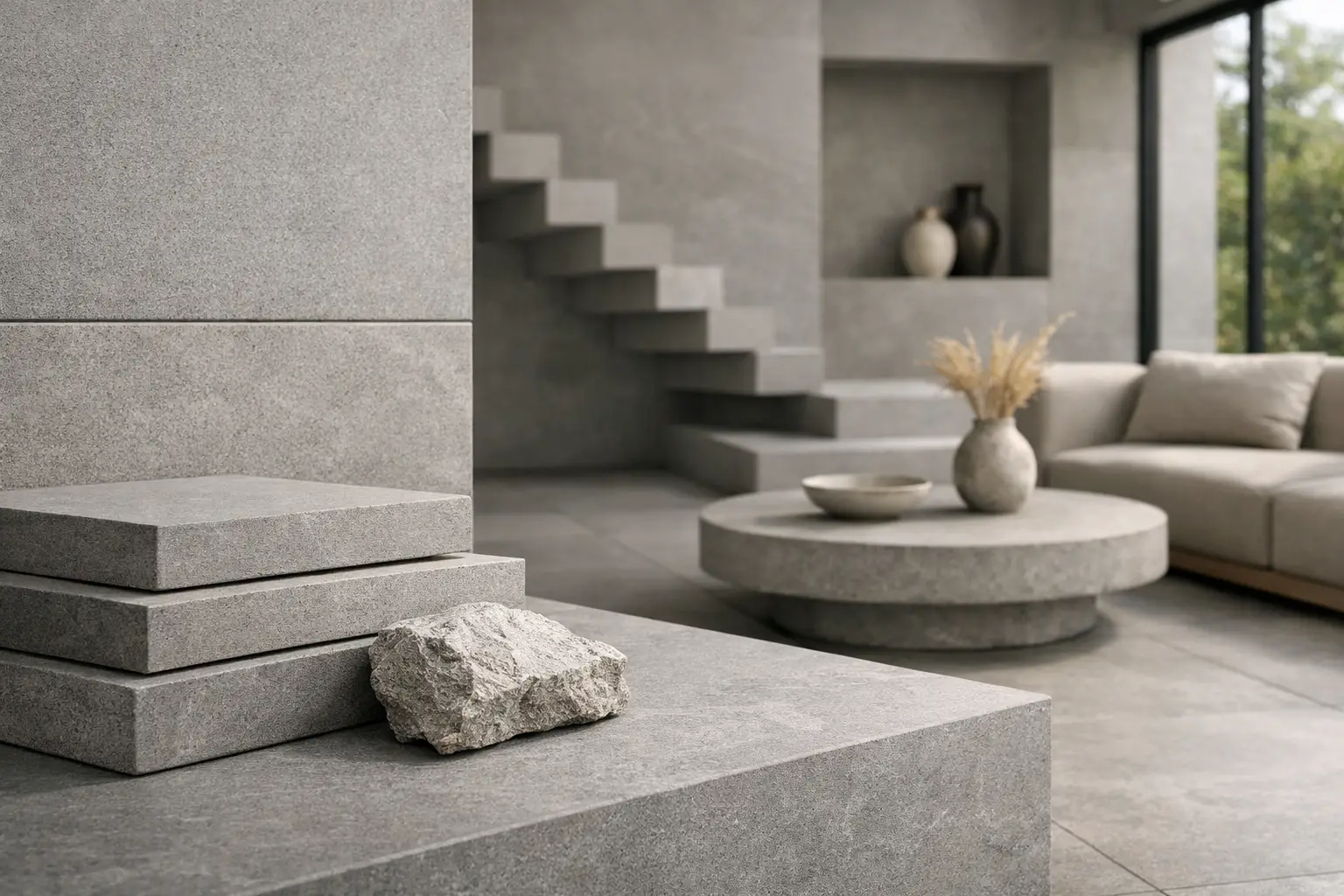
Pietra Serena is not a stone chosen merely for its quiet grey colour. It is chosen for the atmosphere it creates: shaded Tuscan courtyards, measured Renaissance facades, cool stair halls and rooms where light settles softly across a finely worked surface. This guide to Pietra Serena considers the qualities that make it so enduring, as well as the practical decisions required to use it well in contemporary architecture and interiors.
What Pietra Serena Is, and Why Its Origin Matters
Pietra Serena is a compact sandstone traditionally quarried in Tuscany, particularly around the Florentine hills. Its name is often translated as “serene stone”, an apt description of its characteristic blue-grey to warm grey tones. Depending on the quarry face and selection, the material may reveal subtle variations of taupe, pale blue, charcoal and brown. These shifts are not defects. They are part of the stone’s natural identity and should be considered when composing a floor, wall or architectural element.
For centuries, Pietra Serena has given Florence much of its visual language. It frames portals and windows, forms columns and staircases, and provides the restrained architectural punctuation seen in cloisters, palazzi and churches. Its historic importance makes it particularly compelling for restoration, but it should not be confined to period buildings. In a well-resolved modern setting, its matte depth and mineral texture bring gravity to clean-lined interiors without the glare of polished marble.
Its heritage also asks for discernment. “Pietra Serena” is sometimes used loosely for grey sandstones with a similar appearance. Yet geological structure, porosity, strength and response to weather vary considerably. For projects where authenticity, durability or conservation standards matter, the precise provenance and technical suitability of the selected stone must be established before fabrication begins.
A Guide to Pietra Serena in Architecture and Interiors
The best use of Pietra Serena begins with proportion. This is an architectural stone, capable of acting as a calm field or a sharply defined detail. A generous floor of large honed slabs can make an entrance hall feel grounded and composed. A finely profiled fireplace surround can give a contemporary living room a sense of permanence. Used for thresholds, window reveals, stairs and plinths, it creates continuity between spaces without insisting on attention.
Floors, stairs and thresholds
Pietra Serena flooring is prized for its understated surface and tactile quality underfoot. Honed finishes suit interiors where an elegant, soft reflection is desired, while brushed or lightly textured finishes are often more appropriate in entrances, garden rooms and areas that may be exposed to moisture. Joint width, slab format and laying direction have a significant effect on the finished character. Long, narrow pieces may recall traditional paving, whereas larger formats can make the material feel more contemporary and monolithic.
Stairs demand particular care. The stone must be selected and worked with adequate thickness, suitable edge detailing and a finish that responds to the expected level of use. A highly smooth tread may be beautiful but inappropriate where rain, footwear and heavy footfall are regular realities. In this setting, safety is not separate from design. It is part of its discipline.
Wall cladding and architectural details
On walls, Pietra Serena introduces depth without visual heaviness. It works especially well around doorways, fireplaces, niches and internal courtyards, where its grain can be appreciated at close range. In larger cladding schemes, panel dimensions and fixing methods should be developed early, particularly where ventilation cavities, insulation or structural movement are involved.
The stone’s aptitude for carving remains one of its finest qualities. Moulded cornices, pilasters, bas-reliefs, capitals and bespoke surrounds can be shaped with a clarity that celebrates handcraft rather than spectacle. A simple chamfer, a deep reveal or a carefully resolved arris may be all that is needed. Great stonework often resides in such measured decisions.
Gardens, terraces and exterior settings
Pietra Serena has a natural affinity with planting, water and aged brick or plaster. It can be used for paving, steps, coping, benches and low walls, lending a garden the feeling that it belongs to its landscape rather than having been placed upon it. Yet exterior application is where technical knowledge becomes indispensable.
Sandstone absorbs moisture to differing degrees. Frost exposure, persistent shade, salt-laden air, standing water and the quality of drainage will all influence performance. A stone suitable for a sheltered courtyard in central Italy may require another solution in a harsh, exposed climate. Surface texture, bedding orientation, thickness, sealant choice and water management should be specified as one system, not as separate afterthoughts.
Selecting Colour, Finish and Fabrication
No two blocks of Pietra Serena are identical. For this reason, selection should be based on representative samples large enough to show natural movement, rather than a small chip that offers only a simplified impression. A sample should also be viewed in the proposed light. Daylight, warm interior lighting and wet conditions can each alter the perceived colour.
Finish changes the stone’s expression. A sawn finish is more direct and architectural, retaining the trace of cutting. Honing brings refinement while preserving a low sheen. Brushing can soften the surface and emphasise the grain, while bush hammering provides texture and greater grip. The correct choice depends on use, maintenance expectations and the desired dialogue with surrounding materials.
Pietra Serena is particularly eloquent beside lime plaster, oak, bronzed metal, handmade brick and restrained natural textiles. It can also sit beautifully with white marble, though the contrast should be intentional: marble brings luminosity and veining, while Pietra Serena provides shadow, structure and visual rest. In formal settings, this relationship can recall historic Italian interiors. In contemporary homes, it can create a quiet balance between precision and warmth.
Fabrication is equally decisive. A stone element must be assessed for grain direction, veining, structural dimensions and the location of joints before work begins. This matters especially for stair treads, long lintels, sculptural pieces and thin cladding panels. Skilled processing allows the material to appear effortless while respecting its natural limits.
Care, Patina and the Value of Prevention
Pietra Serena does not ask for elaborate care, but it does reward considered maintenance. Its surface should be cleaned with pH-neutral products formulated for natural stone, using as little water as practical. Acidic cleaners, bleach, harsh degreasers and ordinary household descalers can damage or mark the surface. Abrasive pads may leave unwanted pale scratches or disturb a carefully chosen finish.
For kitchens, dining areas and external paving, an appropriate breathable protective treatment may help reduce absorption and make routine cleaning easier. It is not an invisible promise against every stain, nor should it create a plastic-looking film. The aim is to support the stone’s natural performance while preserving its appearance and vapour permeability.
Spills should be attended to promptly, particularly oil, wine, citrus and strongly coloured liquids. Outdoors, leaves, soil and plant matter should not be allowed to remain wet against the paving for long periods. Drainage channels, properly formed falls and regular inspection of joints are among the most effective forms of protection.
Patina should not be confused with neglect. A gentle softening of tone, slight wear at a threshold or the mellowing caused by light may enrich the stone over time. Deep staining, flaking, persistent damp or surface loss, however, call for specialist assessment. Historic material deserves repair methods that are compatible with its mineral nature, not cosmetic treatments that conceal a problem for a season.
When Pietra Serena Is Not the Right Choice
A refined material is not automatically the right material. Where very high stain resistance is essential, such as a heavily used commercial food-preparation area, a denser stone or another surface may be more suitable. In exposed coastal, alpine or freeze-thaw conditions, the selected Pietra Serena must be proven for the specific application, or an alternative should be considered.
The same caution applies to uniformity. Clients seeking a perfectly consistent industrial grey may find the natural variation of sandstone frustrating. Pietra Serena offers a living range of tone and texture. Its beauty lies in that measured irregularity.
For bespoke projects, Torchio Marmi approaches this material as both an architectural resource and a bearer of memory. From selection through to cutting, installation and, where required, restoration, each decision should protect the stone’s dignity as well as its performance.
A well-chosen Pietra Serena surface will not compete with the life around it. It will hold light, frame movement and grow more persuasive with the years - a quiet foundation for architecture made to last.