
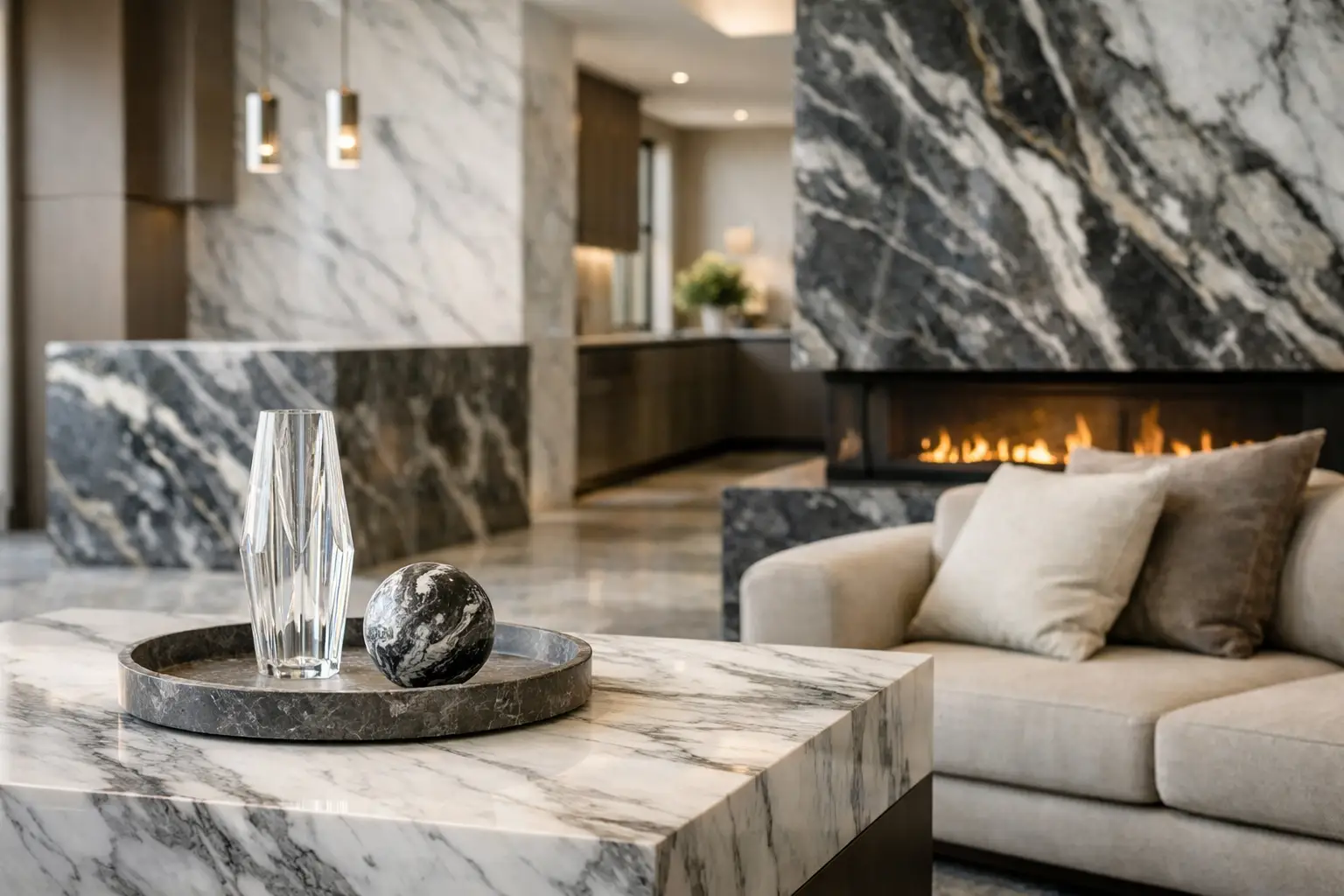
A marble surface can be beautiful from the first day. The rarer achievement is for it to become more convincing with time: responding to changing light, acquiring the quiet marks of life, and remaining fully at ease within its architecture. Bespoke marble interior design begins with this longer view. It is not the selection of a fashionable finish, but the considered composition of material, proportion, craft and purpose.
For a private residence, a hotel suite, a retail interior or a historic setting, natural stone has a presence no manufactured surface can reproduce. Its veining is a record of geological time; its variations make every slab an original. Yet marble only reveals its full character when it is designed for the room it will inhabit, then shaped and installed with exacting care.
Bespoke marble interior design begins with the stone
The most successful interiors do not begin with a catalogue image. They begin with a conversation about atmosphere. Is the ambition serene and architectural, richly decorative, softly contemporary or faithful to an existing historic language? Is the space flooded with southern light, or does it rely on carefully placed artificial illumination? Will the stone be touched every day, or admired at a distance?
These questions guide the choice of material. Calacatta can bring a pale, sculptural grandeur to a bathroom or reception room. Arabescato offers animated veining and a more expressive rhythm. Verde Alpi introduces depth and botanical richness, while Nero Marquina can give a fireplace, bar or floor a precise, dramatic gravity. Travertine, onyx, granite and other natural stones may be equally appropriate, depending on the desired mood and technical demands.
No two blocks are identical, and no two slabs tell the same story. That is why selection matters beyond the name of a stone. The scale, direction and density of the veining must be read in relation to the dimensions of the room and the intended components. A bold vein that appears magnificent across a large wall may overwhelm a compact vanity. A quieter field may allow finely worked brassware, timber or art to take their place without competition.
For a commission with significant visual continuity, slabs should be selected as a family rather than as isolated pieces. This allows the fabricator to plan the movement of the stone across a floor, wall, stair or fireplace, so that each junction feels deliberate rather than accidental.
The difference is in proportion and detail
Marble is often associated with grand entrances and formal bathrooms, but bespoke work gives it a far wider vocabulary. It can form a monolithic kitchen island, a bookmatched shower enclosure, a softly honed floor, a curved staircase, a desk, a wall-lined lift lobby or an inset panel within joinery. Its role may be prominent or restrained. In both cases, proportion determines whether it feels inevitable.
A substantial stone island needs more than a beautiful slab. Its thickness, overhangs, structural support, edge profile and relationship to surrounding cabinetry must be resolved together. A fireplace requires attention to heat exposure, expansion, fixing methods and the depth of its reveals. A shower room demands considered falls, discreet drainage, compatible waterproofing and a finish that is both elegant and practical underfoot.
The details are where craftsmanship becomes visible. A mitred edge can create the impression of a solid block. A gently rounded arris softens a contemporary composition. A finely worked bullnose may belong naturally in a classical interior. Bookmatching can turn a pair of slabs into a symmetrical composition, while vein matching across adjacent pieces creates visual calm. None of these decisions is merely decorative. They affect how light travels over the stone, how the object is perceived, and how comfortably it will serve its purpose.
Finishes shape the atmosphere of a room
Polished marble reflects light with clarity and brings an almost ceremonial quality to an interior. It is especially compelling on walls, vanity tops and decorative surfaces where the natural depth of colour can be appreciated. Honed marble has a gentler, more tactile appearance, often suited to floors and rooms intended for daily living. Brushed, leathered or sandblasted finishes can introduce texture and improve slip resistance in the right context.
There is no universally superior finish. A highly polished floor may be entirely appropriate in a formal entrance but less suitable for a busy family home, particularly where wet footwear is expected. A honed kitchen worktop is more forgiving of visual wear, although acidic liquids can still etch marble if left unattended. In areas of high traffic or intensive use, granite or quartzite may be the more resilient choice, while marble remains the ideal material for feature surfaces where its luminosity is central to the scheme.
This is not a compromise in luxury. It is the discipline of choosing the right material for the right place. Lasting interiors are built on informed decisions, not on the assumption that one stone should perform every task.
From design drawing to finished installation
Bespoke stonework is a sequence of precise acts. Once the concept is established, site measurement confirms the realities that drawings cannot always reveal: imperfect walls, concealed services, floor levels, access routes and structural conditions. Templates and technical drawings define joint positions, grain direction, cut-outs, thicknesses, tolerances and fixings before fabrication begins.
In the workshop, digital technology supports accuracy, but it does not replace judgement. Cutting, shaping, finishing and dry laying demand an experienced eye, particularly when a vein must continue through a return, a curve must meet a wall without a visible hesitation, or a repair must honour an older piece of stone. Hand-finishing remains essential to the character of a completed work.
Installation deserves equal respect. Large-format slabs are inherently demanding to handle and must be transported, lifted and fixed with care. The finest fabrication can be diminished by poor setting-out or hurried joints. A specialist team considers substrate preparation, adhesive selection, movement allowances, alignment, protection during other trades and the final cleaning of the surface. These are quiet disciplines, but they are what allow stone to appear effortless.
Since 1860, Torchio Marmi has approached this process as a meeting of material knowledge and design at the service of dreams. That continuity is especially valuable when contemporary interiors require complex bespoke fabrication, or when new stone must sit respectfully beside historic architecture.
Marble as a material for daily life
Natural stone rewards attention, not anxiety. A properly specified and sealed marble surface is designed to be lived with, but it should be treated according to its nature. Use pH-neutral cleaning products, wipe spills promptly and avoid aggressive descalers or abrasive powders. Coasters, trivets and felt protection beneath decorative objects are simple habits that preserve a refined finish.
Over years, marble may develop a softened patina. For many owners, this is part of its appeal: evidence that the interior is inhabited rather than preserved behind glass. Others prefer a more pristine appearance and may choose finishes, colours and locations that minimise visible change. Both approaches are valid. The essential point is to establish expectations before the stone is chosen.
Maintenance is also an opportunity for stewardship. Small chips, dull areas and open joints can often be repaired or renewed by skilled craftspeople. In heritage buildings, this ability to conserve rather than replace has particular cultural value. Stone carries memory, and careful restoration allows that memory to remain present.
Designing for permanence
A bespoke marble interior should not be asked to imitate a showroom. It should belong to a particular building, a particular light and the people who will move through it each day. When material selection, technical expertise and artistic restraint are given equal importance, the result is more than a luxurious finish. It becomes part of the architecture's lasting identity.
Choose stone not only for the impression it makes when the room is newly completed, but for the life it will hold in the decades that follow. That is where true permanence begins.