
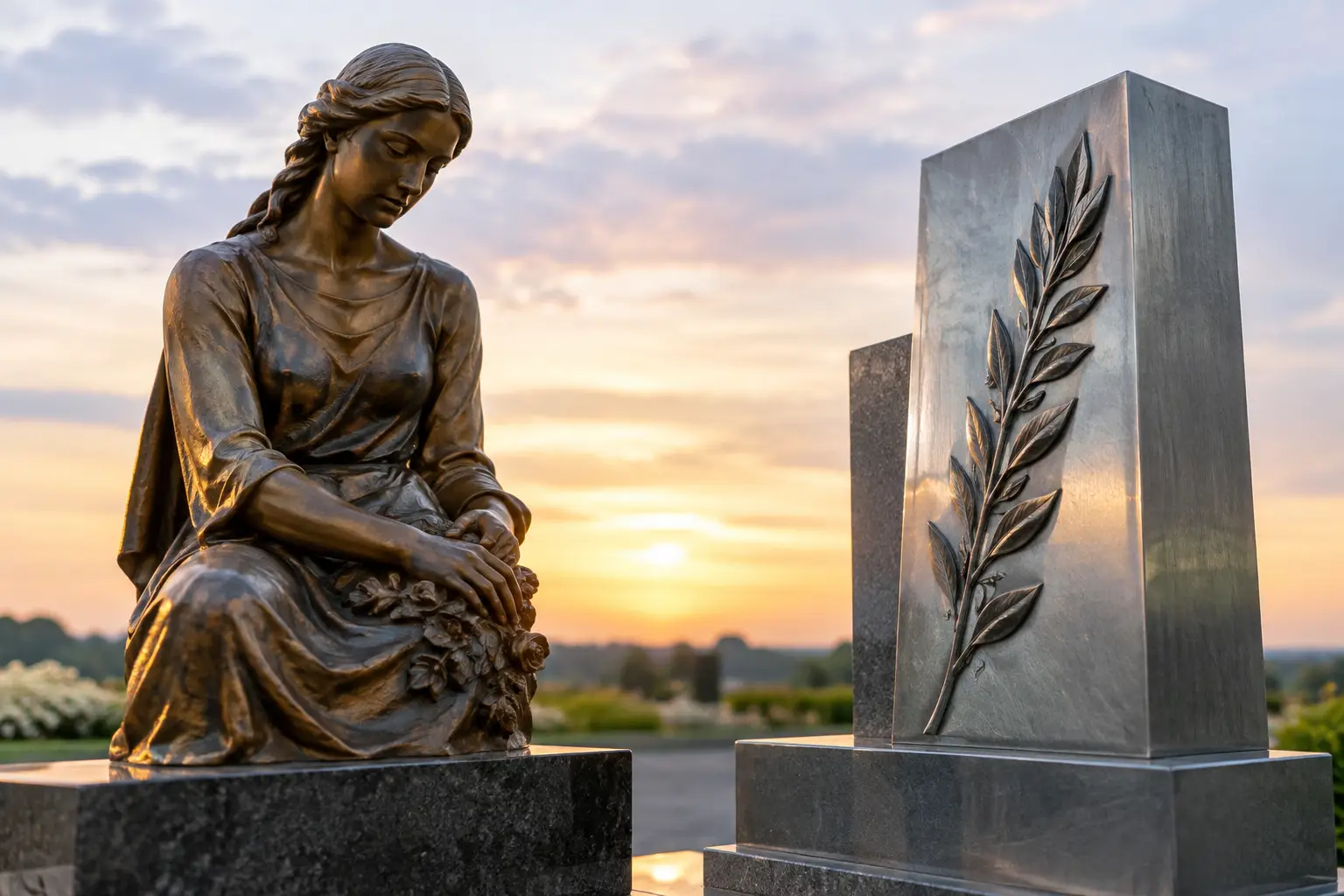
A memorial begins with a question of character. Should it carry the warm, settled dignity of bronze, or the restrained, contemporary line of steel? In considering bronze versus steel memorials, families, architects and cemetery authorities are choosing more than a finish. They are defining how remembrance will meet weather, time and the surrounding landscape.
Both materials can form beautiful and enduring monuments when selected with care and joined to stone by experienced hands. Their qualities, however, are distinctly different. The right choice depends on the intended atmosphere, the architectural setting, the level of detail required and the way the memorial is expected to age.
Bronze versus steel memorials: a question of expression
Bronze has belonged to the language of commemoration for centuries. Its visual warmth and substantial presence give it a natural affinity with marble, granite and traditional cemetery architecture. Cast lettering, relief portraits, sculpted symbols and decorative branches all gain depth in bronze, where light settles softly across the raised surface.
Steel speaks in a different register. It may be polished to a mirror-like brightness, brushed for a quiet satin finish or allowed, in the case of weathering steel, to acquire an earthy protective surface. Its clean planes and precision make it especially suited to contemporary monuments, architectural memorial walls and projects where inscription is intended to feel spare, graphic and exact.
Neither material is inherently more meaningful. A bronze plaque can feel formal and historic; a steel element can feel direct, personal and unexpectedly intimate. The decision should arise from the person being remembered and the place in which the monument will stand, rather than from fashion alone.
How bronze changes over time
Bronze is an alloy, most commonly based on copper, valued for its ability to be cast and its strong resistance to atmospheric corrosion. Freshly finished bronze can appear golden brown, deep chestnut or almost black, depending on the alloy and patination process. With exposure, it develops a living surface known as patina.
That evolution is one of bronze's great virtues. In sheltered areas, the colour may deepen gradually. In wetter or coastal environments, green and blue-green tones can emerge as the metal reacts with air and moisture. This is not simply deterioration. A well-formed patina can protect the underlying metal and give the memorial the visual depth associated with age, continuity and honour.
Yet natural ageing is not entirely predictable. Rainfall, surrounding vegetation, airborne salts and cleaning practices all influence the result. Where an even appearance is desired, bronze may require periodic professional attention, particularly around raised lettering and intricate relief work where deposits can gather.
Bronze is particularly compelling when a memorial calls for sculptural detail. It can preserve subtle modelling in a face, a hand, a floral motif or a religious emblem in ways that feel tactile and enduring. For historic cemeteries and sacred settings, it often creates an immediate dialogue with existing monuments and architectural fabric.
The care bronze deserves
Bronze should not be treated with harsh household chemicals, abrasive pads or improvised polishing products. These can strip protective waxes, mark the surface and create uneven patches of colour. Gentle cleaning and occasional conservation-led maintenance are usually sufficient, with the approach tailored to the memorial's age, setting and intended patina.
A bronze component also needs thoughtful engineering. Its weight, method of fixing and contact with adjacent stone must be considered from the outset. Water should never be allowed to sit behind a plaque or penetrate poorly designed joints, where staining or movement can compromise the whole composition.
Steel and the discipline of contemporary remembrance
Steel memorials are not one material in one condition. The term may refer to stainless steel, selected for its corrosion resistance and luminous modern appearance, or weathering steel, chosen for its oxidised surface and warm architectural character. These options should never be confused, as they call for different detailing and different expectations of ageing.
Stainless steel offers clarity. Laser-cut letters, engraved panels and finely fabricated forms can achieve a level of precision that suits modern architecture and minimal memorial design. It is especially effective against dark granite, pale limestone or honed marble, where the contrast between stone and metal gives an inscription exceptional legibility.
Its apparent simplicity should not be mistaken for a lack of craft. Stainless steel reveals poor workmanship quickly. Misaligned lettering, careless welds and fingerprints on highly polished surfaces diminish the material's elegance. The best results depend on carefully considered proportions, disciplined fabrication and a finish appropriate to the site's light and surroundings.
Weathering steel has a more mineral presence. As its outer surface oxidises, it develops rich tones from orange-brown to dark umber. Properly specified, this layer protects the metal beneath. It can establish a powerful relationship with stone, autumnal planting and rural or garden-like memorial settings.
There is an essential technical consideration: weathering steel can release coloured runoff during its early ageing period. On pale, porous stone, this may leave staining that is difficult to remove. Drainage, separation details and the choice of surrounding materials must therefore be resolved before installation. A material that looks effortless in a photograph demands precise knowledge on site.
When stainless steel is the wiser choice
For exposed urban locations, coastal areas and memorials requiring a consistently clean, bright appearance, high-quality stainless steel is often preferable. Its grade should be selected according to the environment, particularly where salt, pollution or persistent damp are present. The visible finish matters as much as the alloy: brushed steel may conceal minor handling marks more gracefully than a polished surface, while still offering refined light reflection.
Stone, metal and the setting of the memorial
Memorials are rarely experienced as metal alone. Bronze and steel are often set into granite, marble, natural stone or architectural concrete, and their success lies in the relationship between those elements.
Bronze brings warmth to cool stone. Against black granite, it creates a classic contrast of dark depth and golden relief. Against pale marble or limestone, it offers a softer visual anchor, though the detailing must prevent moisture from carrying metal residues onto absorbent surfaces. A bronze inscription can also echo the tones of old gates, church fittings and historic statuary nearby.
Steel offers sharper contrast. Brushed stainless steel can bring a composed, contemporary edge to white marble, grey granite or travertine. It is well suited to plaques set flush with stone, discreet family-name panels and larger public memorial schemes where consistency of line is essential. Weathering steel, by contrast, is often most persuasive beside textured stone, split-faced granite or landscape elements that welcome its changing colour.
Cemetery regulations and local conditions should be examined early. Some burial grounds prescribe dimensions, materials, finishes or methods of fixing. Others have strong visual traditions that deserve respect even where contemporary design is permitted. A monument should belong to its setting without losing the individuality of the life it honours.
Durability is designed, not merely specified
It is tempting to ask which metal lasts longer. In practice, longevity depends less on a simple bronze-or-steel verdict than on design, fabrication, installation and care. A finely made bronze plaque with appropriate fixings may serve generations. So may a correctly specified stainless steel memorial. Conversely, an unsuitable alloy, inadequate drainage or poor contact between materials can shorten the life of either.
The details that are least visible often matter most: concealed fixings, expansion allowances, breathable joints, the direction of water flow and the compatibility of metals with nearby stone. Inscriptions must also be considered as part of the structure. Raised cast bronze lettering creates shadow and texture; etched or cut steel lettering offers precision, but requires sufficient scale and contrast to remain readable in changing weather.
For a family memorial, there is value in imagining the work not on installation day but decades later. Will its surface feel richer with age? Will a future visitor be able to read it clearly? Does the material express quiet permanence without requiring constant intervention? These questions lead to more enduring choices than a comparison of initial appearance alone.
Choosing with memory in mind
Bronze may be the natural choice for a memorial seeking sculptural presence, historical resonance and a surface that gathers dignity over time. Steel may be right where architectural purity, precise lettering and a contemporary relationship with stone are central to the design. In many commissions, the most eloquent answer is not an either-or decision but a carefully balanced composition of stone and metal.
At Torchio Marmi, each monument is approached as an individual work of remembrance, shaped by material knowledge, proportion and the atmosphere of its setting. The finest memorial is not simply built to withstand time. It is made so that time may add to its meaning.