
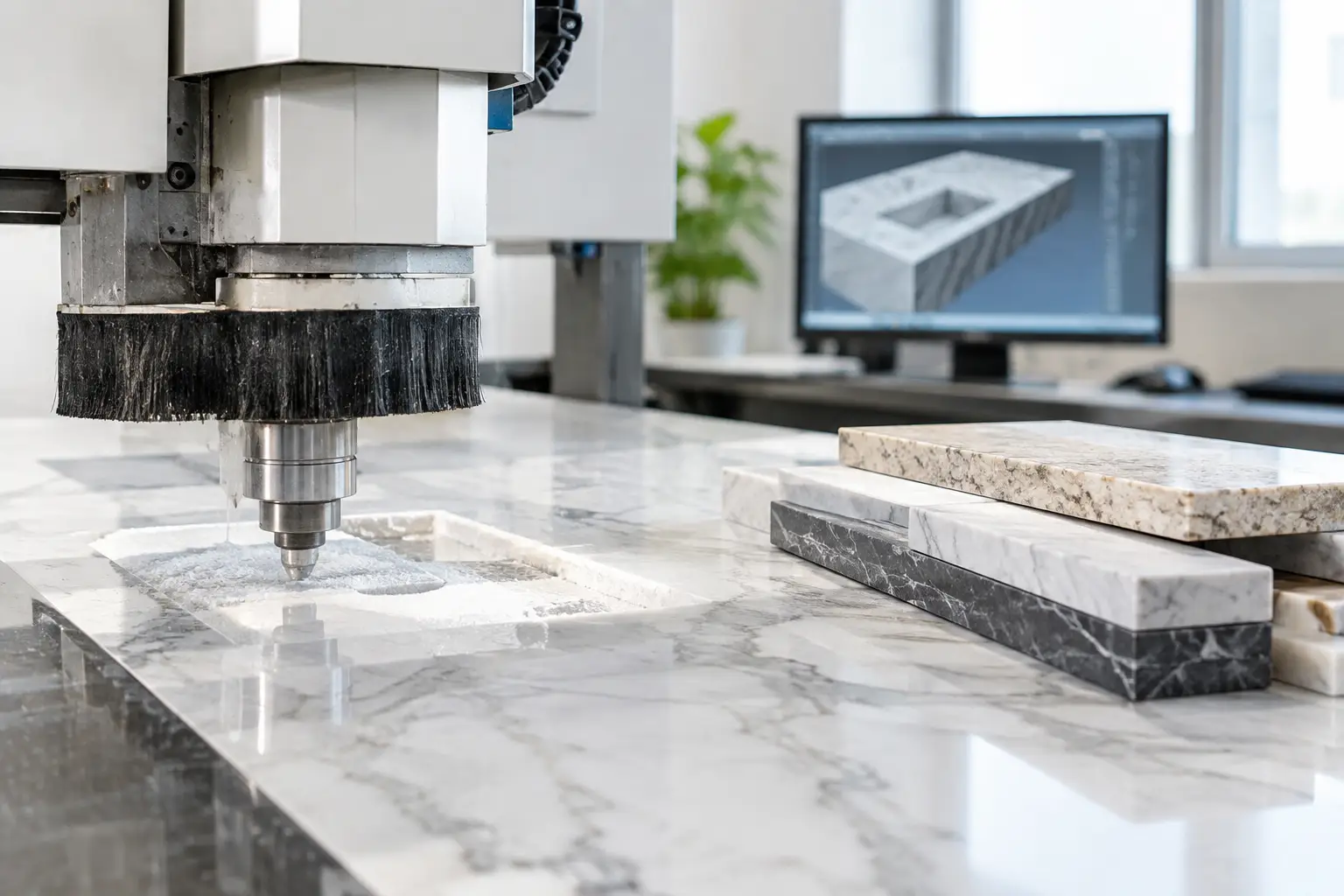
A veined marble slab is never merely a surface to be cut. Its movement, translucency, natural fissures and tonal shifts ask to be read before a line is drawn. The most meaningful digital stone fabrication trends therefore do not replace the eye of the master craftsman. They give that judgement greater reach, allowing complex visions to be measured, tested and realised with an accuracy once reserved for the simplest forms.
For architects, designers and private clients, this is changing what can be imagined in stone. Curving staircases can be resolved before installation begins; bookmatched walls can be composed across an entire room; a historic cornice can be documented without disturbing its fragile fabric. Yet technology only fulfils its promise when it remains in service of the material, rather than forcing natural stone into the logic of an industrial product.
Digital stone fabrication trends begin with the real material
The first advance is not the machine, but the digital understanding of each individual slab. High-resolution slab scanning records veining, colour variation, mineral inclusions and naturally occurring features. This allows designers and fabricators to position templates directly onto a digital image of the chosen block or slab.
The result is particularly important for dramatic materials such as Calacatta marble, onyx and strongly veined travertine. A reception desk, fireplace surround or bathroom wall can be planned so that veins continue across joints, turn around corners or meet in a deliberate mirrored composition. What might appear spontaneous in the finished interior is, in fact, an act of careful composition.
This process also makes decisions visible earlier. A client can see whether a proposed basin interrupts the most expressive portion of a slab, or whether a long kitchen island would benefit from a quieter selection of stone. Digital layout reduces unwelcome surprises, but it should never suggest that all variation can be predicted. Natural stone retains its singular character, and that character is part of its value.
From measured survey to made-to-measure installation
Laser measurement, photogrammetry and three-dimensional scanning have transformed the relationship between site and workshop. Rather than relying only on manual templates, fabricators can capture walls, floors, stairwells and architectural details as precise digital surveys. Those measurements then inform cutting drawings and installation plans.
This is especially valuable in grand residences, hotels and period buildings, where walls may not be perfectly square and existing fabric must be respected. A stone floor with a complex border, for example, can be set out in relation to fireplaces, door thresholds and historic features before a single piece is cut. The same approach assists large-format wall cladding, where millimetres matter to the rhythm of joints and the alignment of bookmatched panels.
There is a practical gain as well as an aesthetic one. Better surveys reduce repeated site visits, minimise on-site adjustment and help co-ordinate stone with joinery, metalwork, lighting and plumbing. For a project with exacting tolerances, this earlier co-ordination is often the difference between a composed interior and a sequence of compromises.
Digital models need human verification
A scan is highly informative, not infallible. Site conditions can change between survey and fitting; older buildings can reveal concealed irregularities; stone itself may require allowances for movement, weight and fixing systems. Experienced teams verify critical dimensions, review substrate conditions and retain responsibility for the final fit.
The most reliable workflow combines digital capture with physical inspection. Technology provides a precise map. Craft knowledge determines how that map should be interpreted.
CNC and waterjet cutting expand the language of stone
Computer numerical control, commonly known as CNC, has made intricate geometry more accessible in natural stone. Five-axis machinery can shape curved profiles, sculptural basins, fluted surfaces and compound forms with a consistency that would be exceptionally laborious by hand. Waterjet cutting, meanwhile, is well suited to precise inlays, fine mosaics and the meeting of contrasting materials such as marble, brass and stone.
For contemporary architecture, these tools allow stone to move beyond the flat slab. A monolithic washbasin may appear to flow from a wall; a staircase can carry a softly profiled underside; a floor can contain an exacting geometric inlay without losing its material warmth. Digital machining also supports repetition where it is genuinely required, such as a series of façade elements or identical wall modules.
However, precision is not automatically beauty. A sharply rendered digital form may prove visually cold, structurally impractical or unsympathetic to the grain of the selected stone. The choice of toolpath, feed rate and cutting direction affects the finished surface, while the stone’s density and veining influence what is technically wise. Some details are best machined; others gain their final dignity from a hand-finished arris, a softened edge or a subtly honed plane.
The return of the artisan finish
One of the most encouraging digital stone fabrication trends is the renewed value placed on finishing by hand. As technology makes complex cutting more attainable, the distinction of a project increasingly lies in its touch: the refinement of a profile, the quality of a polish, the way a honed surface receives light, or the restrained texture that allows a stone to feel ancient and contemporary at once.
A machine can repeat a specified curve, but it cannot decide with sensitivity how much lustre a particular marble should carry in a dimly lit hall. Nor can it replace the judgement needed to work around a mineral vein, ease a vulnerable edge or balance adjacent pieces selected from different parts of a quarry block.
For this reason, digital fabrication is best understood as an extension of the workshop. At Torchio Marmi, the enduring discipline remains the same: material knowledge, proportion and workmanship guide the process from selection to final installation. The machine offers precision; the artisan gives it meaning.
Digital co-ordination for architecture, interiors and art
Building information modelling and shared three-dimensional co-ordination are becoming more relevant to high-value stone projects. Stone is often among the last materials to be installed, yet it must respond to many earlier decisions: structural openings, underfloor heating, concealed fixings, drainage falls, lighting recesses and service positions.
A co-ordinated digital model can identify conflicts before fabrication. It is useful when a stone vanity must accommodate discreet plumbing, when a fireplace surround meets bespoke joinery, or when a ventilated façade requires carefully engineered anchors. In public and commercial projects, such preparation helps protect programme and quality alike.
There is, nevertheless, a boundary to observe. A digital model can make every object look equally certain, while a quarry block is not uniform and a heritage building is not abstract. The model must remain open to informed adjustment once the actual stone and site are encountered.
Restoration gains a careful new instrument
Digital tools have particular significance in conservation. Three-dimensional scanning can record worn carvings, damaged mouldings and monumental details with remarkable fidelity. These records support condition assessments, create a lasting archive and assist the design of replacement elements where intervention is justified.
For sacred buildings, civic monuments and historic façades, this capability brings care rather than haste. A damaged profile can be compared with surviving sections; a new stone insert can be machined close to its intended form, then finished and integrated by skilled hands. The objective is not to erase history with a perfect replica. It is to preserve legibility, stability and the quiet continuity of the place.
Digital documentation also has value beyond the immediate works. It creates a record for future custodians, who may need to understand what was repaired, where original fabric remains and how materials have weathered over time. In this sense, technology can serve stone’s oldest quality: permanence.
Less waste, more intelligent selection
Sustainability in stone fabrication is not solved by software alone. Quarrying, transport, thickness, fixing methods and long-term maintenance all matter. But digital nesting and slab optimisation can reduce offcuts by arranging components more efficiently across available material. Accurate surveys can limit remakes, while prefabrication may reduce dust, noise and cutting on site.
The more profound opportunity is thoughtful specification. A project may use full slabs where their presence is essential, but employ smaller elements, reclaimed material or locally appropriate stone elsewhere. Offcuts can become shelves, trays, thresholds or decorative inserts rather than waste. Such choices demand design discipline from the beginning, not an environmental gesture added at the end.
Durability remains central. A well-selected and properly installed stone surface can outlive several cycles of fashion, and its capacity for repair gives it an advantage over materials designed for replacement. Digital efficiency should support that long view, not encourage needless complexity or excess.
Designing for a future that still feels timeless
The future of stone fabrication is unlikely to be defined by technology alone. It will be defined by projects in which digital precision and human perception are allowed to complement one another. The most successful work will not advertise the software behind it. It will simply feel resolved: veins placed with purpose, joints composed with restraint, details shaped for the hand as well as the eye.
For a private residence, a hotel, a civic space or a monument to memory, the right question is not whether a process is digital or traditional. It is whether every technical choice honours the stone, the architecture and the life that will unfold around it. When that standard is met, innovation becomes almost invisible, and the material is free to speak across generations.