
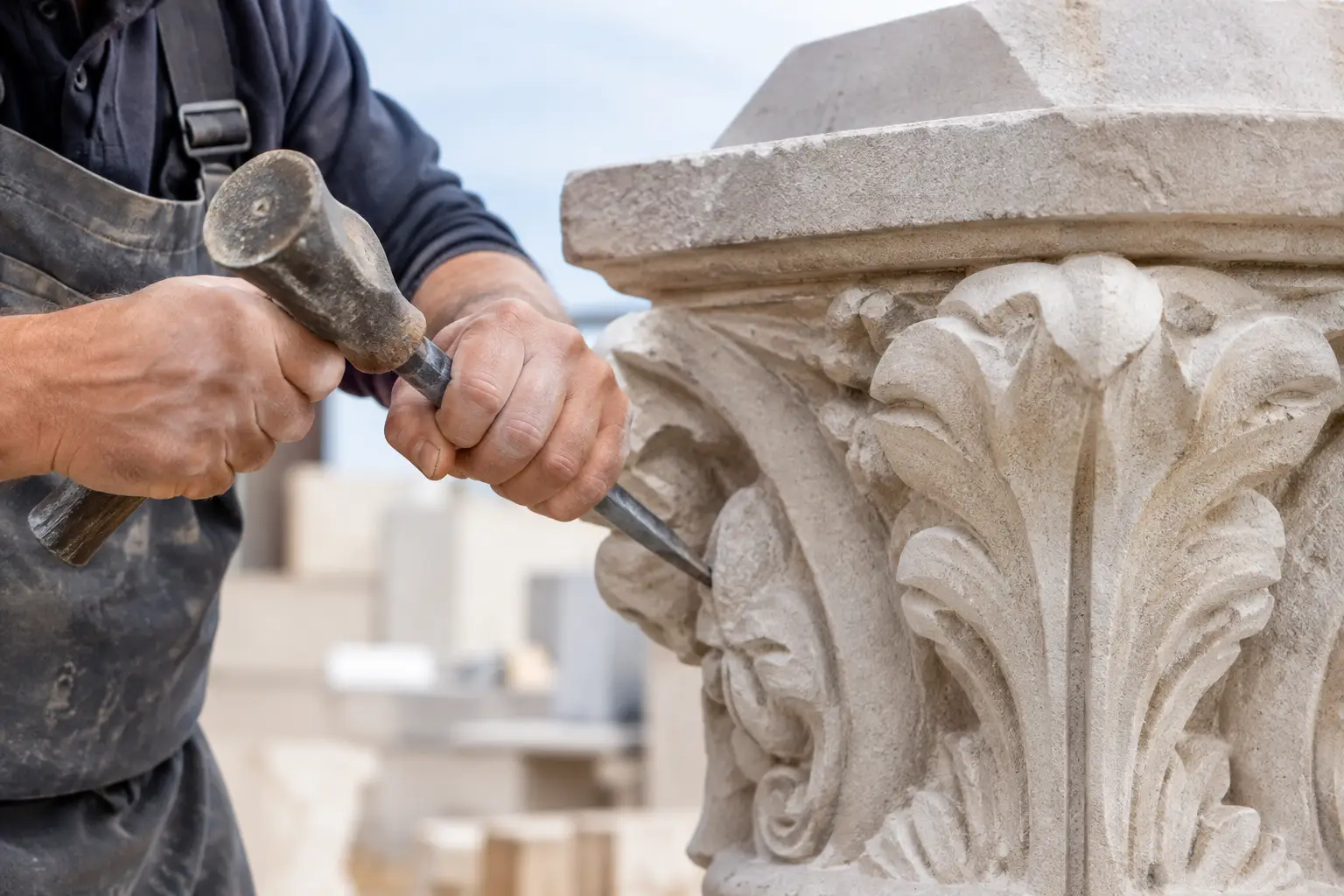
A capital, cornice or carved doorway is never merely ornament. It catches light, establishes scale and gives a façade its particular voice. This guide to architectural stone carving considers the decisions that allow a decorative detail to belong to its building - whether the work forms part of a new residence, a public interior or the careful repair of historic fabric.
Architectural carving asks more of the maker than sculptural expression alone. The piece must withstand weather, movement, loading and the visual demands of the whole composition. Its beauty lies in the meeting of drawing, material and disciplined handwork.
Begin with the architecture, not the motif
The most convincing stone carving grows from proportion. Before a leaf, rosette, inscription or figure is drawn, the carver and designer must understand the building’s language: its period, structural order, surrounding materials and the distance from which the detail will be seen.
A deep acanthus carving that appears generous at street level can become visually heavy above a narrow window. Conversely, a fine inscription may disappear entirely when viewed from a courtyard or across a nave. Scale is not simply a matter of enlarging a drawing. It determines the depth of relief, the width of shadow lines and the degree of simplification required for the work to read clearly.
For new architecture, the aim need not be historical imitation. A contemporary portal can carry restrained fluting, a geometric frieze or a precisely incised family emblem while remaining faithful to modern proportions. In restoration, the responsibility is different. New work should respect surviving evidence and make a coherent contribution without inventing a false history.
Reading drawings, models and shadows
A full-size template is often the decisive stage. It allows the team to test dimensions against joints, adjacent cladding, openings and fixing points before stone is selected or cut. Clay models, plaster maquettes and digital surveys can all serve the process, but they do not replace the judgement gained by reviewing a profile at full scale.
Light should be considered at this point, not after installation. Raking sunlight reveals every plane on an exterior elevation; soft internal lighting may ask for a gentler modelling of the surface. A relief intended for a sheltered entrance can sustain subtle transitions that would be lost on a façade exposed to broad daylight.
Choosing stone for architectural carving
The choice of material directs both the character and the longevity of the carving. Marble has a luminous, refined quality and accepts delicate detail beautifully, making it especially compelling for interiors, sacred spaces and protected architectural elements. Yet a marble selected for an exposed urban façade must be assessed with care, as atmosphere, frost, salts and pollution can alter the surface over time.
Limestone has long been favoured for façades and ornamental work because many varieties carve with clarity while carrying a warm, architectural presence. Its performance varies greatly according to density, porosity, bedding and geological composition. A stone that is pleasing under the chisel is not automatically suited to a rain-swept elevation.
Travertine offers a distinctive, living texture and can be used to powerful effect in contemporary architecture. Its natural voids may be celebrated or selectively filled depending on the intended finish and exposure. Granite is exceptionally durable but demands different tools, more time and a design language suited to its hardness; it is rarely the first choice for intricate, deeply undercut ornament, but can create inscriptions and monumental forms of notable permanence.
Material selection should include more than a sample viewed indoors. The quarry source, direction of bedding, block soundness, veining, mineral inclusions and likely weathering must all be evaluated. If a cornice is composed from several pieces, the orientation of each block matters. Vein and bed should support the form, not undermine vulnerable projections.
From block to finished relief
Carving begins with a sound, properly oriented block. The stone is cut to its working dimensions with an allowance for refinement, then set out with reference lines transferred from the approved drawing or template. At this stage, accuracy prevents costly corrections later, especially where a carved element must meet mouldings, panels or structural stone already prepared in the workshop.
The first work is one of removal. Points establish the major masses; then toothed tools develop planes and transitions. Only when the composition is stable should finer chisels define edges, petals, lettering or facial features. Rushing into detail is one of the common failures in decorative stonework. It produces a busy surface with no governing form, rather than a carving with calm, legible depth.
Tool marks are part of the final language. A crisp chisel finish can express precision and vitality. A rubbed or honed surface may suit a quieter interior. Bush-hammering, pitching and hand-sawn textures can provide contrast around carved areas, but each finish changes the way light settles across the stone. The correct choice depends on the architectural setting, not fashion alone.
Machine technology has an honourable place in this work. Digital scanning can record fragile originals, and CNC cutting can establish complex volumes with exceptional consistency. For repeated modules, it can also make a demanding commission more efficient. But final carving, crisping and finishing remain matters of judgement. A hand understands resistance, grain and visual balance in ways that a programmed path cannot fully anticipate.
Depth, drainage and fixing: where craft becomes performance
Exterior carving must be designed to shed water. Horizontal ledges, deep hollows and ornamental recesses can hold moisture, dirt and salts if they are not properly shaped. A modest adjustment to a profile - a fall, drip or protected return - may be invisible to the eye while greatly extending the life of the work.
Undercutting requires similar restraint. It creates shadow and liveliness, but projections that are too fine may fracture during handling or deteriorate in exposed conditions. The answer is rarely to abandon richness. It is to place delicacy where it can be protected and to give vulnerable forms sufficient substance.
Fixing should be resolved before carving reaches its final stage. The weight of the stone, its centre of gravity, joint arrangement, support conditions and allowance for movement all influence the design. Stainless steel anchors, dowels and concealed brackets may be appropriate, but every system must be compatible with the stone and the substrate. Poorly detailed metalwork can introduce staining, stress or water paths that compromise even the most beautifully executed carving.
For heritage buildings, intervention should be proportionate and readable to future conservators. Existing stone may contain hidden repairs, corroded fixings or structural cracks. A survey, close inspection and, where needed, careful trial openings are essential before any replacement programme is agreed.
Restoration is an act of interpretation
Historic carving carries evidence beyond its visible form: tool marks, former finishes, repairs and weathering all tell part of its story. The conservation question is therefore not simply, “Can this be made new again?” It is, “What must be retained for the building to remain truthful?”
Cleaning may be sufficient where soiling obscures a stable surface. Localised repairs can preserve more original fabric than wholesale replacement. Where a section has failed beyond repair, a new stone indent or faithfully carved replacement may be justified. The decision depends on condition, significance, exposure and the role of the element within the wider monument.
Patina should not be confused with neglect. A softened edge or subtle colour variation can be integral to the dignity of an old façade. Equally, active decay should never be romanticised. Specialist judgement distinguishes the marks of time worth safeguarding from the damage that threatens the stone’s future.
A guide to architectural stone carving that begins with collaboration
The finest results arise when architect, client, conservator, engineer and stone workshop are involved early enough to influence the outcome. Carving cannot be treated as a decorative addition at the end of a programme. It affects wall build-ups, tolerances, budgets, lead times and installation sequencing.
Torchio Marmi has worked with natural stone as both architectural material and bearer of memory since 1860. That long experience teaches a simple principle: a successful carved element is not measured only by the day it is installed. It is measured by how naturally it belongs to the place, and by the grace with which it will endure.
When commissioning a carved stone feature, bring the earliest drawings, references and ambitions to the conversation. The right material, depth of relief and method of making can then be found before compromise is built into the design - allowing the finished work to become part of the architecture’s lasting character.