
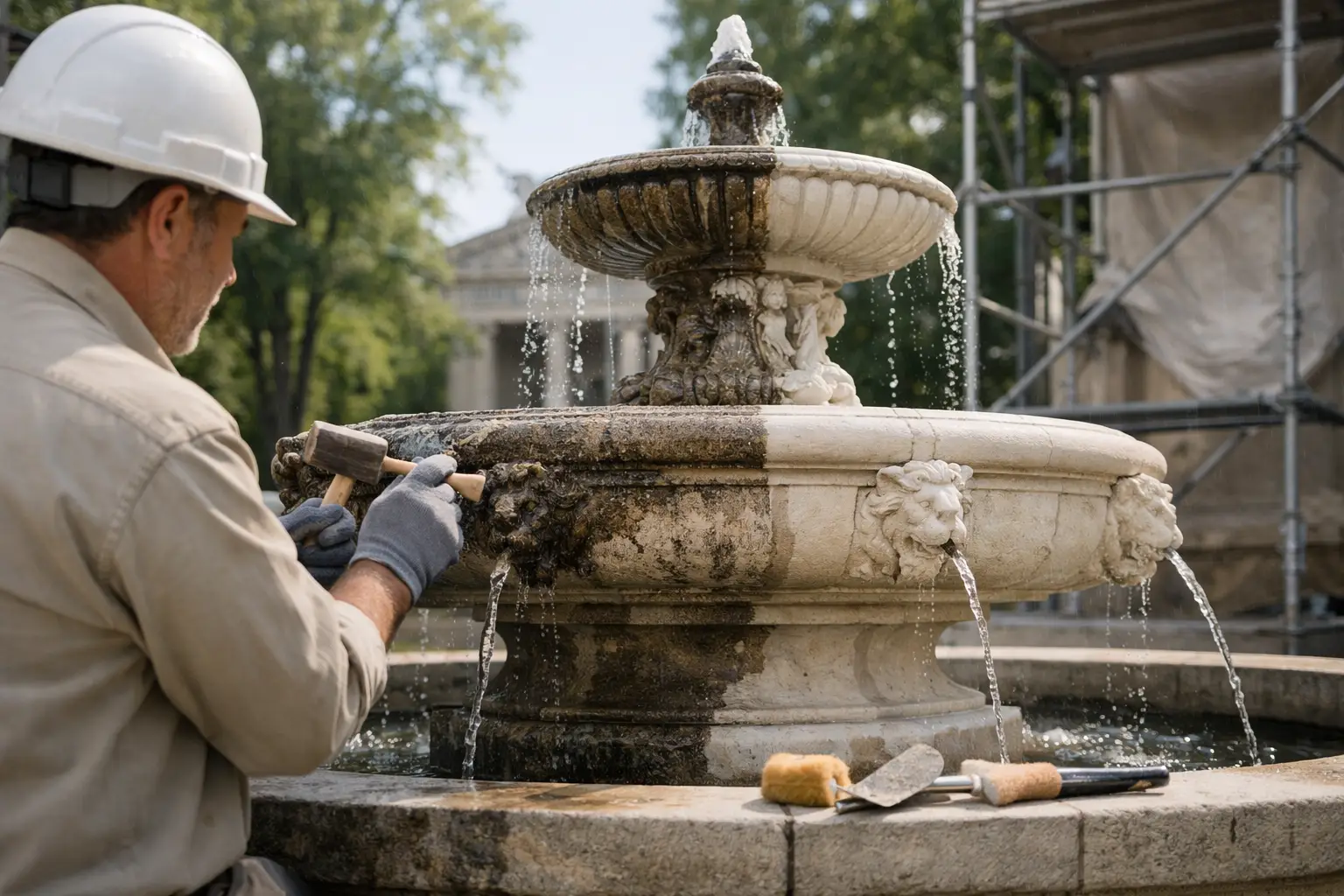
A historic fountain is never merely an ornament in a square, courtyard or garden. Its basin holds the marks of weather, ceremony and daily life; its stone records the hand of the original maker. Heritage fountain restoration begins with respect for this accumulated presence. The purpose is not to make an old fountain look newly manufactured, but to return clarity, stability and water to a work that belongs to its setting and its memory.
For municipalities, heritage bodies, religious institutions and owners of historic estates, this requires far more than a cosmetic intervention. Water has its own persistent logic. It enters joints, deposits salts, weakens concealed fixings and reveals weaknesses that may have remained hidden for decades. A successful restoration must therefore unite conservation knowledge, hydraulic understanding and the patient workmanship of a stone atelier.
Heritage Fountain Restoration Begins with Reading the Stone
Before a fragment is removed or a surface is cleaned, the fountain must be understood as a whole. This means studying the original materials, construction sequence, repairs from different periods and the way water presently moves through the structure. Marble, limestone, granite and travertine each respond differently to moisture, temperature change and cleaning methods. Even stones of the same family can vary in density, colour, veining and porosity according to their quarry of origin.
The first survey should identify structural movement, open joints, detached elements, biological growth, surface erosion, rusting metal cramps and failures in the water system. Historic photographs, drawings and archival descriptions can be as valuable as physical inspection. They may reveal a missing finial, the intended profile of a carved spout or the original finish of a basin worn smooth by generations of flowing water.
This stage also establishes a principle that should guide every later decision: retain as much authentic material as possible. A chipped edge may need consolidation rather than replacement. A darkened surface may be part of the fountain's age and atmosphere, not a defect to be erased. Restoration is an act of judgement. It asks what must be repaired for safety and function, what should remain as evidence of time, and what can be discreetly renewed without falsifying the whole.
Cleaning Without Erasing History
Cleaning is often the most visible part of heritage fountain restoration, and the most easily mishandled. Layers of algae, mineral deposits, urban pollution and old coatings can obscure the carving beneath. Yet an aggressive treatment can roughen a polished surface, open the pores of soft stone or remove the gentle tonal variation that gives historic marble its depth.
The right approach depends on the substrate and the deposit. Low-pressure water systems, carefully selected poultices and controlled mechanical methods may be appropriate where they have been tested on discreet areas first. Harsh acids and indiscriminate abrasive cleaning have no place in sensitive restoration work. Their apparent speed can carry a permanent cost.
Cleaning trials are therefore essential. They allow conservators and clients to assess not only technical effectiveness but also visual character. A fountain should emerge legible and cared for, not stripped of its dignity. The aim is to reveal the original design while allowing the stone to retain its honest patina.
Repairs that follow the original language
Cracks, losses and unstable components demand precise treatment. Where a repair is necessary, compatible mortars are chosen to work with the historic stone rather than against it. Cement-rich materials, frequently used in earlier repairs, can trap moisture and create damaging stresses. Their removal must be planned with care, particularly where the surrounding material has become fragile.
Replacement stone presents a different challenge. It should be selected for geological compatibility, visual harmony and long-term behaviour, rather than for superficial resemblance alone. A new section of marble may need to echo the grain, translucency and finish of the original block. A carved volute or mask should be produced from measured evidence, with the hand of the artisan visible in its sensitivity to proportion, never in an overconfident attempt to improve the historic design.
Where a lost element cannot be accurately documented, restraint is often the finer solution. A clearly necessary reconstruction may restore the fountain's composition and function. Speculative decoration, however skilfully made, risks turning conservation into invention.
The Invisible Work: Water, Drainage and Structure
A fountain can appear immaculate while remaining vulnerable beneath the surface. Leaking pipework, blocked drains and poorly detailed waterproofing are among the most common causes of recurring damage. Water migrating behind stone linings can lead to staining, salt crystallisation, frost damage and detachment. The visible repair will not last if the source of moisture is left unresolved.
For this reason, the hydraulic system should be considered from the outset. Modern pumps, filtration and recirculation equipment can usually be incorporated discreetly, reducing water waste and improving maintenance without altering the fountain's historic appearance. The technical choices depend on the site: a public urban fountain may require greater resilience and accessible service points, while a private garden fountain may permit a quieter, more concealed arrangement.
Drainage deserves equal attention. Basins need to empty reliably for inspection, cleaning and winter protection. Overflow routes must direct water away from vulnerable masonry. In colder locations, provision for seasonal shut-down can prevent freeze-thaw cycles from opening joints and damaging carved details.
Structural repairs may involve concealed stainless-steel pins or carefully designed anchors where original elements have become unstable. Such interventions should be minimal, reversible where practical and fully documented. The best technical work is rarely noticed by visitors. It gives the fountain the strength to remain itself.
Material Authenticity and the Question of Replacement
There is no single rule for deciding how much of a fountain should be renewed. A basin with localised erosion may be stabilised and retained. One compromised by deep fractures, failed previous repairs and water loss may require a new internal lining or selected replacement sections. The distinction lies in evidence, condition and future use.
For heavily used civic sites, durability and public safety may call for carefully integrated modern measures. In a protected cloister or ceremonial courtyard, the threshold for intervention may be higher. The right solution balances heritage requirements with the reality that a fountain is intended to live with water, weather and people.
Torchio Marmi approaches this balance through material knowledge developed across generations of Italian stonework. The most convincing repairs do not compete with the original. They respect its scale, restore its coherence and allow the natural character of marble or stone to continue speaking.
A Restoration Programme That Endures
Completion is not the end of care. Stone fountains benefit from a planned maintenance regime, particularly in environments exposed to pollution, hard water or falling leaves. Gentle, regular attention is less costly and less invasive than allowing deposits and minor faults to become major failures.
A practical programme should include seasonal inspection of joints and carved surfaces, cleaning of filters and drains, monitoring for leaks, and a record of any change in staining or stone condition. Water chemistry should also be managed with care. Treatments that protect pumps but harm natural stone are a false economy.
Documentation has lasting value. Surveys, photographs, material records and details of every repair provide future custodians with a clear account of what was found and what was done. Heritage is protected not only through skilled intervention, but through the transmission of knowledge.
Restoring a Place of Gathering
When water returns to a historic fountain, a place changes. The sound softens a courtyard, gives rhythm to a garden and draws people towards the centre of a square. What has been restored is both a construction of stone and a shared experience of place.
That is why the finest work remains measured. It honours the original design without pretending history can be reversed, combines contemporary technical discipline with traditional craft, and leaves the fountain ready to gather another generation around its water.