
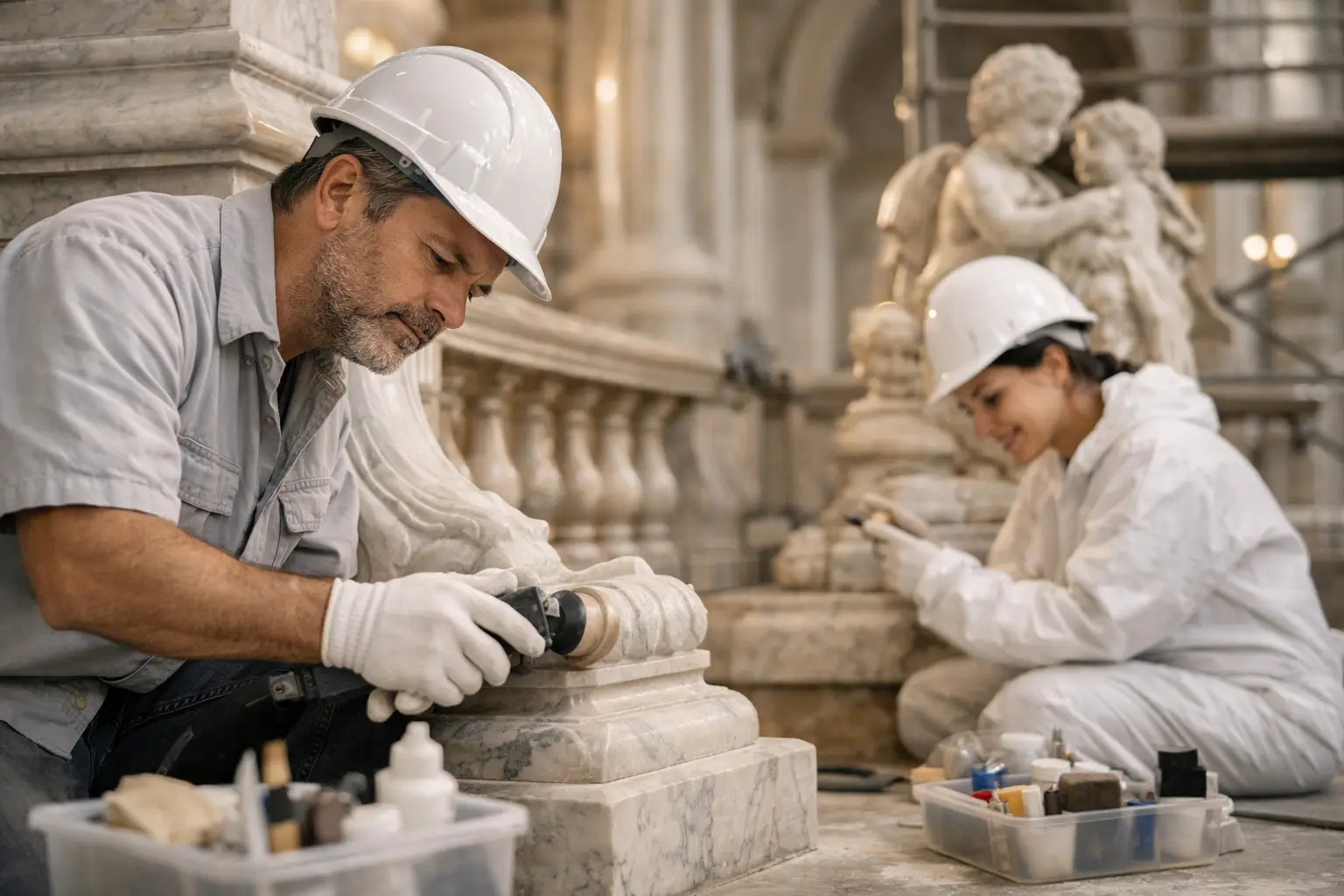
A worn threshold in a palazzo, a chapel floor softened by generations of footsteps, a veined mantelpiece dulled beneath unsuitable wax: these are not simply damaged surfaces. They are records of use, craft and place. Historic marble restoration specialists are entrusted with protecting that record while allowing the stone to recover its presence - with judgement, restraint and respect for the material’s original character.
Marble can appear permanent, yet its surface is sensitive to water, salts, acids, movement and poorly chosen past treatments. Restoration is therefore never merely a matter of making stone look new. The finest work preserves age where age is meaningful, repairs loss where loss threatens the whole, and returns coherence without erasing the hand of history.
What Historic Marble Restoration Specialists Actually Protect
A historic stone interior is composed of more than visible slabs. Its significance may lie in the quarry source, the unusual direction of the veining, a hand-finished edge, the original bedding mortar, or the relationship between marble, bronze, plaster and painted decoration. In a sacred building or a listed residence, even a small intervention can alter the balance of the room.
The first responsibility is to understand what is original, what has been altered and what is causing deterioration. A pale bloom on a floor may be salt migration rather than a cleaning issue. A crack may result from structural settlement, not from an isolated impact. A darkened patch may be the legacy of an old oil, resin or adhesive. Treating the symptom without investigating the cause risks creating a more serious problem beneath a newly polished surface.
This is why restoration begins with observation. Specialists study the condition of the marble in changing light, identify previous repairs, assess joints and substrates, and consider the wider building environment. Moisture, ventilation, footfall and cleaning habits all matter. The right intervention is often less dramatic than an owner expects, but its value lies in its durability and discretion.
The Difference Between Cleaning, Repair and Restoration
These terms are often used interchangeably, though they describe very different levels of work. Cleaning removes surface soiling or deposits through methods selected for the particular stone. Repair addresses a local fault, such as a chip, open joint or fractured corner. Restoration considers the architectural and visual whole.
For a marble staircase, restoration may involve carefully lifting unstable elements, correcting movement in the base, replacing failed bedding material, reassembling broken fragments and refining the finish so that repaired areas sit quietly within the existing surface. On a decorative wall facing, it may include consolidating fragile marble, resolving staining caused by metal fixings and remaking a missing profile from matching material.
A perfect visual match is not always the goal. Where a replacement is necessary, the selected marble should belong naturally to the composition in colour, grain and scale. Yet in some conservation contexts, a subtle distinction between old and new is appropriate, allowing future custodians to understand the building’s history. The decision depends on the cultural importance of the work, the extent of loss and the requirements of the relevant heritage authority.
Why Over-Polishing Can Be a Loss
The temptation to restore a high gloss is understandable. Marble responds beautifully to light, and a polished finish can transform an interior. But many historic surfaces were never intended to resemble a contemporary hotel lobby. Their finish may have been honed, satin-like, textured by hand, or gently worn by time.
Aggressive grinding can flatten the natural undulation of old flooring, weaken arrises, remove tool marks and make repaired sections conspicuous. It may also expose a fresher layer of stone whose colour bears little resemblance to the aged surface around it. A careful specialist chooses the least invasive process that can achieve the required stability, cleanliness and visual harmony.
A Method Led by Material Knowledge
No two marbles behave alike. Carrara marble, Verde Alpi, Breccia, Portoro and ancient coloured stones each have their own density, porosity, mineral composition and response to treatment. The presence of veins and fissures is not necessarily a defect; it is often part of the stone’s expressive identity. However, those same features may influence how a piece is cut, supported, cleaned or bonded.
The work commonly moves through a sequence of assessment, testing, stabilisation and finishing. Tests are essential before broader treatment begins. A poultice that draws one stain from a pale marble may leave another stone uneven. A cleaning product that appears mild can react badly with a calcareous surface. Even water must be managed carefully where soluble salts or vulnerable substrates are present.
Where fragments survive, reassembly is generally preferable to replacement. Lost sections can be carefully integrated with compatible stone, shaped by hand and finished to respect adjacent material. Fine repairs may be reinforced discreetly where needed, but the choice of resin, pinning system or mortar must take account of reversibility, ageing and movement. A repair that looks convincing on the day of installation is not a successful repair if it discolours, cracks or traps moisture a few years later.
Restoration Within a Living Building
Historic marble rarely exists in isolation. It shares space with carved wood, terrazzo, mosaics, metalwork and architectural plaster. In churches and civic buildings, restoration must often be planned around worship, public access or ceremonial use. In private residences, the challenge may be to preserve original features while meeting the practical expectations of contemporary life.
This calls for technical planning as well as craftsmanship. Access routes must protect existing finishes. Dust, vibration and moisture must be controlled. Heavy elements require careful handling, particularly when working on upper floors or within confined historic rooms. When new services, underfloor heating or structural works are involved, stone specialists need to work in close dialogue with architects, engineers and conservators.
The most successful projects are not those in which restoration is treated as the final decorative phase. Stone should be considered early, while decisions about drainage, movement joints, lighting, heating and adjacent materials can still be made intelligently. A beautiful repair cannot compensate for a recurring water ingress problem or an unstable subfloor.
Respecting Use Without Sacrificing Beauty
A heritage floor can be preserved and still used. The approach may include carefully considered entrance matting, protective measures for events, suitable cleaning routines and periodic inspections. These measures are not an afterthought. They are part of stewardship.
There are trade-offs. A completely untreated surface may retain an authentic appearance but be vulnerable in a heavily used entrance. A protective treatment may reduce staining risk, yet must never produce an artificial sheen or obstruct the stone’s natural behaviour. The correct choice depends on location, traffic, exposure and the owner’s tolerance for patina.
Choosing Historic Marble Restoration Specialists
Credentials matter, but so does the quality of questions asked at the outset. A considered specialist will want to know the building’s history, the purpose of the space, previous interventions and the practical conditions the marble must withstand. They will be prepared to say when a proposal requires further investigation rather than promising immediate transformation.
Look for a workshop with proven familiarity across stone sourcing, fabrication, installation and conservation. Historic restoration often requires all four disciplines. It may demand the ability to locate a compatible block, shape a replacement to an existing profile, install it without disturbing surrounding fabric, and finish it with sensitivity to the original surface.
Torchio Marmi approaches this work from a heritage of Italian stone craftsmanship established in 1860, where technical precision serves the larger character of the place. From significant public settings to intimate commemorative works, every commission asks the same essential question: how can stone endure with dignity?
Clear documentation is equally valuable. Condition records, photographs, samples and agreed treatment areas provide reassurance to owners, designers and heritage stakeholders. They also create a useful reference for future care. In important buildings, restoration is part of a continuing chain of responsibility, not a single event.
Marble rewards patience. Before approving a broad treatment, ask to see a discreet trial area in the actual light of the room, and consider not only how the stone will appear on completion, but how it will be cared for in the years that follow. That is where a restoration becomes more than an improvement: it becomes a faithful act of preservation.