
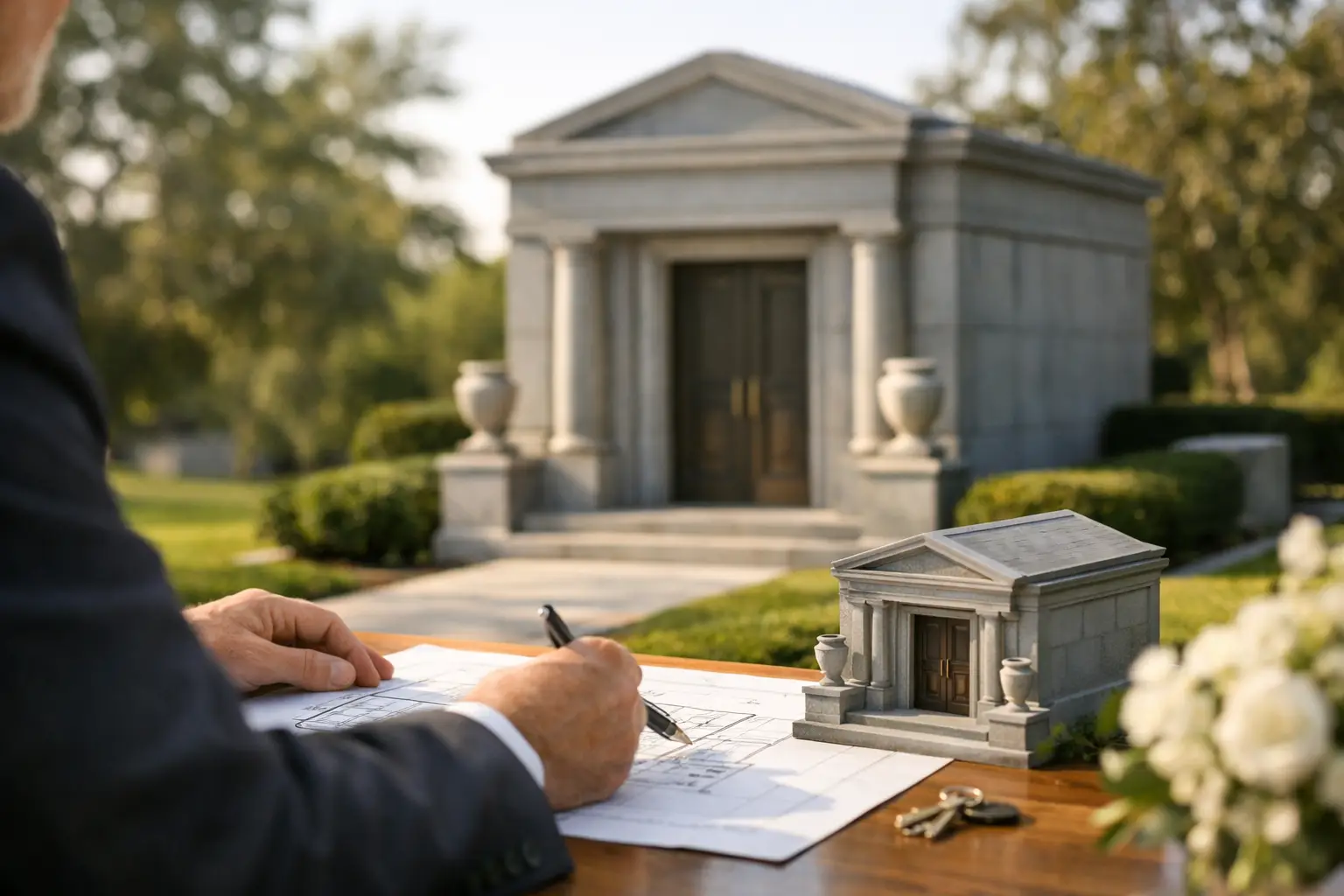
A private mausoleum is not simply a structure for interment. It is an architectural expression of family memory, shaped to endure across generations. For those considering how to plan a private mausoleum, the most valuable first step is to allow time for thoughtful decisions: the setting, the family’s wishes, the language of the design and the material that will carry its meaning.
Unlike a standard memorial, a mausoleum brings together cemetery regulation, architecture, stone engineering and deeply personal commemoration. Its success lies in the harmony between those elements. A well-conceived work should feel settled in its place, dignified in every proportion and capable of ageing with grace.
Begin with the cemetery and the family’s long view
Before selecting marble or sketching a façade, establish what is permitted on the chosen site. Every cemetery has its own rules governing plot dimensions, height, permitted materials, architectural styles, access for installation and the number of interments. In some locations, the cemetery authority may require a formal design submission before work can proceed; in others, local planning, heritage or religious requirements may also apply.
This early dialogue prevents a beautiful idea becoming an impractical one. It also clarifies whether the commission is for a freestanding family chapel, an above-ground wall vault, a small monument containing one or two crypts, or an enlargement of an existing family memorial. These are different architectural propositions and require different foundations, closures and methods of construction.
The family’s long view matters equally. Consider who the mausoleum is intended to honour now, and whom it may serve in the future. Capacity should be discussed with sensitivity but without ambiguity. A design for two interments has a different rhythm and scale from a family mausoleum conceived for several generations. Making provision at the outset often preserves visual unity and avoids disruptive alterations later.
How to plan a private mausoleum around its setting
The site should guide the architecture rather than merely receive it. Observe the approach to the plot, the level of natural light, neighbouring monuments, established avenues and the prevailing materials of the cemetery. A mausoleum in an open, formal avenue may call for a composed classical front, while a quieter garden setting may suit a more restrained, contemporary volume.
Proportion is fundamental. The structure should possess enough presence to communicate permanence, yet never appear imposed upon its surroundings. The relationship between the base, the body of the mausoleum, the entrance or closure panels and any crowning element must be resolved as one composition. Even modest dimensions can carry great distinction when the lines are calm and the details exact.
Privacy also deserves consideration. Some families seek a chapel-like interior for reflection; others prefer an exterior monument with discreet inscription panels. A bronze gate, a framed doorway or a recessed threshold can create a sense of arrival without turning remembrance into spectacle. The most enduring designs are often those that speak quietly.
Choose stone for beauty, structure and time
Natural stone gives a mausoleum its emotional and architectural character, but material selection must go beyond colour alone. Marble offers luminosity, fine detail and a long association with sacred and commemorative art. Granite brings exceptional density and resistance to weathering, often lending itself to crisp lettering and polished surfaces. Limestone, travertine and certain natural stones can offer warmer, more textured expressions, although their suitability depends on the climate, finish and intended exposure.
Each block has its own veining, movement and mineral composition. This is not a defect to be eliminated, but part of the material’s identity. A skilled stone specialist will assess how the figure of the stone should run across a façade, around a corner or through paired panels. Book-matched marble, for example, can create a quiet symmetry, while a more uniform granite may support a disciplined monumental design.
Finishes influence both appearance and maintenance. Highly polished stone reflects light and can feel ceremonious, while honed, brushed or lightly tooled surfaces soften reflection and bring the material closer to the hand. Exterior conditions matter. Rain, frost, pollution, tree cover and coastal air will all affect the choice of stone, fixing methods and protective detailing. The correct material is one that remains beautiful in the place where it will live, not only in a showroom.
Give equal attention to engineering and craft
A mausoleum must be designed as a lasting building. Beneath the visible stone are foundations, drainage considerations, structural support, concealed fixings and carefully resolved joints. These technical elements protect the work from settlement, water ingress and movement over time.
The thickness of panels, the method of anchoring, the weight of a roof or pediment, and the way dissimilar materials meet all require specialist judgement. Bronze and steel may introduce depth and contrast, but they expand and weather differently from stone. Their integration must be deliberate, not decorative afterthought.
Craftsmanship is especially visible at the edges: a precisely mitred corner, a finely tooled moulding, an inscription cut at the correct depth, a door that closes with assurance. These details create the difference between an object assembled from components and a true commemorative work. At Torchio Marmi, the same respect for material knowledge that informs monumental restoration can be brought to a family commission of any scale.
Shape the memorial language with restraint
Inscriptions are among the most personal choices in the project. Names, dates, quotations, religious symbols, family emblems and photographic portraits can all be incorporated, but they should be considered as part of the architecture. The typeface, letter spacing, position and method of carving determine whether the words feel harmonious with the stone.
Hand-cut lettering has a depth and living quality that suits many traditional designs. Sandblasted or machine-cut lettering can be appropriate where a cleaner, more contemporary character is desired. Gilding, lead filling and bronze letters each produce a different presence in changing light. There is no universal right choice; what matters is that the memorial language remains legible, dignified and true to the family.
Personal symbolism can be equally subtle. A carved branch, a favourite flower, a small mosaic, an engraved landscape or a bronze relief may express a life more eloquently than extensive text. The strongest commemorative details are usually those with genuine significance, not those added merely to fill a surface.
Establish the scope and budget early
The cost of a private mausoleum depends on the site, the number of crypts, the scale of the structure, selected materials, transport, foundations, installation conditions and the amount of hand-crafted detail. A simple granite family vault and a marble chapel with a bronze gate, interior lining and carved ornament belong to very different levels of work.
Rather than beginning with a fixed aesthetic and attempting to reduce it later, set a realistic investment range at the start. A good design process can then direct resources towards what will matter most: a superior stone, a finely composed façade, long-lasting construction or deeply personal inscription work. This is not about reducing meaning to a budget. It is about giving each decision the proper weight.
Ask for clarity on what the commission includes, from drawings and approvals to foundation works, fabrication, installation and any future access needed for additional interments. The most dependable projects are those in which practical responsibilities are clearly defined before stone is cut.
Plan for care without fearing age
Natural stone acquires character over time. A mausoleum should be inspected periodically, particularly after severe weather, to check joints, lettering, metalwork and areas where water may collect. Cleaning should be gentle and undertaken with materials suited to the particular stone. Aggressive acids, pressure washing and unsuitable sealants can do more harm than years of ordinary exposure.
Some families prefer a carefully maintained polished appearance; others value the quiet patina that develops naturally. Both approaches can be appropriate, provided the stone remains sound and the intent is respected. Keeping original drawings, stone records and details of inscriptions will also assist those who care for the monument in the future.
A private mausoleum asks for patience, discernment and a willingness to make decisions beyond the immediate moment. Given that care, it becomes more than a place of interment: a monument to memory, made from the earth’s most enduring materials and entrusted to those who follow.