
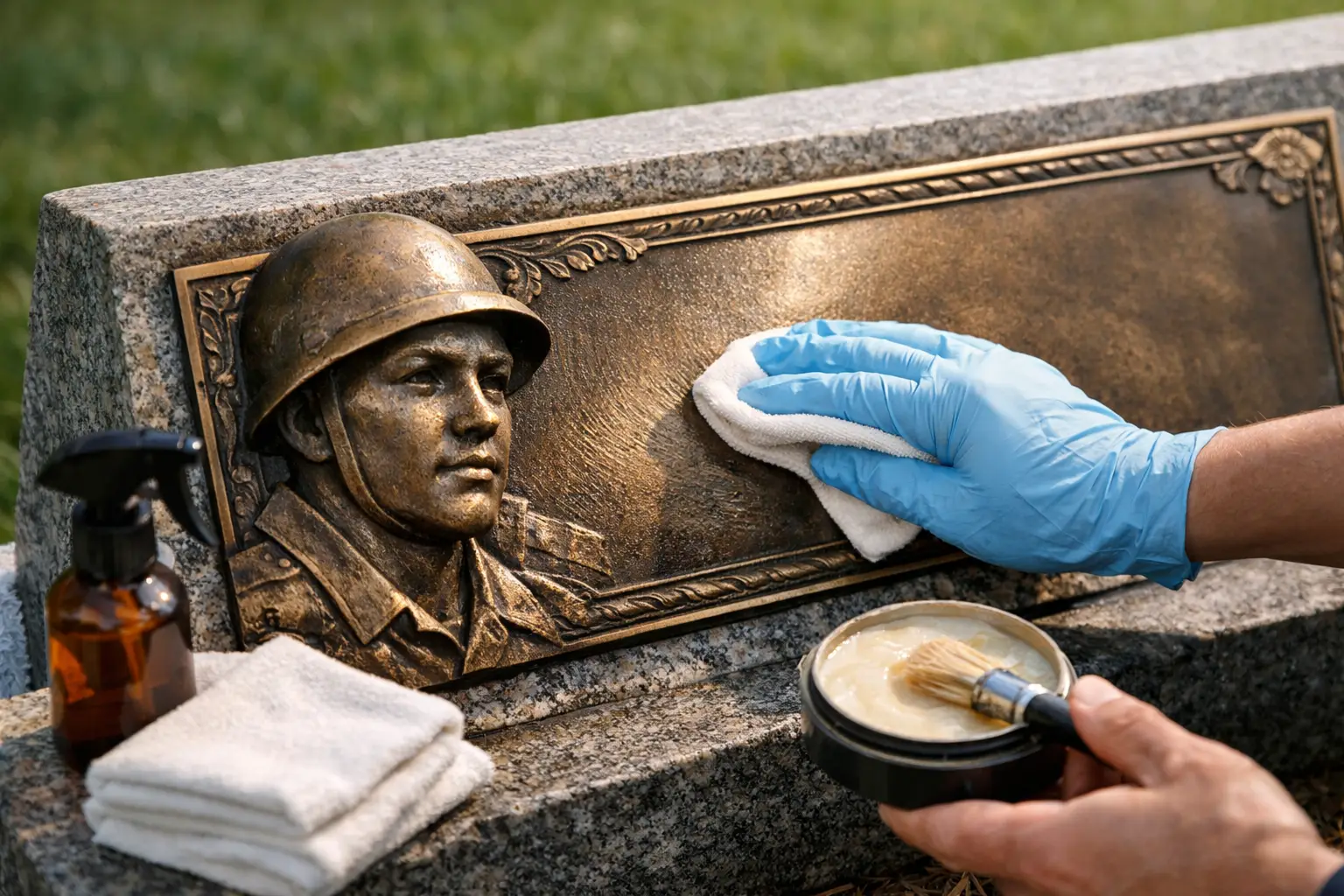
A bronze memorial is never merely an object exposed to the weather. It carries a name, a date, a dedication and often the visual language of a family, a community or a sacred place. Knowing how to preserve bronze memorials means respecting this accumulated meaning as much as the metal itself. The right care protects legibility and dignity without erasing the patina that gives bronze its depth and history.
Begin by understanding the bronze
Bronze is valued for its strength, expressive surface and ability to age with grace. Yet it is not immune to change. Rain, airborne pollution, salt, bird deposits, leaf tannins and inappropriate cleaning products can all alter its surface. In sheltered conditions, bronze may develop rich brown, umber or green tones that can enhance its character. In harsher environments, corrosion may become uneven, powdery or disruptive.
The first distinction is essential: not every change in colour is damage. A stable patina is often part of a memorial’s intended beauty and may have formed over decades. It protects the metal to a degree and connects the work to its setting. Aggressive polishing, however well meant, can strip this surface away, leaving the bronze bright but historically diminished and more vulnerable to renewed corrosion.
Look closely at the whole monument rather than the plaque or figure alone. Water may be entering from a cracked stone base, an open joint, a failed fixing or a recessed area where leaves collect. Bronze preservation is frequently a matter of managing water, dirt and contact between materials, not simply treating the visible metal.
How to preserve bronze memorials through gentle cleaning
Cleaning should be modest, infrequent and guided by the condition of the surface. For an intact memorial with ordinary dust or grime, begin with a soft natural-bristle brush or clean microfibre cloth. Use it dry first, working carefully around raised lettering, portraits, emblems and fine cast details.
If further cleaning is needed, use clean water with a small amount of mild, pH-neutral soap. Apply it sparingly with a soft cloth or sponge, avoiding prolonged saturation around joints and fixings. Rinse gently with clean water and dry the surface with a lint-free cloth. The aim is to remove surface deposits, not to make the bronze shine like a newly cast object.
Never use wire wool, scouring pads, metal brushes or abrasive powders. Acidic cleaners, bleach, household detergents, vinegar and proprietary metal polishes can etch the surface, leave residues or remove a carefully developed patina. Pressure washing is equally unsuitable: it can force water into seams, damage surrounding stone and dislodge fragile details.
Particular restraint is required where bronze has a dark or variegated finish. Rubbing one area more firmly than another can create pale patches that are difficult to reconcile. If a memorial has gilded lettering, applied finishes or areas of coloured wax, even mild cleaning may be too invasive without specialist advice.
Protect the patina rather than pursuing brightness
Patina is the visible record of bronze meeting time, climate and place. Its tones may range from warm brown to olive green, with subtle variations around lettering and sculpted relief. A harmonious, well-adhered patina should generally be retained, even if it does not match the idea of polished bronze.
Trouble appears when corrosion is active. Watch for pale green or blue powder, blistering, flaking, pitting, cracking, lifting layers or corrosion concentrated around bolts and joints. These symptoms can indicate moisture and salts trapped against the metal. Left untreated, they may obscure inscriptions, weaken edges and compromise cast details.
Protective wax coatings can help reduce contact with moisture and pollutants, especially on exterior memorials. However, wax is not a universal remedy. It needs a clean, stable surface, careful application and periodic renewal. Applied over dirt, unstable corrosion or incompatible earlier treatments, it may trap moisture and make future conservation harder. The correct coating and maintenance interval depend on the bronze’s finish, setting and exposure.
A memorial in a city cemetery, for example, faces a different atmosphere from one in a coastal churchyard or an enclosed cloister. Salt-laden air, shade, drainage, tree cover and public access all affect the appropriate approach. Preservation should respond to the site, not follow a generic cleaning routine.
Attend to stone, joints and fixings
Many bronze memorials are inseparable from their marble, granite or natural-stone supports. The junction between bronze and stone deserves close attention because it is often where water lingers. Staining, open sealant lines, rust marks from hidden iron fixings and cracks in the stone can all signal a problem beneath the surface.
Do not seal around a bronze plaque with an arbitrary mastic. Some sealants discolour stone, restrict drainage or fail prematurely. Nor should corroded screws be replaced casually with whatever metal is at hand. Incompatible metals can accelerate galvanic corrosion when moisture is present. A conservation-led repair considers the bronze, the fastenings, the stone and the movement of water as one system.
Where a plaque has loosened, a sculpture shifts on its base or lettering has become detached, avoid temporary adhesives. These interventions can stain, fail under weathering and complicate a proper repair. Secure the area from accidental handling and arrange an assessment before material is lost.
Know when specialist restoration is required
There is a clear boundary between thoughtful maintenance and conservation work. A specialist should assess memorials showing active corrosion, unstable patina, structural movement, missing decorative elements, illegible inscriptions or damage caused by vandalism. The same applies to historically significant cemetery monuments, war memorials, religious works and sculptures with artistic or civic value.
Professional restoration begins with observation and documentation. Surface condition, historic finishes, foundry marks, fixings and relationships with the stone base are recorded before treatment is proposed. Cleaning may involve carefully selected mechanical or chemical methods, but only after testing confirms that the chosen approach will not sacrifice original material or visual coherence.
Where inscriptions have worn, the temptation to deepen letters or apply a new, uniform dark finish should be resisted until the original technique is understood. A memorial’s character lies partly in the hand of its maker, the crispness or softness of its casting, and the way its materials have matured together. Restoration should recover stability and readability while preserving that identity.
For monuments in protected settings, consultation with cemetery authorities, heritage bodies or ecclesiastical custodians may also be required. This is not bureaucracy for its own sake. It ensures that the work respects the legal, artistic and communal significance of the memorial.
Establish a calm, regular inspection routine
A considered inspection once or twice a year is more valuable than occasional intensive cleaning. Visit after winter, and again following periods of heavy rain or autumn leaf fall. Brush away loose debris, check that drainage paths remain clear, and examine the base, joints and lettering for change.
Photographs taken from the same angles can be particularly useful. They create a quiet record of the memorial’s condition and make gradual changes easier to recognise. Note new staining, green powder, cracks, movement or areas where water repeatedly collects. Early intervention is usually gentler, less costly and more faithful to the original work than a major later repair.
For family memorials, this routine can become an act of remembrance in its own right. For institutions and cemetery operators, it supports a planned programme of care that protects many monuments before neglect becomes irreversible.
The finest preservation does not attempt to deny age. It allows bronze to retain its noble, time-shaped surface while ensuring that every inscription, form and gesture remains present for those who come after us. When care is guided by patience, material knowledge and respect for place, a memorial continues to stand as it was intended: a lasting monument to memory.