
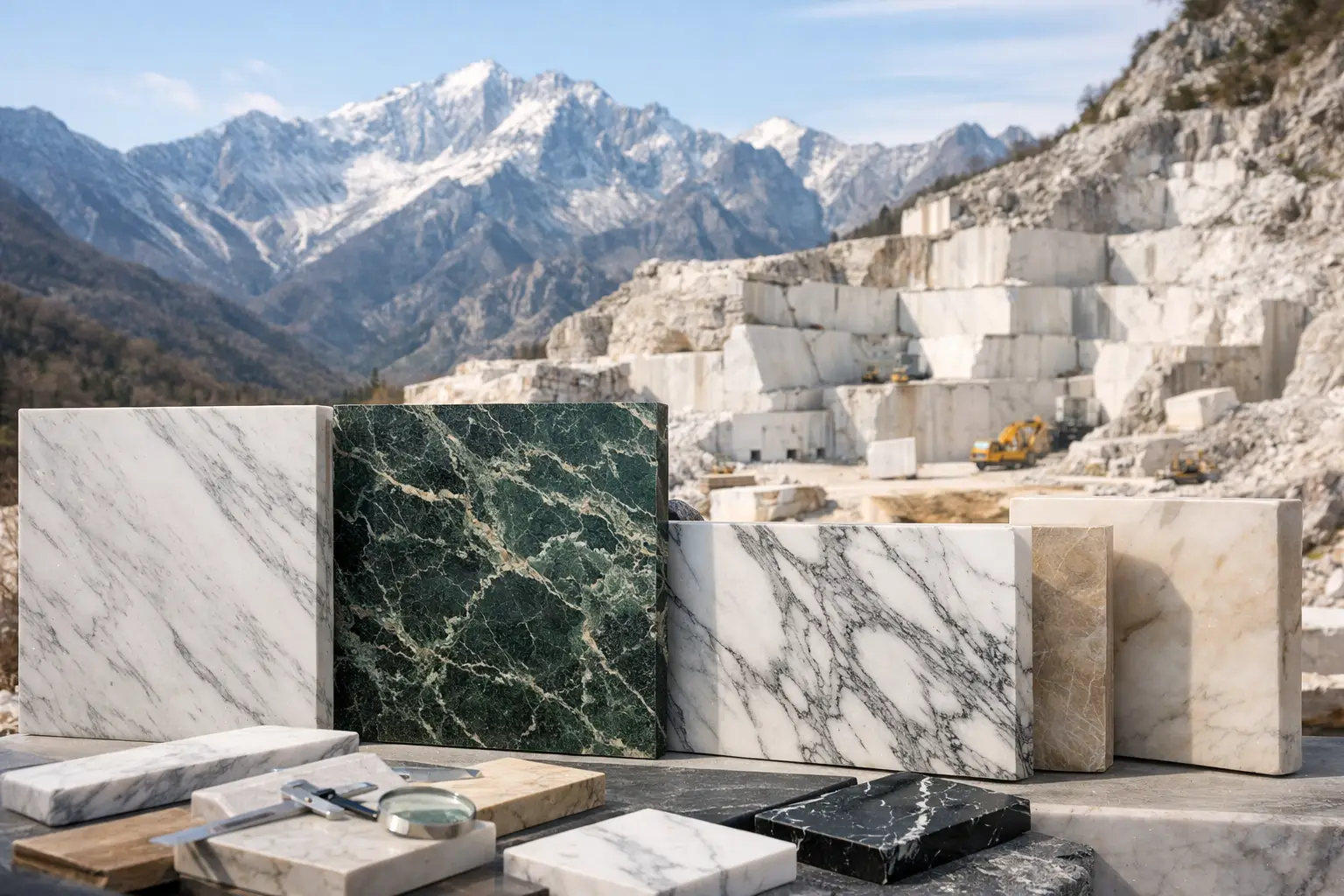
A marble surface is never merely specified. It is selected from a living geological material whose veining, tone and movement will shape a room for generations. This Italian marble sourcing guide is intended for architects, designers and private owners who want that selection to be made with discernment: not from a small sample alone, but through an understanding of origin, character, performance and craft.
Italian marble has long been associated with the highest expression of architectural beauty. Yet its value does not rest only in a celebrated quarry name. The finest result comes from aligning the right stone with the right setting, then carrying it faithfully through cutting, finishing, installation and care. A pale marble may bring serenity to a private bathroom; a dramatic brecciated slab may give a reception hall its defining gesture. Neither choice is inherently superior. Both require a clear purpose.
An Italian marble sourcing guide begins at the quarry
Italy offers an extraordinary range of marbles, each formed under distinct geological conditions. Carrara remains central to the world’s imagination, with materials ranging from quiet, finely grained Bianco Carrara to the bolder, more sculptural character of Calacatta and Statuario. Elsewhere, Arabescato introduces intricate grey movement, while richly coloured marbles and breccias offer depth, warmth and unmistakable presence.
Names, however, should be treated as a starting point rather than a guarantee. Commercial classifications can be broad, and a stone’s appearance changes between quarry benches, blocks and individual slabs. Two slabs described by the same name may differ in ground colour, crystal structure, vein density and the scale of their movement. This is not a defect. It is the essential truth of natural stone.
For a project where visual continuity matters, sourcing should begin with the intended composition. Consider whether the design asks for calm fields of material, bookmatched drama, a strong directional vein or a more dispersed pattern. A stone chosen for a sample’s individual beauty may prove unsuitable when repeated across a large floor, a long wall or multiple bathroom surfaces. Conversely, a slab with expressive movement can become magnificent when its placement is planned as a single architectural drawing.
Choose for place, not prestige alone
The most expensive or rarest marble is not automatically the most appropriate. Stone must belong to its environment. In a heritage interior, it may need to converse with existing joinery, plasterwork and historic paving without imitating them. In a contemporary residence, it may be asked to provide contrast against metal, timber and glass. In a sacred or commemorative setting, restraint, permanence and symbolic resonance may be more important than visual spectacle.
Light deserves particular attention. North-facing rooms can cool the appearance of white marble, making grey veining more pronounced. Warm artificial light may enrich creamy backgrounds but alter the reading of certain green, red or violet stones. View slabs vertically where they will be used on walls, and horizontally where they will become floors or worktops. A polished face reflects light differently from a honed one, and the same marble can feel either formal or intimate as a result.
Function is equally decisive. Marble is a calcareous stone and will react to acidic substances. For a kitchen used daily for citrus preparation, wine and cooking, a client should accept that a polished marble worktop may acquire a gentle patina, or choose a less reactive material for the principal preparation area. In a bathroom, careful detailing around standing water and appropriate cleaning habits are often more relevant than anxiety about the material itself. For exterior use, frost resistance, surface finish, drainage and local exposure must be assessed stone by stone.
There is no universal answer to whether marble is suitable for a demanding space. There is only an honest conversation about use, expectations and the kind of ageing that will be considered beautiful.
Inspect the actual slabs
A hand sample is useful for colour direction and finish, but it cannot reveal the full composition of a natural slab. Final approval should, wherever possible, take place on the actual material reserved for the project. This is particularly important for bookmatching, large-format cladding, staircases, fireplaces and continuous flooring.
During slab selection, assess the material at a useful distance as well as close up. Look for consistency across the batch, but do not confuse consistency with uniformity. Examine the way veins enter and leave each slab, especially where two pieces will meet. Identify natural fissures, filled areas and changes in density. These are often stable and entirely acceptable when correctly processed, yet they must be understood before a fabrication plan is agreed.
A specialist fabricator will distinguish between features that are intrinsic to the stone and issues that could compromise the intended use. Resin treatment, mesh backing and carefully executed repairs can be appropriate technical measures, especially with more open or dramatic materials. Their suitability depends on location, slab thickness, finish and loading. The question is not whether a stone has been treated, but whether it has been treated intelligently and transparently for its architectural purpose.
Photography can assist approval, particularly for international projects, but colour-managed images, slab maps and physical reference samples should work together. Screen images alone are vulnerable to lighting and display variation. Where decisions are consequential, an in-person viewing remains the clearest way to understand a stone’s atmosphere.
Plan yield, movement and fabrication together
Sourcing is often mistaken for the purchase of slabs. In reality, it is the first stage of design and production. Before material is confirmed, the fabricator should understand finished dimensions, joint locations, edge profiles, cut-outs, wall conditions and the desired vein direction. These details determine how much material is required and whether the selected batch can produce the intended effect.
A generous slab may yield less usable material than expected once natural fractures, variation, cut-outs and matching requirements are considered. For a bookmatched feature wall, the orientation of the block cut matters as much as the overall quantity. For a vanity with an integrated basin, the position of a strong vein can either become a deliberate focal point or create visual imbalance. For flooring, the calibration of thickness and the relationship between joints, thresholds and surrounding materials require early resolution.
This is where a made-to-measure approach protects both the design and the investment. At Torchio Marmi, material knowledge is joined to fabrication judgement so that stone is not treated as a standardised finish, but as a composition with its own demands. The workshop’s role is to preserve the material’s character while translating it into precise, durable architecture.
Do not separate logistics from quality
The journey from quarry or yard to finished site involves handling, crating, transport, storage, cutting and installation. Each stage can affect programme, cost and the condition of the material. Large slabs require careful support; finished pieces need protected edges and clear identification; site access must be checked before fabrication reaches its final stages.
For projects outside Italy, allow time for export documentation, transport planning and the realities of site sequencing. A stone installation should not arrive before the substrate is stable, dry and properly prepared. Walls may require levelling, reinforcement or a mechanical fixing strategy. Floors need suitable tolerances, movement considerations and compatible adhesives. The most beautiful slabs cannot compensate for an unready site.
It is also wise to secure sufficient material from a single batch when the project requires continuity or may later need additions. Reordering an apparently identical marble months later can result in a noticeably different background or vein pattern. A modest allowance for future repairs or a small matching element can be a thoughtful safeguard, particularly in hospitality, commercial and heritage settings.
Select a finish that honours the stone
Polishing heightens colour, depth and reflection, making it a natural choice for formal interiors, decorative wall panels and certain work surfaces. Honing offers a quieter, more tactile reading and can be better suited to contemporary schemes or floors where reduced glare is desired. Brushed, sandblasted and antiqued finishes introduce further possibilities, though they must be selected with care according to cleaning needs, slip resistance and the stone’s structure.
A finish is not simply an aesthetic decision applied at the end. It changes how the material receives light, reveals veining and responds to touch. Request finish samples made from the selected stone rather than from a generic substitute. The difference may be subtle, but subtlety is where lasting interiors are often won or lost.
Care for a material that records life
Marble rewards correct care without asking to be treated as fragile. Use pH-neutral products, wipe spills promptly and avoid acidic or abrasive cleaners. In high-use areas, appropriate sealing can reduce absorption, although it will not make marble immune to etching or physical wear. Protective treatments should be chosen for the stone and application, not adopted as a universal remedy.
Over time, a floor may soften under footsteps, a kitchen surface may gather small marks, and a threshold may become smoother with use. For many owners, this is not deterioration but the quiet evidence of a life lived well. Where a pristine appearance is essential, the material and finish should be chosen accordingly from the outset.
The right Italian marble does more than complete a specification. It gives architecture a memory: of the mountain from which it came, of the hands that shaped it, and of the daily life that will continue across its surface.