
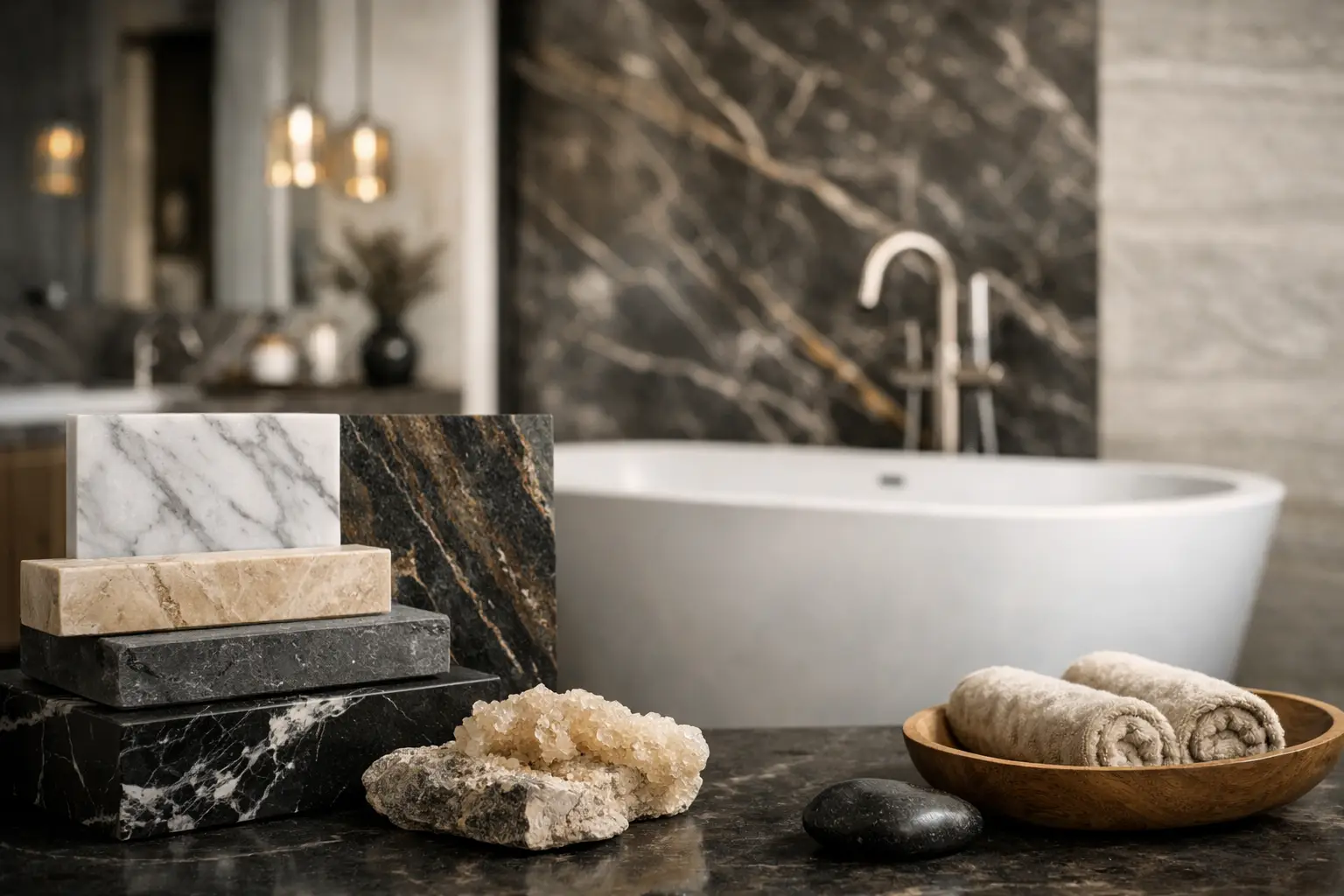
A luxury bathroom is often decided before the fittings are chosen. It begins with the surface beneath the hand, the quiet movement of veining across a wall, and the way light settles on stone after a bath. The finest luxury bathroom stone options do not simply decorate a room. They establish its atmosphere, giving a private space the permanence and visual depth of architecture.
For a residence, boutique hotel or considered restoration, the right choice is never only a question of appearance. Water, steam, cleaning routines, scale, natural light and the detailing of joints all influence whether stone will remain beautiful over decades. A material selected with knowledge can become design at the service of dreams. Selected only from a small sample, it may not reveal its true character until it is too late.
Luxury bathroom stone options begin with atmosphere
Stone has a presence that manufactured surfaces cannot replicate. Every slab carries its own mineral history: clouds of colour, fossils, crystalline brightness or a vein that seems to have been drawn by hand. In a bathroom, where the palette is often restrained, that individuality is especially powerful.
The first decision should be emotional as well as practical. Do you imagine a calm, pale sanctuary with softly honed surfaces? A dramatic room where richly veined marble frames a sculptural basin? Or a warm, earth-toned bathing space with the tactile character of a historic Italian interior? The answer helps determine not only the stone, but the finish, format and level of variation that will feel right.
Large-format wall cladding can make a compact room feel composed and expansive, particularly when the veining is bookmatched or continued from one plane to another. Smaller pieces, mosaics and textured finishes introduce rhythm underfoot or inside a shower. Neither approach is inherently more luxurious. The distinction lies in proportion, precise fabrication and the confidence to let the material lead.
Marble: the enduring language of elegance
Marble remains the defining material for many exceptional bathrooms. Its luminosity gives pale schemes a softness that ceramic imitations struggle to achieve, while its veins can lend a room a sense of movement and ceremony. From discreet white marbles with fine grey tracery to bolder varieties with burgundy, green, gold or charcoal tones, the design possibilities are almost limitless.
A white marble can bring a classical, gallery-like clarity to a principal bathroom. More expressive stones are often most successful when used with discipline: across a vanity, as a full-height feature wall, or around a freestanding bath where the veining can be appreciated as a natural composition. Matching slabs before fabrication is essential. It allows the direction and continuity of each vein to be considered rather than left to chance.
Marble does ask for understanding. It is sensitive to acidic products, and polished finishes can show etching from cosmetics or toiletries. This is not necessarily a reason to avoid it. A honed finish often gives marble a more contemporary, velvety appearance while making minor marks less visually insistent. In a carefully maintained private bathroom, the gentle patina that develops can be part of the stone's charm rather than a flaw.
Choosing marble beyond the sample
A small sample cannot convey the full scale of a marble's veining or background colour. Some stones are quiet from a distance and intricate up close; others make a powerful statement across a full slab. Viewing and selecting the actual blocks or slabs is therefore an important part of a bespoke project, particularly for bookmatched walls, integrated basins and continuous flooring.
It is also worth considering the room's light. Cool northern light can make a white marble appear bluer, whereas warmer lighting may bring out cream or gold undertones. A specialist fabricator can help translate this natural variation into a balanced composition.
Travertine: warmth, texture and quiet grandeur
Travertine offers a gentler expression of luxury. Its porous character, layered tones and subtle banding create an immediate sense of warmth, making it particularly suited to bathrooms intended as places of retreat. It has long belonged to Italian architecture, yet it can feel equally at home in a minimal contemporary setting.
The stone may be supplied with its natural voids filled for a smoother, more practical finish, or with a more open texture where the design calls for a tactile, artisanal quality. Honed travertine floors and walls can create a calm envelope around timber, brushed metal and linen-like textiles. Its restrained palette also gives brass, bronze and dark fittings a particularly handsome contrast.
For shower floors, the finish matters as much as the material. A brushed, textured or suitably honed surface offers more secure footing than a high polish, while small-format pieces allow the falls towards a drain to be formed accurately. Sealers and correct installation are fundamental, but no surface should be chosen without considering how the room will truly be used.
Onyx: a statement made with light
Onyx is not an everyday choice, which is precisely why it can transform a bathroom into something unforgettable. Its translucency allows it to be backlit, revealing layers of amber, ivory, green, rose or deep mineral shadow. Used behind a basin, within a niche or as a carefully framed wall panel, it becomes less a covering than an illuminated work of natural art.
Its delicacy calls for restraint and technical care. Onyx is generally better suited to focal elements than to heavily used floors or expansive shower surfaces. The lighting design must also be developed with the stone itself, as uneven illumination can distract from its natural pattern. When fabricated and installed with precision, however, backlit onyx gives a room an atmosphere that is both intimate and theatrical.
Granite and quartzite: strength without compromise
For bathrooms subject to heavy use, granite and quartzite offer reassurance alongside visual presence. Their hardness and resistance make them especially appropriate for vanity tops, shower thresholds, floors and family bathrooms where performance cannot be an afterthought.
Granite can be remarkably refined, far removed from the heavily speckled appearance many people associate with it. Dark varieties create depth and formality, while lighter or more delicately figured selections can support a contemporary architectural scheme. Quartzite often has a marble-like movement but usually provides greater resistance to scratching and etching, making it a compelling option where dramatic veining is desired with a more forgiving daily surface.
Even these harder stones benefit from sensible care. Abrasive powders, harsh chemicals and neglected standing water are never kind to natural materials. The aim is not to make stone behave like a synthetic surface, but to choose a material whose natural qualities suit the life of the room.
The details that give stonework its distinction
The difference between an attractive bathroom and an exceptional one is often found at the edges. A stone vanity with a finely profiled front, a recessed shadow gap around a mirrored wall, a bath deck with perfectly aligned grain, or a discreetly integrated drainage channel all require planning well before installation.
Bespoke fabrication also allows practical elements to become part of the design. A basin may be carved from the same stone as its counter. Shower benches, shelves and window reveals can be formed as continuous architectural elements rather than added afterwards. Where the room permits, a threshold in a single piece of stone gives an almost effortless sense of permanence.
Grout lines deserve equal attention. Narrow, carefully positioned joints preserve the visual continuity of large slabs, but movement joints and waterproofing must never be sacrificed for appearance. A beautiful stone bathroom depends on what lies behind the visible surface as much as on the surface itself: sound substrate preparation, proper falls, compatible adhesives and meticulous sealing.
Selecting stone for the way you live
The most appropriate material depends on the room and its users. A guest cloakroom may allow for a highly expressive onyx or rare marble because wear is limited. A principal en-suite can accommodate marble beautifully when the owners accept its need for considered care. A busy family bathroom may favour travertine, granite or quartzite in a more forgiving finish, with marble reserved for the vanity or a protected wall.
Scale matters too. In a smaller room, a boldly veined stone can be extraordinary when carried across one uncluttered plane, but overwhelming when fragmented into many surfaces. In a generous space, the same material may need large panels and thoughtfully placed lighting to reveal its full power. Stone should be selected in relation to the architecture, not as an isolated object.
At Torchio Marmi, this judgement is rooted in the knowledge that every commission is individual: an encounter between material, craftsmanship and place. From sourcing and slab selection to fabrication and installation, each stage has the potential to protect or diminish the integrity of the final work.
A bathroom built in natural stone will never be entirely anonymous, nor should it be. Let the veins, tonal shifts and marks of geological time remain visible. With the right material and the right hands, they turn an everyday ritual into a lasting encounter with beauty.