
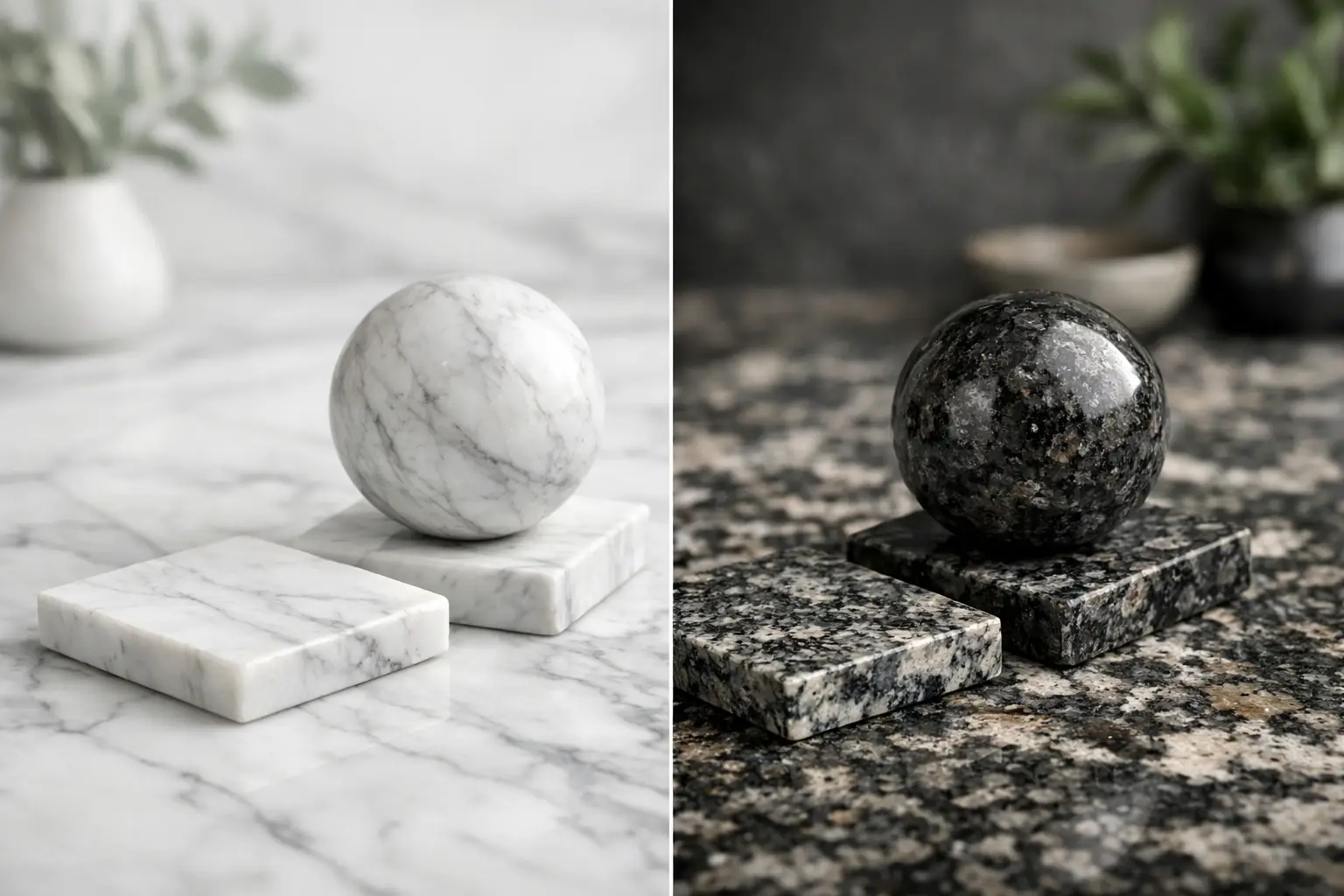
A pale marble hearth that catches the morning light and a deeply figured granite kitchen island may both be works of natural beauty, yet they ask very different things of a space. The question of marble versus granite is not simply about choosing a colour or a price point. It is about atmosphere, use, longevity and the particular story a material will tell over time.
For a private residence, hospitality setting, sacred building or historic restoration, the right choice begins with understanding the nature of the stone itself. Marble and granite are both enduring materials, but their appearance, structure and response to daily life are distinct. A considered selection allows architecture and material to speak with one voice.
Marble versus granite: two different characters
Marble is a metamorphic stone, formed when limestone is transformed by heat and pressure. Its characteristic veining is not a surface decoration but part of its geological history: a movement of minerals, compressed over immense time. This gives marble its exceptional depth. A honed white marble can feel quiet and luminous; a richly veined variety can become the focal point of an entire room.
Granite is an igneous stone, created through the gradual cooling of molten rock. Its composition often includes quartz, feldspar and mica, producing a crystalline, granular appearance. Where marble tends to offer flowing veins and soft tonal transitions, granite presents a more compact visual structure, often with mineral flashes and remarkable chromatic depth.
Neither is inherently more beautiful. Marble is chosen for its elegance, softness and classical association with sculpture and architecture. Granite is valued for its strength, visual density and confident presence. The decision rests on the intended mood. A marble bathroom may suggest a private spa or a historic palazzo; a dark granite reception desk can convey permanence, precision and contemporary gravitas.
Appearance: light, movement and scale
Marble has an unusual ability to receive light. Its surface can appear almost luminous, particularly in lighter varieties with a fine, open ground. Veins bring direction and rhythm, making it especially suited to bookmatched walls, grand staircases, fireplace surrounds and bathrooms where the stone can be appreciated as a continuous composition.
This expressive quality also calls for careful planning. Vein direction, slab layout and the relationship between adjoining pieces should be resolved before fabrication. In a bespoke project, the difference between a merely attractive result and a convincing architectural statement often lies in these decisions. The stone is not simply cut to fit; it is composed.
Granite usually has less linear movement, although certain varieties can be highly dramatic. It performs particularly well in larger uninterrupted surfaces, where its crystalline field becomes legible from a distance. Black, grey, green, blue and warm brown granites can anchor a scheme with considerable authority. A flamed granite external paving, for example, has a very different presence from a polished granite vanity, though both retain the material’s inherent density.
For interiors built around softness, light and decorative harmony, marble often takes the lead. For schemes requiring contrast, depth or a more mineral, architectural expression, granite can be the more persuasive choice.
Performance in daily use
The practical distinction matters most on surfaces that are touched, cleaned, heated, wetted or exposed to the weather.
Marble is generally softer and more porous than granite. It can be etched by acidic substances such as lemon juice, vinegar, wine and certain cleaning products. Etching is not always a stain: it is a change in the polish caused by acid reacting with the stone. On a highly polished marble worktop, this may appear as a dull mark. In a honed finish, it can be more discreet, becoming part of a gentle patina.
Granite is typically harder, denser and more resistant to scratching and heat. Properly sealed, it is usually more forgiving in kitchens with frequent food preparation and intensive family use. This makes granite a sound choice for worktops, utility rooms, outdoor kitchens and heavily used commercial counters.
Yet material performance should not be reduced to a simple scorecard. A marble kitchen worktop can be entirely appropriate for a client who appreciates natural ageing and accepts attentive care. Conversely, a pale granite may not suit every interior simply because it is technically resilient. The most successful specification brings together performance and sensibility.
Finishes alter the experience
Surface finish changes both the appearance and the behaviour of stone. Polished marble amplifies colour, vein and reflection, but may reveal etching more readily. Honed marble has a softer, more contemporary appearance and often accommodates the marks of use with greater grace.
Granite can be polished for a formal, reflective effect, honed for restraint, or textured for external paving and cladding. Flamed, bush-hammered and brushed finishes improve grip and give exterior areas a more tactile, weathered character. The right finish must respond to the setting, especially where water, foot traffic or frost are expected.
Care, ageing and the value of patina
Both materials benefit from professional sealing appropriate to the particular stone and finish. Sealing does not make natural stone indestructible, nor does it remove the need for considered daily care. It provides valuable protection by slowing absorption, allowing spills to be addressed promptly.
For marble, pH-neutral products and a soft cloth are the correct foundation. Abrasive powders, bleach and acidic cleaners should be avoided. Granite is more tolerant, but it too deserves non-aggressive care and periodic assessment of its protective treatment.
There is also a philosophical choice involved. Granite tends to retain a more uniform appearance under hard use. Marble records life more visibly. A faint softening around a basin, a subtle change near a dining table or the gentle wear of a stair tread can be seen as flaws, or as evidence of inhabitation. In heritage contexts, this patina is often part of the material’s dignity.
Clients seeking a pristine, highly controlled surface may prefer granite in demanding areas. Those drawn to the lived beauty of natural materials may find that marble becomes more meaningful with time.
Where each stone is most at home
Marble is especially compelling for bathrooms, feature walls, fireplaces, staircases, floor inlays, dining tables and decorative interiors. It remains one of the great materials for spaces intended to inspire pause: an entrance hall, a boutique suite, a chapel, a memorial or a finely detailed private dressing room. Its association with sculpture also makes it an exceptional choice where carved profiles, bas-relief or bespoke artistic work are required.
Granite is often specified for kitchen worktops, exterior paving, façades, thresholds, public areas and architectural elements subject to substantial wear. Its resistance and stability make it highly valuable in projects where durability cannot be compromised, including public buildings and commemorative works exposed to changing seasons.
These are not rigid boundaries. A carefully selected marble can serve beautifully in a kitchen, particularly with a honed finish and a client prepared to care for it. Certain granites, meanwhile, have enough visual refinement for the most elegant bathroom or living space. The material should be selected according to the exact variety, finish, thickness, detailing and intended use, rather than by category alone.
Craftsmanship determines the final result
A stone slab is only the beginning. Its true potential is realised through selection, cutting, finishing, edge work, reinforcement, installation and the careful resolution of joints. This is particularly important with marble, where vein matching can transform several pieces into a single visual gesture. With granite, precise fabrication allows a dense, strong material to appear unexpectedly refined.
For architectural coverings and floors, technical considerations are equally essential. Substrate preparation, movement joints, drainage, fixing systems, weight, slip resistance and exposure must be addressed from the earliest design stage. In restoration work, the process also requires respect for historic fabric, original proportions and the language of the existing building.
At Torchio Marmi, this understanding has been shaped by more than a century and a half of working with stone as both material and cultural inheritance. Whether the commission is an interior surface or a monument to memory, craftsmanship protects the design intention long after installation.
Choosing with confidence
Choose marble when its light, veining and expressive character are central to the desired atmosphere, and when a graceful patina is welcome. Choose granite when intensive use, exterior exposure or a more resistant working surface takes priority, without sacrificing natural distinction.
The most enduring projects do not ask which stone is universally better. They ask which stone belongs to this architecture, this landscape and this life. When material, proportion and skilled execution are brought into harmony, both marble and granite can become design at the service of dreams.