
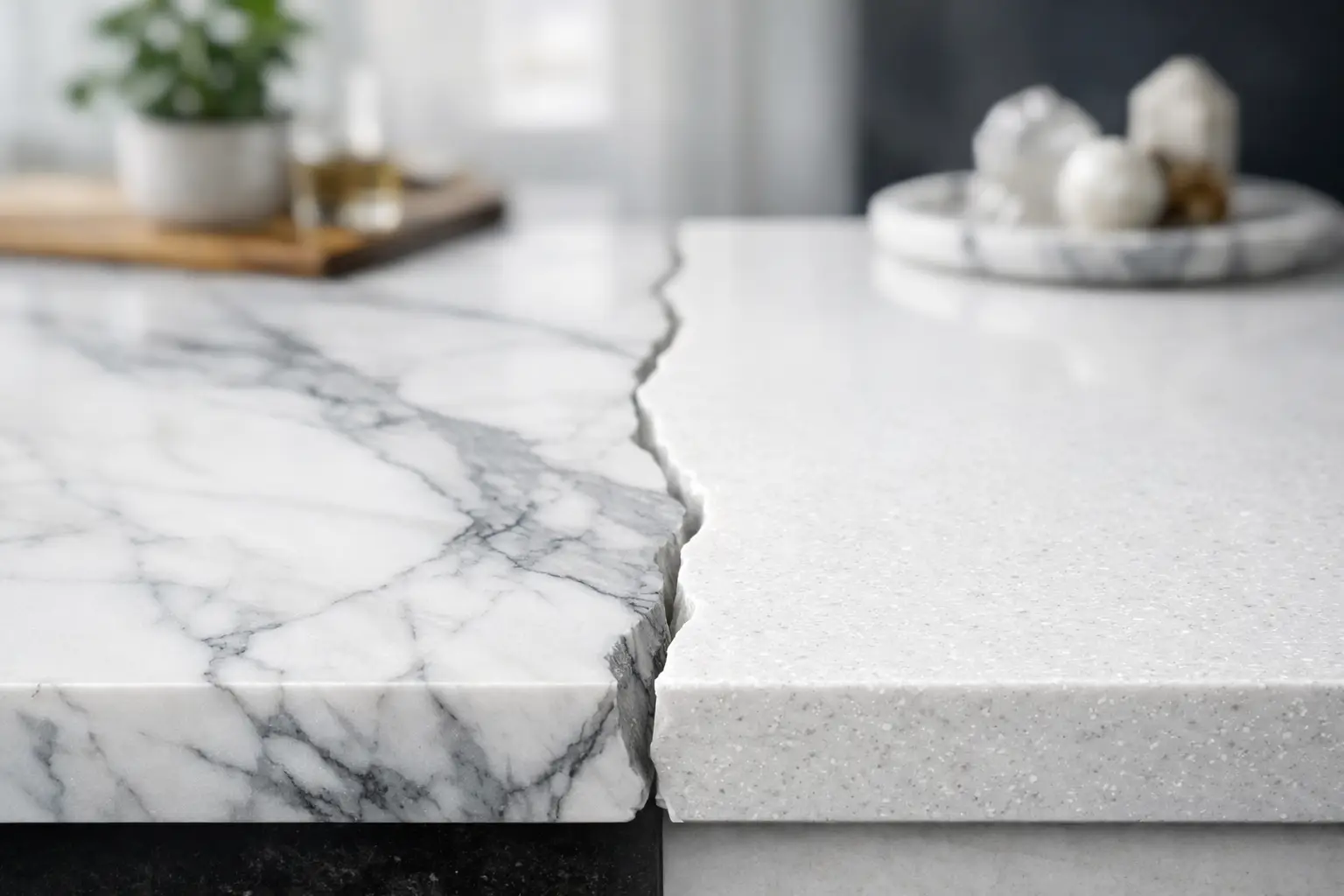
A worktop is never merely a horizontal plane. It receives the morning light, the weight of daily rituals, the warmth of a pan and the marks of a life lived at home. When considering marble versus quartz surfaces, the real choice is not simply between two attractive finishes. It is a decision about authenticity, atmosphere, maintenance and the kind of ageing one wishes to welcome into an interior.
For a tailored residence, a hospitality setting or a considered architectural scheme, both materials can perform beautifully. Yet they speak very different visual and material languages. Marble is shaped by geological time and carries a singular, unrepeatable presence. Quartz is engineered for consistency and practical resilience. Understanding where each excels allows the surface to serve the design rather than dictate it.
Marble versus quartz surfaces: two distinct characters
Marble is a natural stone, formed through immense pressure and heat. Its veining, tonal movement and occasional fossils or mineral variations are not defects to be corrected but evidence of its origin. A slab of Calacatta, Arabescato or Verde Alpi has its own composition, and even pieces drawn from the same quarry will not be identical. This individuality gives marble extraordinary depth, particularly across large kitchen islands, bathroom walls, fireplace surrounds and architectural floors.
Quartz surfaces are engineered materials, typically made from ground quartz combined with resins and pigments. The result is a stable, non-porous surface available in a broad range of colours and patterns. Some designs evoke the look of natural marble with impressive precision, while others embrace a more contemporary, uniform appearance. Their predictability can be valuable where a scheme requires controlled repetition across multiple rooms or properties.
The distinction is therefore philosophical as much as technical. Marble offers nature’s variation, movement and patina. Quartz offers a composed visual language, designed to remain consistent. Neither is inherently superior. The right choice depends on whether the project calls for the living expression of stone or the discipline of an engineered finish.
Beauty that changes, beauty that remains constant
Marble has a luminous quality that is difficult to reproduce. Light seems to enter its crystalline structure before returning softly to the room, giving pale stones a depth that photographs rarely capture. Honed finishes feel velvety and restrained; polished marble reflects light with ceremonial brilliance. In a heritage residence, a classical bathroom or an entrance designed to make a quiet impression, marble can establish an atmosphere of permanence and cultivated ease.
Its beauty also develops through use. With time, marble may acquire gentle etching around a basin, a softened area near a frequently used preparation space, or subtle changes in sheen. For some owners, this is a drawback. For others, it is precisely the point: the surface becomes personal, recording the passage of years much like aged timber, leather or brass.
Quartz generally holds its original appearance more steadily. It does not develop a traditional patina and its pattern remains visually consistent. This makes it especially appealing for busy family kitchens, rental properties, polished hospitality interiors and projects where the client expects a uniform finish over time. However, a marble-effect quartz surface should not be selected on the assumption that it will offer the same visual depth as a natural slab. It can suggest marble’s graphic movement, but it does not possess the same geological variation or translucency.
Daily use, staining and etching
The practical conversation begins with porosity and chemical sensitivity. Marble is calcareous, which means acidic substances such as lemon juice, vinegar, wine and certain cleaning products can etch its surface. Etching is not always a stain. It is a change in the finish, often seen as a duller or lighter mark on polished stone. Red wine, oil and strongly coloured foods may also stain if they are left unattended, particularly on inadequately protected marble.
A professionally applied sealer helps reduce absorption, but it does not make marble invulnerable. It must be renewed at suitable intervals according to the stone, finish and intensity of use. Day-to-day care is uncomplicated: wipe spills promptly, use a pH-neutral cleaner and avoid abrasive pads or aggressive household chemicals. The discipline lies in accepting that natural stone deserves informed care.
Quartz is non-porous and normally requires no sealing. It resists everyday staining extremely well, making it a reassuring choice around coffee, sauces, cosmetics and children’s craft materials. For many households, this reduced maintenance is decisive. Yet quartz is not maintenance-free. Strong chemicals, abrasive products and prolonged exposure to certain dyes can still compromise the surface or its resin binders.
For a kitchen used intensively for cooking with citrus, tomatoes and wine, quartz may offer greater peace of mind. For a kitchen where the island is conceived as a centrepiece and the owners appreciate natural materials that mature, marble can be entirely appropriate, provided its care is understood from the beginning.
Heat, impact and fabrication details
Marble tolerates heat well in principle, but direct contact with very hot cookware is not advisable. Rapid temperature changes can stress the stone, and polished finishes may be affected. Quartz is also vulnerable to excessive heat because its resin content can discolour, scorch or crack under a hot pan. Trivets are sensible for both materials.
In relation to scratching and impact, quartz is generally harder and more resistant to daily abrasion than marble. Marble can scratch, especially near work areas, although honing can make fine marks less conspicuous. Quartz can chip at exposed edges if subjected to a sharp impact, just as marble can. Edge profiles, support, junctions and cut-outs are therefore as important as the material itself.
This is where bespoke fabrication becomes essential. A long, finely proportioned marble island demands careful slab selection so that veining flows with intention. It also requires considered reinforcement around hobs, sinks and overhangs. Quartz benefits from equal precision, particularly where mitred edges, integrated splashbacks or large-format panels must meet with crisp alignment. Fine material deserves fine detailing, whatever its composition.
Where each material belongs
Marble is especially compelling in spaces where sensory richness has priority: a powder room with book-matched walls, a fireplace that anchors a drawing room, a dramatic reception floor or a vanity designed as a sculptural object. It is also a natural choice when working within historic architecture, where authentic stone can converse with existing plasterwork, joinery and ornament without feeling imposed.
Quartz is particularly suited to hard-working kitchen worktops, utility rooms, breakfast areas and commercial environments that need dependable stain resistance and visual order. It can also be a thoughtful choice in a minimalist interior where broad, uninterrupted surfaces and restrained tonality are central to the scheme.
There are projects in which the most refined answer is to use both. Marble might shape the island, dining table or feature wall, where its veining can be appreciated at leisure, while quartz serves the more demanding preparation zone. This is not a compromise. It is a material strategy, allowing each surface to perform the role for which it is best suited.
Cost, value and the long view
Prices vary widely for both marble and quartz according to source, rarity, slab thickness, layout, fabrication complexity and installation conditions. It is misleading to assume that one is always the more expensive option. Rare marbles and intricate book-matching can command substantial investment, while premium quartz installations with elaborate detailing may also carry significant cost.
The more useful question concerns value over time. Quartz offers durability, consistency and lower routine maintenance. Marble offers rarity, repairability in skilled hands and a material presence that can deepen the identity of a property. A carefully chosen stone surface can outlive changing fashions because it was never designed as a fashion in the first place.
For a bespoke project, selection should begin with full slabs, not small samples alone. View them in changing light, discuss the intended finish and decide where movement, joints and edges will fall. At Torchio Marmi, this attention to material, proportion and execution is part of treating every surface as an architectural element rather than a standard product.
Choose quartz when ease of care and consistency will allow the household or project to function freely. Choose marble when its natural variation, quiet luminosity and evolving character are qualities to be cherished. The most enduring surface is the one whose beauty and practical demands are understood before the first stone is cut.