
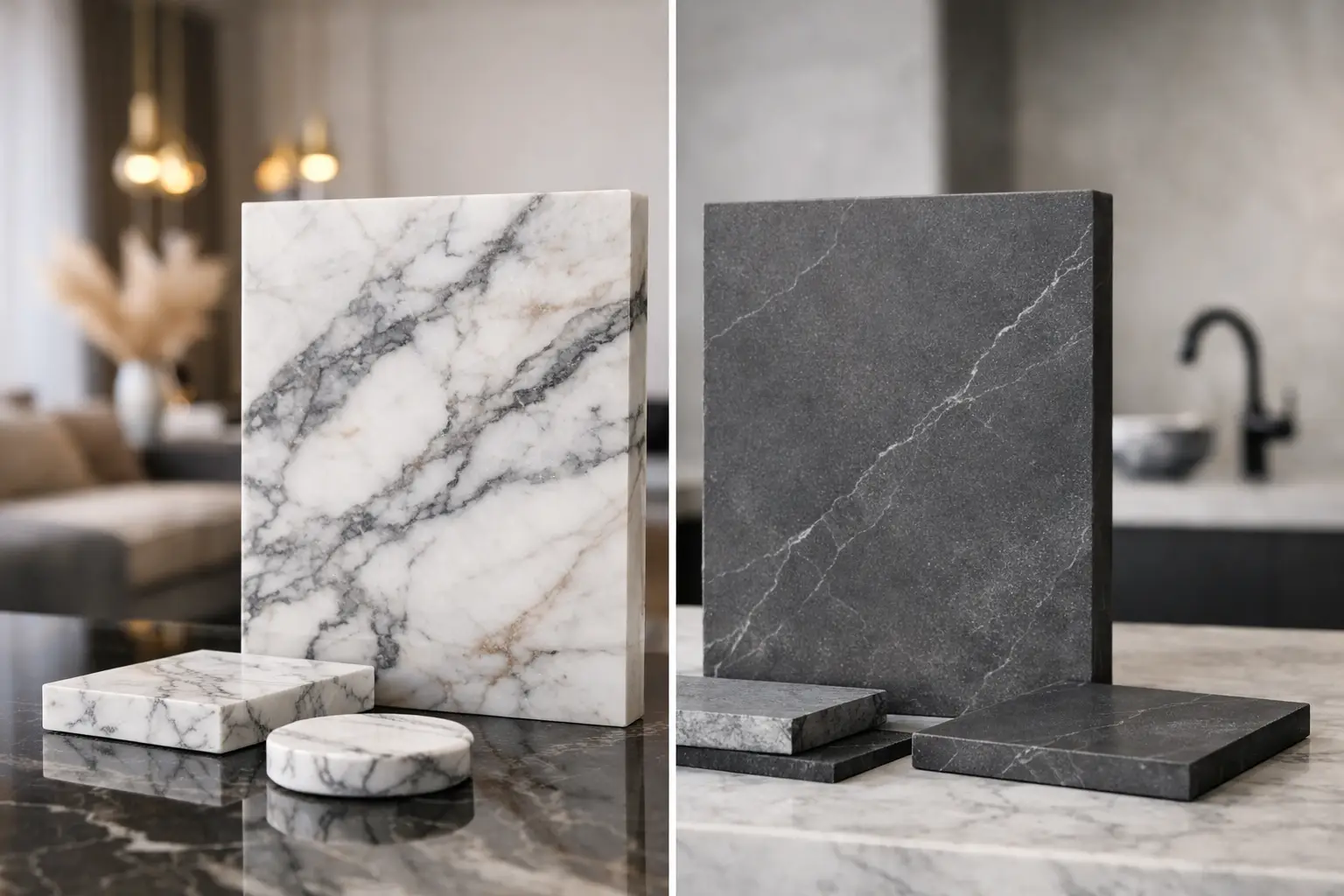
A kitchen island is not merely a worktop. A bathroom wall is not simply a waterproof finish. In a considered interior, each surface carries light, touch, proportion and memory. The choice of marble versus sintered stone therefore asks more than which material is easiest to maintain. It asks what kind of atmosphere a home, hotel or public space should hold for decades to come.
Marble and sintered stone can both create exceptional interiors, yet they belong to very different material traditions. One is formed patiently within the earth and marked by geological time. The other is a highly engineered surface, designed for consistency and demanding everyday performance. Neither is universally superior. The right choice depends on the architecture, the use of the room, the expected level of care and the emotional role the surface must play.
Marble versus sintered stone: two distinct characters
Marble is a natural metamorphic stone. Its veining, crystallisation and tonal movement arise from mineral composition and pressure over millions of years. No two blocks are identical, and no two slabs repeat precisely. That singularity is marble's great distinction: a room finished in Calacatta, Arabescato, Verde Alpi or Nero Marquina possesses a visual identity that cannot be reproduced in full.
Sintered stone is manufactured from natural minerals, often including quartz, clays and feldspar, compacted and fired at very high temperatures. The process produces large-format slabs with low porosity and dependable technical characteristics. Its appearance may be inspired by marble, concrete, metal or other materials, but its pattern is created rather than quarried.
This difference matters beyond appearance. Marble brings depth that shifts with the daylight, fine variations in ground colour and veins that can be selected and composed as part of the design. Sintered stone brings visual control. Where a project calls for a particular pattern repeated across several flats, suites or commercial areas, its consistency can be a considerable advantage.
The case for natural marble
Marble has remained central to Italian architecture because it rewards attention. A carefully chosen slab can make a reception desk feel sculptural, give a fireplace its rightful presence, or turn a bathroom into a private room of calm and ceremony. Its surface has luminosity rather than mere shine. Even honed marble, with its soft and restrained finish, carries a depth that printed or uniform materials rarely match.
For bespoke work, marble offers extraordinary compositional freedom. Veins can be bookmatched to create mirrored movement; quieter sections can be reserved for large fields; more expressive areas can become a basin front, shower wall or table top. Edges may be shaped, moulded or mitred, and the material can be paired with bronze, timber, glass and finely finished metalwork.
Marble also possesses a long future. It can often be cleaned, repolished, filled, repaired or re-honed. A surface that acquires marks through use is not necessarily spent. With specialist judgement, it may be restored while preserving the character that time has given it. This reparability is especially meaningful in heritage properties and in homes intended to pass between generations.
Yet natural marble is not indifferent to daily life. Many varieties are sensitive to acidic liquids such as lemon juice, wine and vinegar, which can etch a polished surface. Oils and strongly coloured substances may stain if left unattended. It can scratch, chip at vulnerable edges and develop a patina. A sealant helps reduce absorption, but it does not make marble invulnerable.
For some clients, these qualities are a reason to choose marble, not avoid it. They accept the small traces of living as part of an honest material. Others prefer marble on vertical surfaces, fireplaces, vanity tops or less intensive furniture pieces, while choosing a more resistant surface for the busiest kitchen zones.
Marble is at its most persuasive when
Marble is particularly suited to projects where individuality, material authenticity and visual drama are central. It excels in entrance halls, feature walls, staircases, fireplaces, bathrooms, dining tables, bespoke furniture and carefully used kitchen islands. It is also the natural language of many restoration projects, where historical integrity cannot be substituted by a contemporary imitation.
Its success depends on selection and fabrication. Not every marble is appropriate for every purpose, and not every finish should be polished. A honed finish may soften the visibility of etching, while a well-designed edge profile can reduce the risk of accidental damage. The most graceful result is usually the one in which the stone's nature has been respected from the first drawing.
The case for sintered stone
Sintered stone answers a different set of priorities. Its low water absorption and resistance to many stains make it attractive for family kitchens, hospitality interiors and highly used bathrooms. It generally copes well with heat, ultraviolet light and ordinary household cleaning, making it suitable for outdoor kitchens and sunlit spaces where colour stability matters.
For a kitchen worktop that will meet frequent cooking, hurried breakfasts and occasional spills, sintered stone can provide welcome assurance. Its technical properties also allow for very thin profiles, large uninterrupted panels and a precise, architectural appearance. A substantial island may be given an elegant visual lightness, while wall cladding can be continued with discreet joints.
The material should not, however, be described as maintenance-free or indestructible. Although it is highly scratch-resistant, the surface and especially its edges can chip under a sharp impact. Repairs can be more difficult to disguise than on natural stone, depending on the pattern and damage. Fabrication requires specialised equipment and expertise, particularly for cut-outs, drainer grooves, mitred edges and large-format installations.
There is also an aesthetic consideration. Marble-effect sintered stone can be exceptionally convincing at a distance and is often beautifully resolved. Under close scrutiny, however, a repeated design or a surface-only pattern may reveal its manufactured origin. For a project seeking the quiet perfection of repetition, this is no disadvantage. For one seeking geological depth and an unrepeatable composition, it may be decisive.
Sintered stone is at its most persuasive when
Choose sintered stone when practical resilience must lead the brief: a hard-working kitchen, a rental property, a busy family home, a restaurant washroom or an exterior entertaining area. It is also valuable where visual uniformity across extensive areas is required, or where a large project needs dependable coordination between many slabs.
The best installations still require careful design. Joints should be planned rather than hidden as an afterthought, support should be engineered correctly, and the relationship between slab pattern, cabinets and architectural lines should be resolved before fabrication begins. A technically advanced material deserves the same precision as a rare natural stone.
How use, light and care should guide the choice
The most useful question is not, “Which surface is better?” It is, “What must this surface endure, and what should it make people feel?” A formal guest bathroom may be the perfect setting for expressive marble, while a heavily used utility room may benefit from sintered stone. A country house kitchen can accommodate marble if its owners value patina and understand care. A coastal outdoor kitchen will often be more comfortable with sintered stone because of sun, food preparation and constant exposure.
Light also changes the decision. Natural marble has a particular relationship with daylight and warm artificial illumination: its crystalline structure can give even a pale surface a gentle internal vitality. Sintered stone offers greater predictability, which can be useful where an interior scheme relies on exact tonal coordination with lacquer, timber or textiles.
Budget should be assessed as a whole, rather than by slab price alone. The final cost of either material depends on slab yield, thickness, edge work, cut-outs, reinforcement, transport, access, installation and the complexity of the design. A simple surface in an expensive stone may cost less than a technically demanding sintered-stone installation with intricate mitres and extensive cladding.
A material decision deserves craftsmanship
Whether the project calls for marble or sintered stone, the decisive work often happens before the material reaches site. Slabs must be inspected, their movement mapped, templates measured precisely and details considered at full scale. The junction between a splashback and worktop, the alignment of veins at a corner, the fall around a basin and the thickness of an edge can determine whether a surface feels ordinary or inevitable.
At Torchio Marmi, this approach has been shaped by generations of working with natural stone in private interiors, civic spaces and works of restoration. Material knowledge is not simply the ability to name a stone or specify a finish. It is the ability to anticipate how that material will behave, age and belong within a particular architecture.
A marble surface may ask for a little more attention, then repay it with a beauty that becomes more personal over time. A sintered-stone surface may offer reassuring resistance, then reward a disciplined design with calm continuity. Choose the material whose character belongs to the life of the space, and give it the care in design and making that allows it to endure.