
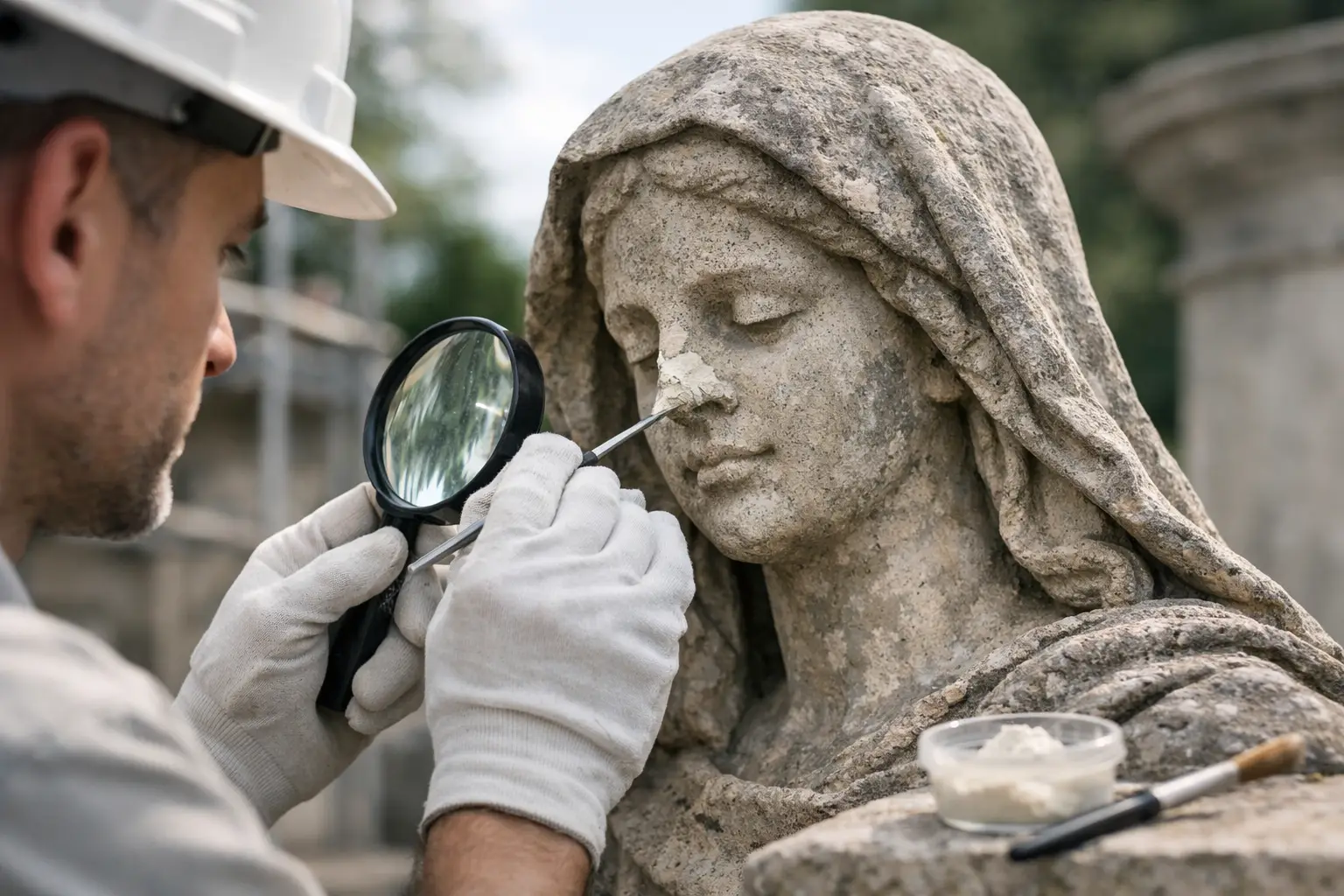
A fractured inscription, a darkened marble angel or a plinth settling out of level may appear to be isolated defects. Often, they are visible signs of a longer story: water entering through an open joint, salts crystallising beneath the surface, unsuitable cement repairs trapping moisture, or decades of pollution obscuring the stone's original character. Restoring damaged stone monuments is therefore not a matter of making age disappear. It is the patient work of protecting a monument's material truth, its dignity and the memory it carries.
For a family memorial, a cemetery monument, a church sculpture or a civic landmark, restoration begins with respect. Stone has its own structure, porosity, veining and response to weather. Each intervention must be proportionate to the damage, technically sound and visually discreet enough to preserve the work as a coherent whole.
Why stone monuments deteriorate
Natural stone is enduring, but it is never inert. Marble, limestone, granite and sandstone each respond differently to rain, frost, airborne pollutants, biological growth and changing ground conditions. A monument may withstand generations of weather, then begin to fail quickly when water finds a path behind an inscription panel or into a fine structural crack.
Marble and limestone are particularly vulnerable to acidic deposition and repeated wetting and drying. Their polished surfaces may lose clarity, while carved details soften gradually. Granite is generally more resistant, yet joints can open, metal fixings can corrode and the foundation beneath can move. Travertine may show surface loss around its natural voids if repairs or cleaning methods are poorly chosen.
Human intervention can be as damaging as time. Aggressive pressure washing, acidic cleaners, wire brushes and hard cement mortars can remove the protective surface of stone or create a repair that is stronger than the original material. When that happens, moisture is forced into the surrounding stone, where it can cause fresh cracking, flaking or staining.
Restoring damaged stone monuments begins with diagnosis
Before any repair is considered, the monument must be read closely. This means identifying the stone, recording its condition and distinguishing superficial soiling from active decay. A dark area may be atmospheric staining, biological growth or moisture held behind the face. A crack may be stable, or it may indicate movement in the base that will compromise every cosmetic repair placed above it.
A careful condition assessment considers the monument as a complete construction. The specialist examines the foundation and plinth, the alignment of separate elements, joints and fixings, inscriptions, carved decoration, previous repairs and the condition of any bronze, steel or lead components. Photographic records and measured observations create a reliable reference point before work begins.
This stage also determines what should remain untouched. The patina formed by age is not automatically damage. On a historic monument, gentle evidence of time can contribute to authenticity and atmosphere. The aim is not to produce a newly quarried appearance, but to arrest deterioration while retaining the presence that gives the work its meaning.
Cleaning is a conservation decision
Cleaning can transform a monument, but it must never be approached as routine maintenance. The chosen method depends on the stone, the type of deposit and the desired finish. Low-pressure water, carefully selected poultices or controlled mechanical cleaning may be appropriate in certain cases. Each should be tested on a small, inconspicuous area first.
The objective is to remove harmful or disfiguring material without opening the stone's surface, bleaching its natural colour or erasing delicate tool marks. A white marble memorial need not be made brilliantly white to be cared for properly. Its veining, warmth and age should remain visible.
Compatible materials preserve the monument
A repair is successful only when it works with the original stone. This principle guides the selection of replacement sections, mortars, dowels, adhesives and surface finishes. The colour of a new marble insert matters, but so do grain direction, mineral composition, density and weathering behaviour. A close visual match that responds differently to moisture may become conspicuous and unstable over time.
Where material has been lost, a new piece may be carved from compatible stone and fitted with minimal intervention to the surrounding fabric. Small losses can sometimes be carefully filled with a breathable, colour-matched restoration mortar. The appropriate solution depends on the scale of loss, its structural significance and the monument's heritage value.
Traditional lime-based mortars are often preferable to dense cementitious products because they accommodate slight movement and allow moisture to evaporate. Corroded iron pins or cramps may require replacement with suitable non-ferrous or stainless-steel fixings, selected and installed to avoid staining and stress within the stone. These details are rarely visible once work is complete, yet they often decide whether a restoration endures.
Inscriptions and carved details require restraint
Names, dates, coats of arms and sacred motifs are often the most emotionally significant elements of a monument. Their restoration calls for particular restraint. Recutting letters can restore legibility, but it can also alter the hand, depth and rhythm of an original inscription if undertaken without skill. In some cases, cleaning and subtle consolidation are sufficient; in others, lettering may be renewed by a specialist who understands historic forms.
The same judgement applies to sculptural features. A broken hand, flower, cross or portrait medallion may be reassembled, pinned and integrated where enough original material remains. Recreating an entirely missing feature is a more complex decision. It should be guided by reliable evidence, the significance of the monument and a clear understanding of where conservation ends and reconstruction begins.
Structural stability comes before surface beauty
A monument that leans, rocks or shows separating joints should not simply be repointed and polished. The underlying cause must be resolved first. Roots, poor drainage, settlement, frost heave and inadequate foundations can all compromise stability. In cemetery settings, movement may be gradual and difficult to notice until a heavy headstone becomes unsafe.
Careful dismantling may be necessary when elements have shifted or fractured beyond safe in-situ repair. Each component is documented, lifted with suitable protection, repaired where required and reassembled on a prepared foundation. This work demands both engineering awareness and sensitivity to the monument's original construction. A perfectly repaired statue placed back on an unstable base has not been restored.
For prominent public, religious or historic sites, restoration may also involve heritage permissions, phased programmes and coordination with architects, conservators and site managers. The finest result is achieved when craftsmanship is part of this wider discipline, rather than an isolated finishing operation.
A tailored approach to memorial restoration
No two monuments ask the same question of the restorer. A nineteenth-century Carrara marble memorial in a sheltered chapel will need a different approach from a granite graveside monument exposed to northern winters, or a civic stonework scheme affected by urban pollution. Cost, programme and visual ambition matter, but they should follow a realistic understanding of condition and risk.
At Torchio Marmi, a heritage of stone craftsmanship informs an approach in which material knowledge and artistic judgement remain inseparable. The work may involve selecting marble with the right character, repairing a fractured architectural element, renewing an inscription or restoring the quiet balance of a funerary monument. In every case, the goal is to respect what already exists while giving it the strength to remain present.
Care after restoration
Restoration is not the final act of care. Periodic inspection can identify open joints, staining, biological growth or foundation movement before damage becomes extensive. Gentle cleaning at appropriate intervals, sound drainage and prompt attention to minor defects are usually more valuable than infrequent, dramatic intervention.
Avoid household cleaners, sealants and improvised repairs unless they have been specified for the exact stone and condition. A product intended to create shine can leave residues, change the surface appearance or prevent the material from breathing. When uncertainty arises, a specialist assessment is the more prudent choice.
A stone monument does more than occupy a place. It holds names, beliefs, affection and the visible trace of a particular time. Treated with patience, compatible materials and skilled hands, it can continue to speak with clarity - not as something made new, but as a monument to memory, carried forward with grace.