
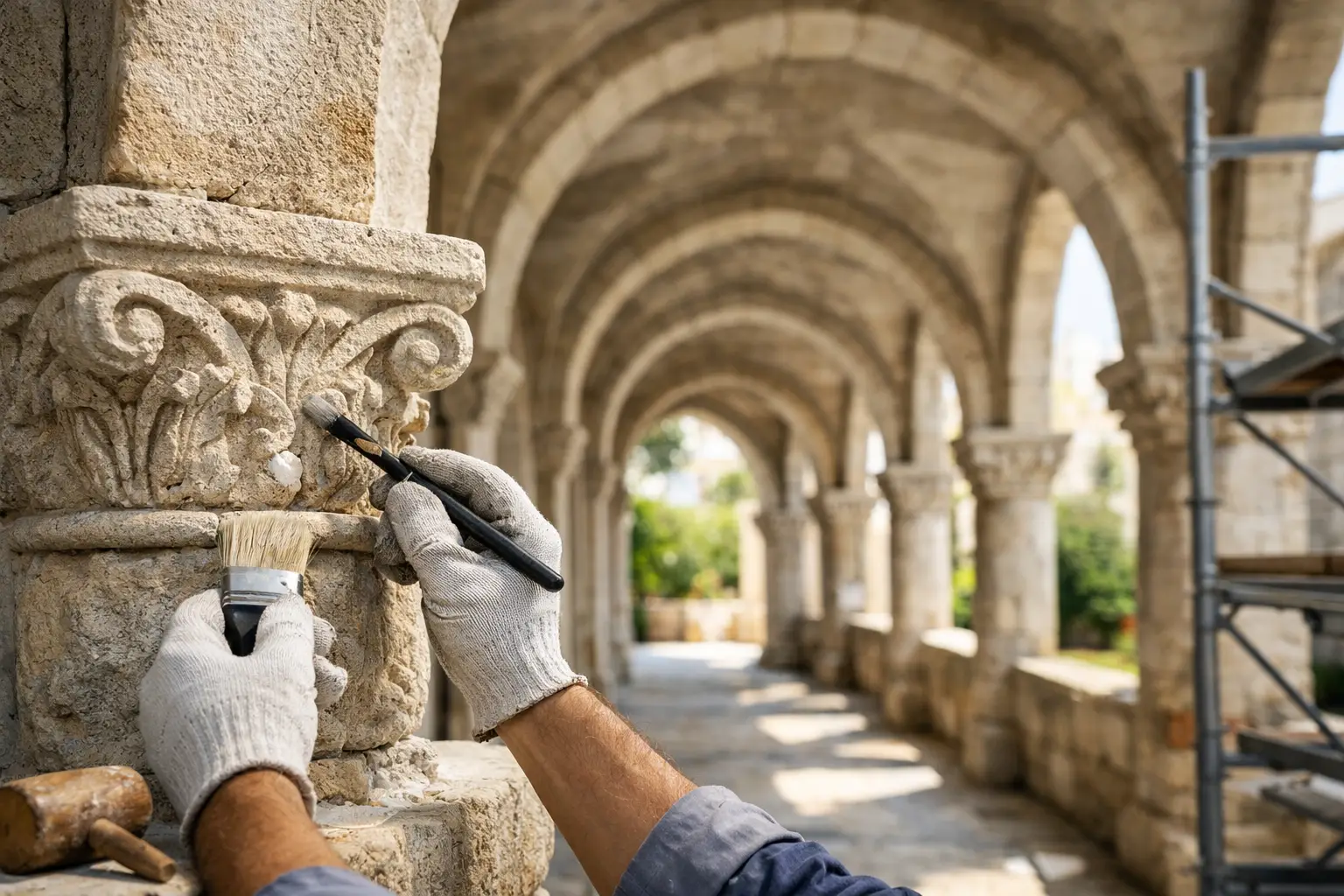
An arcade is never merely a succession of arches. Its rhythm directs the eye, creates shelter and shade, frames a piazza or cloister, and gives a building its public character. Stone arcade restoration must therefore address more than damaged surfaces. It is the careful recovery of proportion, material truth and accumulated memory, so that each bay continues to belong to the whole.
For historic estates, sacred buildings and civic architecture, this work calls for restraint as much as skill. The most successful intervention does not advertise itself from across the square. It restores confidence to the structure, clarity to the stone and dignity to the place.
Why stone arcades require a different approach
Arcades concentrate several architectural forces within a relatively slender construction. Columns or piers carry the thrust of the arches; capitals, imposts and mouldings transfer loads while defining the visual cadence. At ground level, repeated contact, rising damp and winter salts often affect the bases first. Above, open joints, failed flashings or defective roof drainage can admit water directly into the masonry.
This means that a visible crack may be only one expression of a deeper problem. Stone loss around a capital may arise from persistent water run-off. A powdering plinth may point to moisture retained behind impermeable past repairs. An arch that appears settled can be stable, or it can be moving under altered loading. The distinction matters.
Restoration begins with an understanding of the arcade as a system. Its geology, construction sequence, structural behaviour, exposure and former repairs must be read together. Replacing a damaged block without resolving the water path that damaged it risks repeating the failure in a more expensive form.
Reading the stone before any intervention
The first task is patient observation. A close survey records the type of stone, the profile of each element, mortar composition, joint widths, tool marks, decorative details and previous campaigns of work. Historical photographs and drawings, where available, can reveal lost cornices, altered paving levels or changes to drainage that the building itself no longer explains.
Material identification is equally decisive. Limestone, sandstone, granite, marble and travertine do not weather in the same way, nor should they be cleaned or repaired by the same method. Some stones develop an honourable patina that should be protected; others fracture along bedding planes or suffer granular decay after repeated wetting and drying. Matching colour alone is insufficient. Density, porosity, grain, mineral composition and direction of bedding influence how a replacement will perform over decades.
A detailed condition survey should separate superficial soiling from active decay. It should also identify structural cracks, biological growth, cement-rich pointing, corroding metal cramps, salt efflorescence and poorly considered patch repairs. In an arcade, repetition can be deceptive: one pier may have been rebuilt, another may sit on different ground, and a third may receive far more rain than its neighbours.
The value of a measured diagnosis
The temptation to begin with cleaning is understandable. Darkened stone can make an arcade appear neglected, yet aggressive cleaning may erase the very surface that carries its age and character. Likewise, a bright new insert can disturb a façade that needs repair but not visual uniformity.
A measured diagnosis establishes what should remain untouched, what can be conserved and what genuinely requires renewal. It also makes the scope clearer for heritage authorities, designers and property owners. Good restoration is not a catalogue of treatments. It is a sequence of decisions supported by evidence.
Repairing structure without losing character
When an arcade is structurally compromised, the work may involve temporary support, local dismantling, discreet reinforcement or the replacement of individual voussoirs, bases and capitals. Each option carries a different balance of intervention, durability and visual impact.
Where stone can be retained safely, conservation is generally preferable to replacement. Fine fractures may be stabilised, edges repaired with carefully formulated mineral mortars, and open joints repointed with breathable lime-based mortar appropriate to the original fabric. These repairs allow the masonry to manage moisture in a manner closer to its historic behaviour.
Where a stone element has lost its structural role or its decorative profile beyond credible repair, a new piece may be necessary. The replacement should be selected and worked as part of the architectural composition, not treated as a generic unit. The quarry source, grain direction, hand-finished profile and jointing method all contribute to whether the new stone settles naturally into the arcade over time.
There are occasions when discreet modern reinforcement is justified, particularly where public safety, seismic requirements or concealed corrosion demand it. Such measures should be designed to remain compatible with the historic fabric and, where feasible, reversible or inspectable. Stronger is not always better. An excessively rigid repair can transfer stress into older, more vulnerable stone.
The craft lies in proportion and finish
An arch is recognised not only by its span but by the precision of its geometry. Slight changes to the springing line, the width of a joint or the projection of an impost can disrupt the measured rhythm of an entire elevation. This is why hand setting and careful templating remain central to stone arcade restoration.
The same attention applies to surfaces. A too-smooth finish can make an ancient repair appear artificial; a finish that is too rough may catch dirt and weather differently. Mason marks, traces of chisels and softened edges often deserve preservation because they reveal the making of the original work. New additions need not imitate every mark, but they should speak the same material language.
Torchio Marmi approaches such work with the awareness that stone is both construction and expression. The workshop process, from selecting material through cutting, carving and final fitting, must remain connected to the conditions of the site. An elegant profile drawn in the studio is only complete when it sits correctly beneath the arch, receives the light well and resolves the practical details of water and movement.
Moisture, salts and the details that protect an arcade
Many restoration failures begin at the margins: a blocked gully, a hard cement joint, a poorly sloped paving repair or a metal fixing that has expanded with corrosion. These details can be modest in scale but decisive in effect.
Water management deserves early attention. Roof outlets, leadwork, flashing, paving falls and drainage channels should be considered alongside the stone repairs, not after them. If rainwater is allowed to cascade over a capital or stand at the foot of a pier, even the finest replacement stone will be asked to endure conditions it was never meant to bear.
Salt is another persistent concern, especially in arcades close to the ground or exposed to de-icing treatments. Salts travel with moisture and crystallise within pores as water evaporates. The resulting pressure can force the stone surface away in flakes or powder. Treatment depends on the source of moisture and the type of salt; cosmetic coatings that trap damp often worsen the condition. Breathability is not a fashionable preference in historic masonry. It is a practical requirement.
Choosing continuity over false perfection
Owners sometimes hope a restoration will make an arcade look newly built. Yet an arcade of genuine age should not be stripped of every sign of time. The aim is continuity: sound stone, legible form, coherent colour and a surface that retains the atmosphere of the place.
This does not mean accepting avoidable deterioration. It means distinguishing between patina and damage, between a repair that supports the history of the building and one that overwhelms it. In a monastic cloister, a civic portico or the courtyard of a private palazzo, the right degree of renewal depends on use, significance, exposure and the condition of the existing fabric.
A considered programme also recognises that restoration has a life beyond handover. Gentle cleaning, inspection of rainwater goods, monitoring of cracks and prompt repointing where needed are modest acts of stewardship. They protect the investment in craftsmanship and reduce the likelihood of disruptive future work.
An arcade endures because every arch relies on its neighbour. Treat its restoration in the same spirit: with the architect, conservator, stoneworker and custodian working from a shared understanding of what must be preserved. The result can offer more than repaired masonry. It can return a living threshold to the building, ready to shelter another generation of footsteps, conversation and memory.