
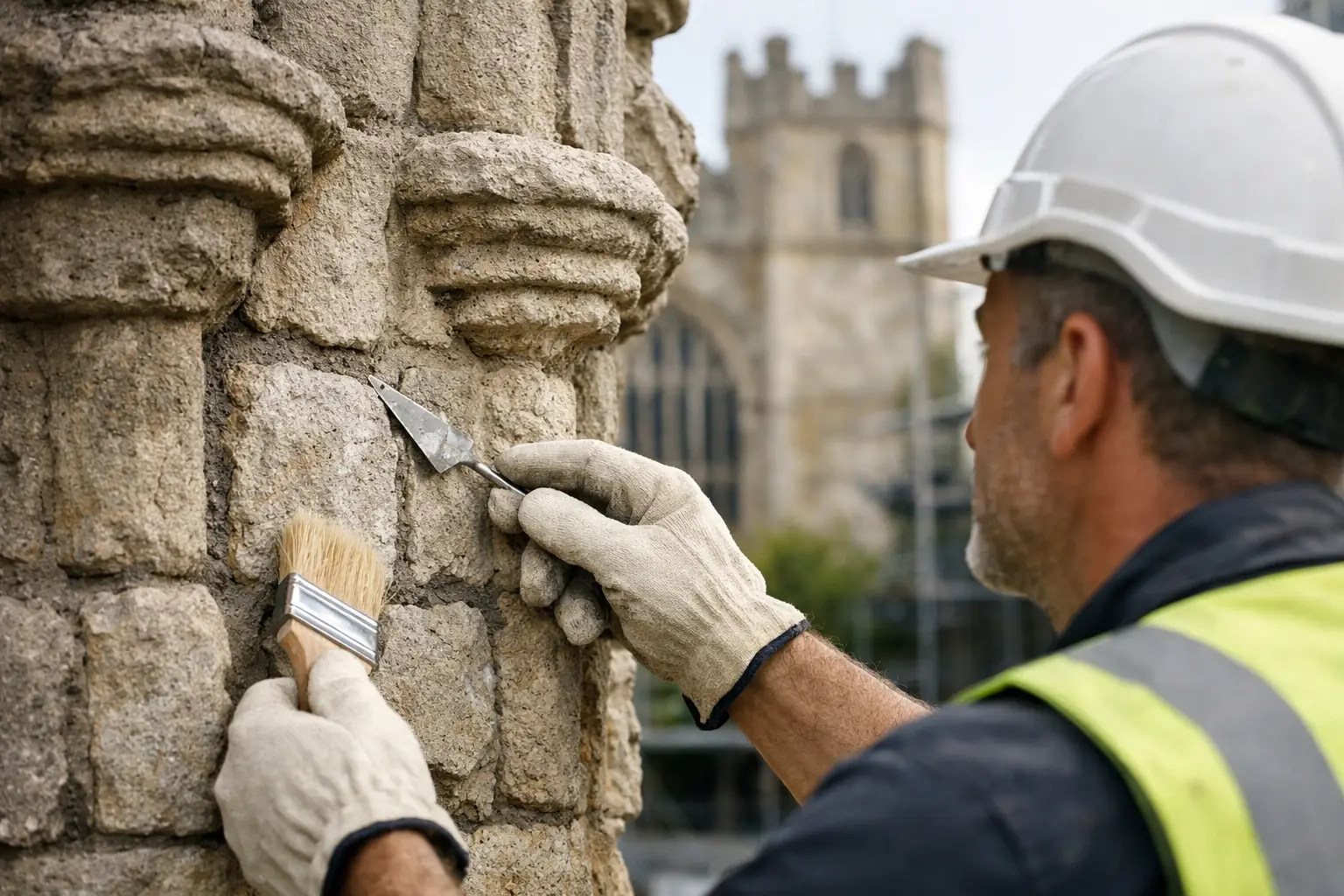
A weathered cornice, a stained limestone plinth or a marble threshold hollowed by generations of footsteps can appear to need urgent renewal. Yet stone conservation for listed buildings begins with a more disciplined question: what must be retained, and what is the true cause of change? The answer is rarely found in a single visit or a catalogue of modern treatments. It lies in reading the building as a whole - its geology, construction, setting, repairs and use over time.
For a listed property, stone is not simply a finish. It carries the hand of its maker, the evidence of regional craft and the quiet patina that gives an elevation or interior its authority. Conservation must protect this accumulated meaning while ensuring that the fabric can continue to perform.
Why original stone deserves restraint
The instinct to replace visibly damaged stone can be understandable, particularly where a façade has become discoloured or a carved element appears fragile. However, age is not failure. Surface variation, softened arrises and historic tooling marks are often integral to the character and significance of a building.
Replacement can also introduce unforeseen problems. A new block may be technically sound yet too dense, too pale or too sharply cut beside surviving work. It may weather differently, disrupt moisture movement or erase evidence of an earlier construction phase. The most successful interventions usually retain as much authentic material as possible, repairing only where loss has compromised stability, weathering or legibility.
This does not mean that every fragment must remain. Severely fractured stone, failed cement repairs and elements damaged beyond secure repair may require carefully judged replacement. The principle is proportion: intervene as little as necessary, but as much as is needed for the building's future.
Stone conservation for listed buildings starts with diagnosis
Before specifying a mortar, cleaning method or replacement stone, a conservator must understand the material. “Stone” is a broad term. Portland limestone, sandstone, Carrara marble, granite and travertine have distinct mineral structures, porosity, strength and responses to water, salts and pollution. Even within one quarry source, beds can vary considerably.
A proper survey records the pattern of decay rather than merely its location. Is erosion concentrated beneath defective gutters? Is a pale crust protecting softer stone beneath it? Are cracks structural, thermal or the result of rusting iron fixings? Is damp entering through open joints, hard cement pointing, an impermeable coating or defective drainage at ground level?
Moisture is frequently the central issue. Water carries soluble salts through masonry; as it evaporates, crystallisation can force the stone surface apart. Repointing with an overly hard, dense mortar may prevent a wall from releasing moisture through its joints, directing damage into the masonry units instead. For this reason, diagnosis should consider roofs, flashings, rainwater goods, ground levels and adjacent repairs, not just the visible face of the stone.
Historic drawings, photographs and close visual inspection can reveal earlier alterations. Where the decision is consequential, petrographic analysis, salt testing and mortar analysis may be justified. These investigations are not academic ornament. They prevent well-intentioned work from becoming an expensive second problem.
Repair before replacement
Conservation work is often most convincing when it is barely noticed. Fine cracks may be stabilised with discreet pinning or carefully selected grout. Localised losses can sometimes be repaired with colour-matched mineral mortar, shaped and tooled to respect the surrounding surface. Open joints may be repointed using a breathable lime-based mortar formulated for the particular masonry.
Where a stone is decayed only at its outer face, indent repair can preserve the sound body behind it. A skilled stonemason cuts back only to firm material, selects a compatible matching stone and forms an insertion with joints placed to follow architectural lines. The repair should not pretend to be untouched original fabric, but neither should it announce itself as an interruption. Its scale, bedding direction, texture and finish must belong to the composition.
Complete replacement is appropriate when an element has lost structural integrity, presents a safety risk or can no longer shed water as designed. In such cases, the choice of replacement stone matters as much as the carving. A visual match alone is insufficient. The new material should have compatible physical behaviour, including porosity, strength and resistance to the local climate.
Cleaning is a decision, not a cosmetic exercise
Few conservation choices are more easily misunderstood than cleaning. Darkened stone can obscure carved detail and retain damaging deposits, but it can also form part of the building's historic appearance. An aggressively brightened façade may look newly completed while losing the visual depth that time has created.
Cleaning should therefore have a stated purpose: to remove harmful crusts, reduce staining caused by a known source, reveal details necessary for repair, or improve the performance of the fabric. The least invasive effective method should be tested first in small, discreet areas. Water, controlled steam, soft brushes, poultices and carefully chosen chemical systems each have a place, depending on the stone and contaminant.
Abrasive blasting, indiscriminate high-pressure washing and strong acidic products can permanently alter a stone surface. They may open the pore structure, erase the fine finish of tooled work, drive water deeper into the wall or leave residues that continue to react. A short-lived visual transformation is a poor exchange for irreversible loss.
Detail, craftsmanship and compatible materials
Listed buildings depend on small details that are easy to overlook: the fall of a coping, the thickness of a joint, the shadow beneath a moulding, the subtle distinction between a rubbed and a punched finish. These details guide water away from the building and establish its architectural rhythm. Conservation must recover both functions.
Traditional hand work remains essential, particularly on mouldings, capitals, steps, window surrounds and commemorative inscriptions. Machine cutting can support accuracy and efficiency, but the final surface often requires the judgement of a stonemason who understands how light travels across natural material. The aim is not nostalgia. It is the precision needed to make a repair technically sound and visually calm.
Mortars, fixings and protective measures require equal care. Lime mortar is often appropriate because it is more accommodating and vapour-permeable than modern cement-rich mixes, though formulation must respond to exposure and masonry type. Stainless steel or non-ferrous fixings may replace corroding historic iron where necessary, but their position and structural role must be carefully designed. Water-repellent treatments are not a universal safeguard; if moisture is already trapped, they can worsen the condition they were intended to cure.
Consent, records and the value of patience
Works affecting the character of a listed building may require listed building consent, even when they concern apparently modest repairs. Requirements vary according to the nature of the work and the relevant local planning authority, so early discussion with conservation officers and the wider professional team is wise. A well-prepared proposal makes clear what is original, what has failed, why the intervention is necessary and how new work will be distinguished without disturbing the whole.
Recording is part of the craft. Measured surveys, photographs, samples, repair schedules and notes on stone sources create a valuable record for owners, future custodians and authorities. They also make maintenance more intelligent. A repair carried out today becomes part of the building's history; it should be legible in the archive, even when it is almost invisible in the fabric.
For complex estates, sacred buildings and public monuments, phased work can be preferable to an all-at-once campaign. It allows priorities to be set around safety, water ingress and material loss, while spreading investment and learning from each completed area. Torchio Marmi approaches this kind of work with the long view that heritage demands: material knowledge, measured intervention and respect for the architecture's original voice.
Maintenance protects the larger investment
The most economical conservation is often regular, observant maintenance. Clearing gutters, checking flashings, monitoring drainage and addressing open joints before winter can prevent a small defect from becoming a major stone repair. Trees and climbing plants also deserve attention where roots, shade or trapped moisture affect masonry.
An annual inspection is especially valuable after severe weather. Look for fresh staining, spalling, displaced fragments, cracks around metal fixings and vegetation emerging from joints. These signs do not always indicate immediate danger, but they deserve professional assessment before the fabric is allowed to deteriorate further.
A listed building should never be frozen in time. It must be inhabited, cared for and, where needed, sensitively adapted. When stone is treated not as an expendable surface but as a record of skill and memory, each repair becomes an act of continuity - allowing the building to carry its beauty, and its story, into the next generation.