
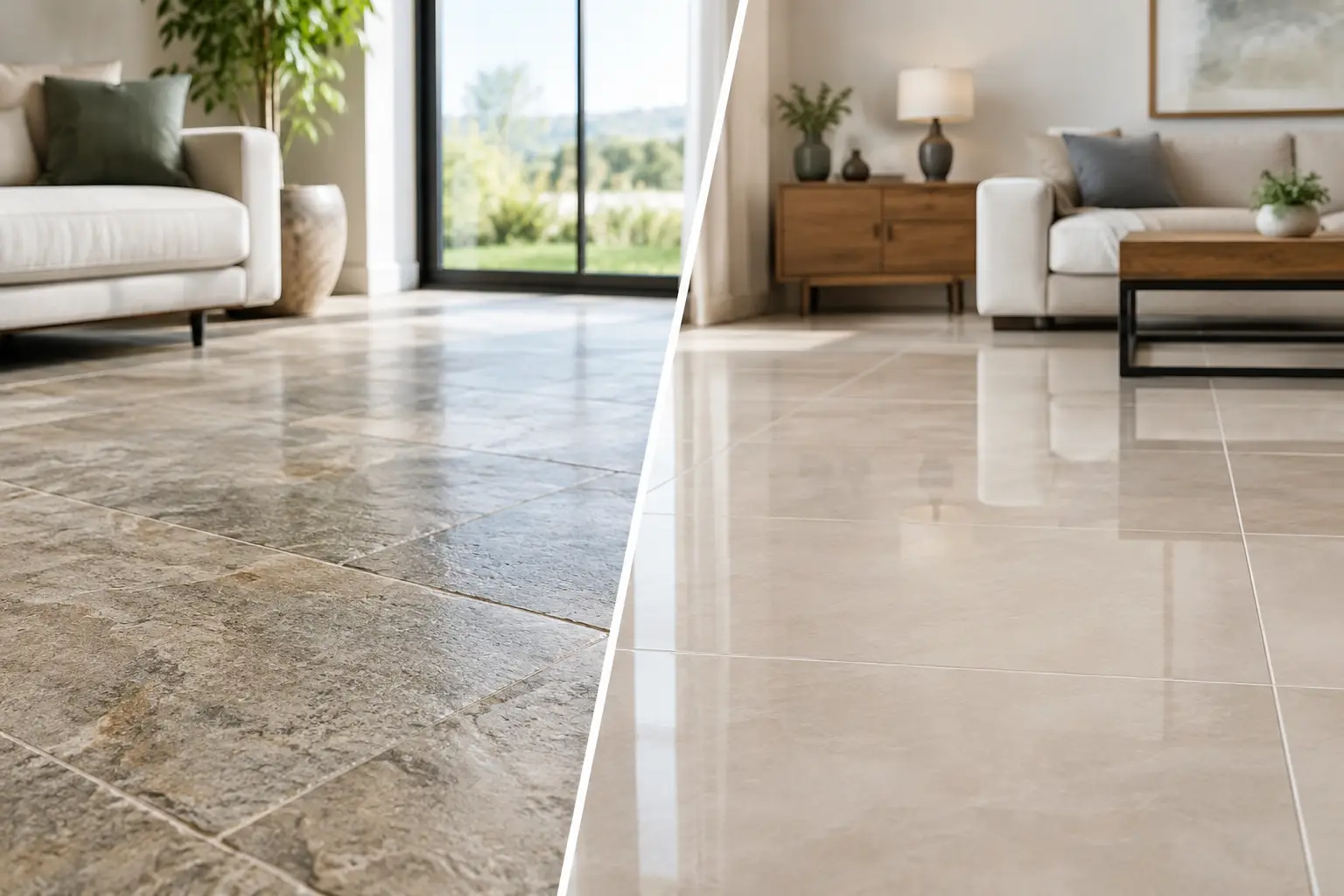
A floor is not merely a finish beneath furniture. It sets the temperature of a room, receives the first light of morning, and gathers the small marks of a life lived well. When considering stone versus ceramic flooring, the decisive question is rarely which material is simply “better”. It is which one can give the architecture, atmosphere and pace of your project the right sense of permanence.
Ceramic has earned its place through technical consistency and broad decorative choice. Natural stone offers something different: geological depth, tonal variation and a presence that becomes more compelling with time. For a city residence, country house, hotel interior or heritage setting, the distinction deserves careful thought before a single slab or tile is laid.
Stone versus ceramic flooring: the essential difference
Natural stone is formed over millennia and cut from a quarry as marble, limestone, granite, travertine, slate or another geological material. Every piece carries variations in veining, grain, fossils, mineral deposits and colour. These are not defects to be eliminated; they are the material’s signature.
Ceramic flooring is manufactured from clay and other minerals, fired at high temperatures and finished with a glaze or printed surface. Porcelain, a denser form of ceramic, is especially popular for floors because it has low water absorption and performs reliably in demanding domestic and commercial settings. Its appearance can be highly refined, including convincing interpretations of marble, timber and concrete.
The difference is therefore more than visual. Stone is a natural architectural material whose character is revealed through selection, cutting, finishing and installation. Ceramic is a precisely engineered surface designed for repeatability. One offers individuality; the other offers control.
The visual character of natural stone
A finely chosen stone floor has a composure that cannot be printed. The movement within Calacatta marble, the quiet warmth of limestone, the open texture of travertine or the deep crystalline structure of granite gives a room visual depth without requiring ornament. It can be cut into generous slabs for a calm, contemporary field, or composed in smaller formats, borders and patterns that echo classical Italian interiors.
This variation asks something of the designer and installer. Samples are useful, but they cannot fully represent an entire consignment. Slab selection, dry laying and the direction of veins must be considered as part of the design. In return, the completed floor belongs specifically to that building. No neighbouring property will have precisely the same surface.
Ceramic provides a more uniform result. This can be an advantage where a project calls for exact repetition, a particular shade, or a very controlled graphic pattern. High-quality porcelain can also reproduce stones that may be difficult to source in quantity or unsuitable for a particular use. Yet even an excellent imitation tends to reveal its repeated pattern over a large area. It captures the image of stone, rather than its depth.
Durability means different things in each material
Porcelain is exceptionally hard-wearing, resistant to staining and generally straightforward to maintain. It is a sensible option for a busy entrance hall, rental property, hospitality project or family kitchen where ease of care is a principal concern. A glazed ceramic tile is also less likely to require specialist sealing than many natural stones.
Natural stone is durable in a more enduring sense. Buildings throughout Italy demonstrate that marble, granite and limestone can outlast fashions and generations when chosen appropriately and cared for knowledgeably. However, durability is not the same as invulnerability. Polished marble can be etched by acidic substances; softer limestones may mark in high-traffic areas; travertine’s pores may need filling depending on the desired finish and use.
These changes need not be failures. A gently softened surface or a small patina may be entirely appropriate in a lived-in house, particularly with honed limestone or tumbled travertine. For clients seeking an immaculate, uniform appearance at all times, porcelain may offer greater reassurance. For those who value a floor that acquires memory and grace, stone can be the more rewarding choice.
Granite and certain quartzites are especially resilient natural options for entrances, kitchens and exterior thresholds. Marble is often better placed in reception rooms, bathrooms and spaces where its luminous quality can be appreciated with considered use. The right comparison is not stone against ceramic in the abstract, but a specific stone against a specific ceramic for a specific room.
Maintenance, moisture and daily life
Ceramic flooring is usually the simpler material to live with. Regular sweeping and washing with a neutral cleaner are generally sufficient. Its low porosity makes it well suited to spaces exposed to splashes, muddy shoes and frequent cleaning.
Stone requires a more deliberate approach, not an onerous one. Most interior stone floors benefit from a suitable impregnating sealer, renewed according to use and the particular material. Harsh acidic or abrasive cleaning products should be avoided, especially on calcareous stones such as marble, limestone and travertine. A pH-neutral cleaner and prompt attention to spills are modest habits that preserve the finish.
In bathrooms, wet rooms and external spaces, surface finish matters as much as the material itself. A polished floor may look magnificent but can be unsuitable where water is regularly present. Honed, brushed, sandblasted or naturally split finishes can offer better slip resistance while retaining the dignity of natural stone. Ceramic and porcelain tiles also come in slip-rated finishes, though a rougher surface may require more attentive cleaning.
Underfloor heating works beautifully beneath both materials when the system, adhesive and movement joints are specified correctly. Stone’s thermal mass is particularly appealing: it warms gradually and holds heat well, bringing a quiet comfort to large rooms. The installation must nevertheless allow for structural movement and use a stable, properly prepared substrate. A beautiful material cannot compensate for poor groundwork.
Installation is where value is protected
The apparent price of flooring rarely tells the whole story. Ceramic tiles can be economical to purchase and quicker to install, particularly in standard formats. Large-format porcelain, however, still demands skilled handling, accurate levelling and careful cutting. Its technical regularity does not remove the need for craftsmanship.
Natural stone involves more decisions before installation begins. Thickness, finish, edge treatment, layout, joint width, bookmatching, transitions to adjoining materials and the relationship between slabs all influence the final result. Veined marble may need sequential selection so that its movement continues naturally across the floor. Travertine can be laid with a formal linear rhythm or with a more relaxed, textured character.
This is why stone flooring should be regarded as architectural work rather than a commodity. A floor can be fabricated to respond to an existing doorway, a historic threshold, a staircase or a bespoke fireplace surround. In restoration settings, material knowledge becomes particularly important: the replacement stone must respect the original fabric, while meeting the practical demands of the present building.
At Torchio Marmi, this relationship between material, setting and workmanship has been central to stonework since 1860. The same attention that serves monumental restoration can bring clarity and permanence to a private interior.
Cost, longevity and the meaning of value
Ceramic normally offers a lower entry cost and a predictable budget, particularly for large surfaces. It is an intelligent choice where performance, speed and visual consistency are priorities. If a tile is damaged, replacing an individual piece can also be relatively simple, provided spare stock has been retained.
Stone often requires a greater initial investment, especially where rare material, custom fabrication or complex patterns are involved. Yet it has an unusual capacity for renewal. A scratched or dulled stone floor can frequently be cleaned, honed, repaired or repolished rather than removed. This possibility changes the long-term calculation. The material may age, but it is not necessarily spent.
For properties of architectural distinction, natural stone can also contribute to the perceived quality and identity of the home. It is not simply an added finish. It becomes part of the structure’s visual language, linking floors to wall cladding, bathroom surfaces, staircases and exterior paving in a coherent whole.
Choosing with the room, not the trend
Choose ceramic or porcelain when the project needs highly predictable colour, low-maintenance practicality, excellent moisture resistance and a tightly managed budget. It is particularly effective in hard-working spaces where a carefully selected technical surface is the right answer.
Choose natural stone when the ambition is atmosphere, originality and a material relationship that will deepen over years. It suits homes where craftsmanship is visible, where details are made to measure, and where a floor is intended to carry the house’s character rather than merely support it.
Before deciding, stand with full-sized samples in the actual light of the room. Consider the sound underfoot, the transition from hall to living space, the finish when wet, and how the material will sit beside joinery, plaster and metalwork. The most enduring floor is the one that feels inevitable in its setting - a surface made not just for the first photograph, but for the years of footsteps, gatherings and memories still to come.