
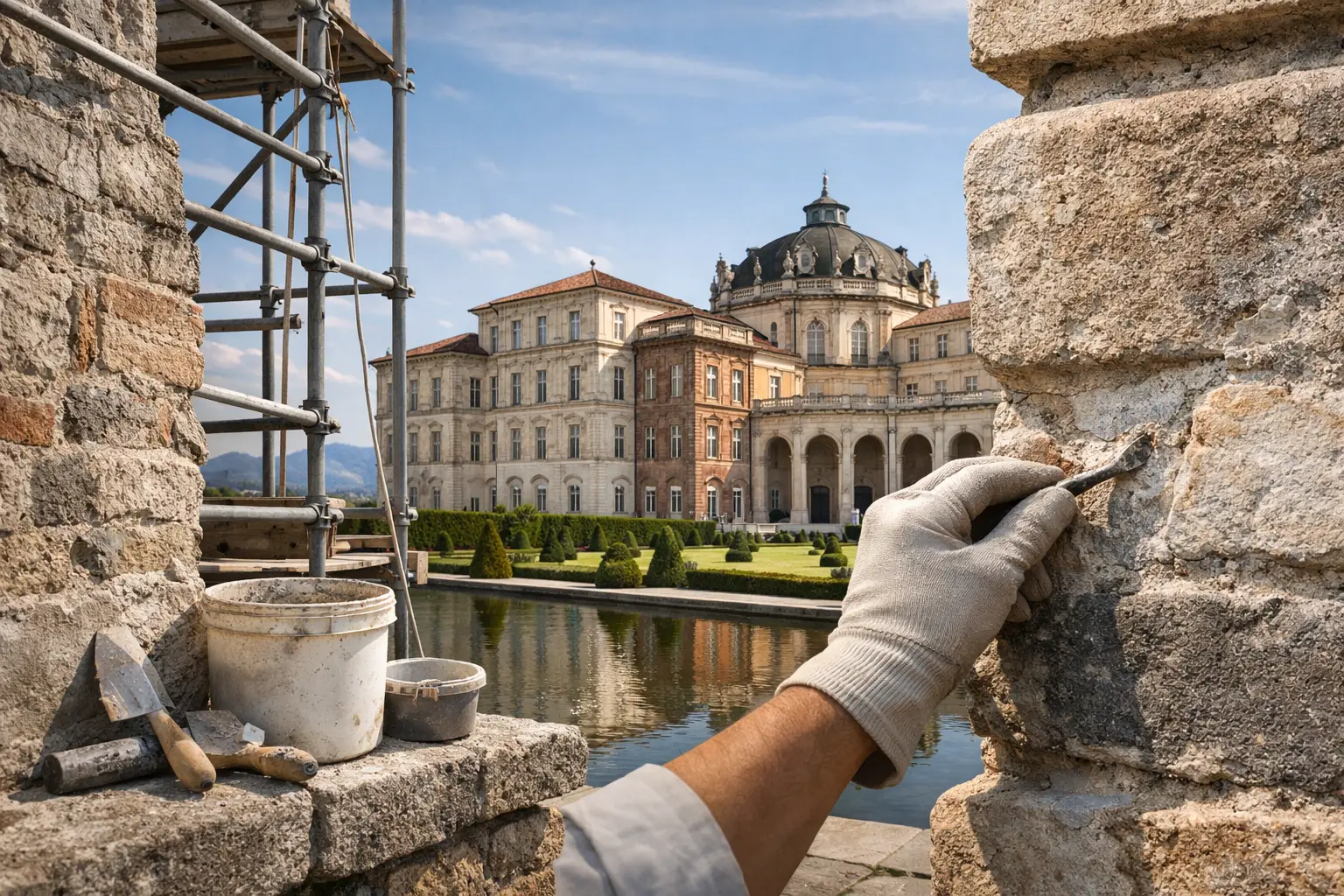
The great question in the Venaria Reale restoration example was never simply how to make a royal residence look new again. It was how to return legibility, dignity and life to a place shaped by centuries of ambition, neglect and change - without erasing the evidence held in every weathered surface.
La Venaria Reale, the extraordinary Savoy residence outside Turin, offers a lesson of lasting value to anyone entrusted with historic architecture. Its restoration demonstrates that stone is not an interchangeable finish. It is a record of quarry, hand, climate and use. To preserve that record requires technical discipline, patience and a deep respect for the original fabric.
For architects, property owners and heritage bodies, the project remains a compelling reference because it places craftsmanship at the service of cultural memory. The result is neither a frozen relic nor an imitation of the past. It is an architectural work made capable of being inhabited, understood and cared for again.
The Venaria Reale restoration example and its true scale
A royal complex is never a single building. At Venaria, architecture unfolds through façades, courtyards, galleries, gardens, service spaces and ceremonial rooms. Each area carries its own history of materials, exposure and alteration. Restoration on this scale demands a reading of the whole, while allowing for the individuality of every element.
That is the first essential lesson. Historic stonework cannot be approached as a uniform surface treatment. A pale limestone threshold worn by generations of footsteps requires a different judgement from a carved cornice exposed to rain, frost and airborne pollution. Marble flooring, stucco, brick, timber and metal fittings all affect one another. An intervention that appears correct in isolation may prove unsuitable when considered within the complete architectural composition.
The work at Venaria required an approach capable of bringing order to complexity. Before cleaning or repair begins, the building must be observed closely: its construction methods, previous repairs, fractures, moisture paths, salts, staining and areas of material loss. This is not administrative preparation. It is the foundation upon which every responsible decision rests.
Restoration begins with restraint
The temptation to make historic stone spotless is understandable, especially when a major public opening is anticipated. Yet a uniformly bright façade may come at a considerable cost. Aggressive cleaning can remove the protective surface developed over time, soften carved detail and expose the stone to more rapid deterioration.
The more exacting objective is not visual novelty. It is stability, coherence and truthful appearance. Cleaning methods must be selected according to the stone’s porosity, mineral composition, condition and the nature of the deposit to be removed. Water, poultices, controlled mechanical action or carefully considered chemical systems may each have a place. None should be treated as a universal answer.
Restraint also applies to replacement. Where original material remains structurally sound, conservation is generally more meaningful than substitution. A repaired fragment may retain the marks of time, but those marks belong to the building’s identity. New stone becomes necessary when loss compromises safety, weather protection or the reading of a significant architectural form. Even then, the replacement should respect the original in geological character, texture, colour variation and finish.
This distinction matters in private residences as much as in palaces. A historic entrance, garden wall or internal staircase gains its atmosphere from authentic material continuity. Replacing every imperfect piece can make a place look expensive while leaving it strangely without memory.
Matching stone is more than matching colour
Selecting a compatible stone is one of restoration’s most demanding acts. Visual similarity is only the beginning. Two stones may appear alike when dry, yet behave very differently once installed outdoors. Their response to moisture, thermal movement and pollution can vary; their hardness and porosity can alter the rate at which they age.
An appropriate replacement is therefore judged through both appearance and performance. The grain, bedding direction, mineral content and capacity to weather with surrounding fabric all deserve attention. So does the finish. A machine-cut surface can be technically precise yet visually discordant beside hand-worked stone whose slight irregularities catch light in a distinctive way.
The finest restoration work does not conceal craft. It allows the new intervention to sit with quiet assurance beside the old, contributing to the architectural whole without competing for attention.
The value of skilled hands and informed tools
Venaria also illustrates why conservation cannot be reduced to specification alone. Surveys, laboratory analysis and diagnostic technologies provide indispensable knowledge, but they do not replace the judgement of experienced craftspeople. A conservator or stoneworker reads a surface through touch, sound and close observation: the edge of a fracture, the strength of a crust, the movement of a joint, the response of stone beneath a chisel.
Hand finishing remains especially significant where mouldings, carved profiles and ornamental details must be repaired. Historic elements often contain subtleties that standard fabrication cannot reproduce: a shallow curve that changes across a length, a leaf motif shaped by an individual hand, or a shadow line created by a particular tool mark. These details are not decorative excess. They govern proportion and give masonry its living character.
At the same time, traditional skill need not reject modern methods. Three-dimensional surveys, photographic mapping and carefully calibrated cutting equipment can improve accuracy, reduce unnecessary intervention and document decisions for future custodians. The balance lies in using technology to serve the fabric, rather than allowing convenience to dictate the result.
For a heritage stonework house such as Torchio Marmi, this balance is central to the discipline: material knowledge must meet the sensitivity to recognise when a stone should be consolidated, when it should be repaired and when a new piece must be made by hand.
A restored monument needs a future
One of the most valuable aspects of the Venaria project is that it restored use alongside appearance. A historic complex survives more securely when it is understood, visited and maintained. However, renewed public use introduces pressures of its own. Floors must withstand footfall, routes must be safe, installations must respect historic spaces, and maintenance must be planned long after the final scaffolding has been removed.
This is where restoration moves beyond a single campaign. Drainage, joints, flashings and water management often matter more to the future of stone than a spectacular repair. Water allowed to enter behind cladding or through an open joint can cause damage that remains invisible until deterioration is advanced. Regular inspection offers a more economical and more respectful alternative to waiting for major failure.
There is also a delicate aesthetic balance. A palace cannot be treated as a theme set, yet visitors need enough clarity to appreciate its architecture. Necessary modern additions should be readable without being intrusive. The best solutions preserve the hierarchy of the original spaces, allowing historic material to remain the principal voice.
Lessons for contemporary commissions
The relevance of Venaria extends beyond state heritage projects. Owners restoring a period villa, designing an extension beside an older building, or commissioning a memorial in natural stone face related choices. The most successful work begins with a question: what should endure here, and why?
Sometimes the answer calls for conservation, retaining worn marble stairs and repairing only their weakened edges. Sometimes it calls for a contemporary intervention in travertine, granite or onyx that deliberately creates a new layer while respecting the proportions and atmosphere of the existing architecture. Neither approach is automatically superior. The right choice depends on the building, the material, the intended use and the honesty of the design.
What should be avoided is false antiquity. Artificially ageing new stone in an attempt to disguise it as original can confuse the building’s history and diminish the authority of both old and new work. Timeless Italian style is not achieved by copying every mark of age. It comes from proportion, material integrity and a finish suited to its setting.
Stone as a custodian of memory
La Venaria Reale reminds us that restoration is an act of confidence in the future. It asks us to devote care, expertise and resources to materials that will outlive us. In return, stone gives architecture its gravity: the coolness of a threshold, the softness of worn steps, the changing colour of a façade after rain, the quiet permanence of a carved detail.
A worthy restoration does not seek to silence those traces. It gives them the conditions to remain visible, beautiful and meaningful for another century of footsteps.