
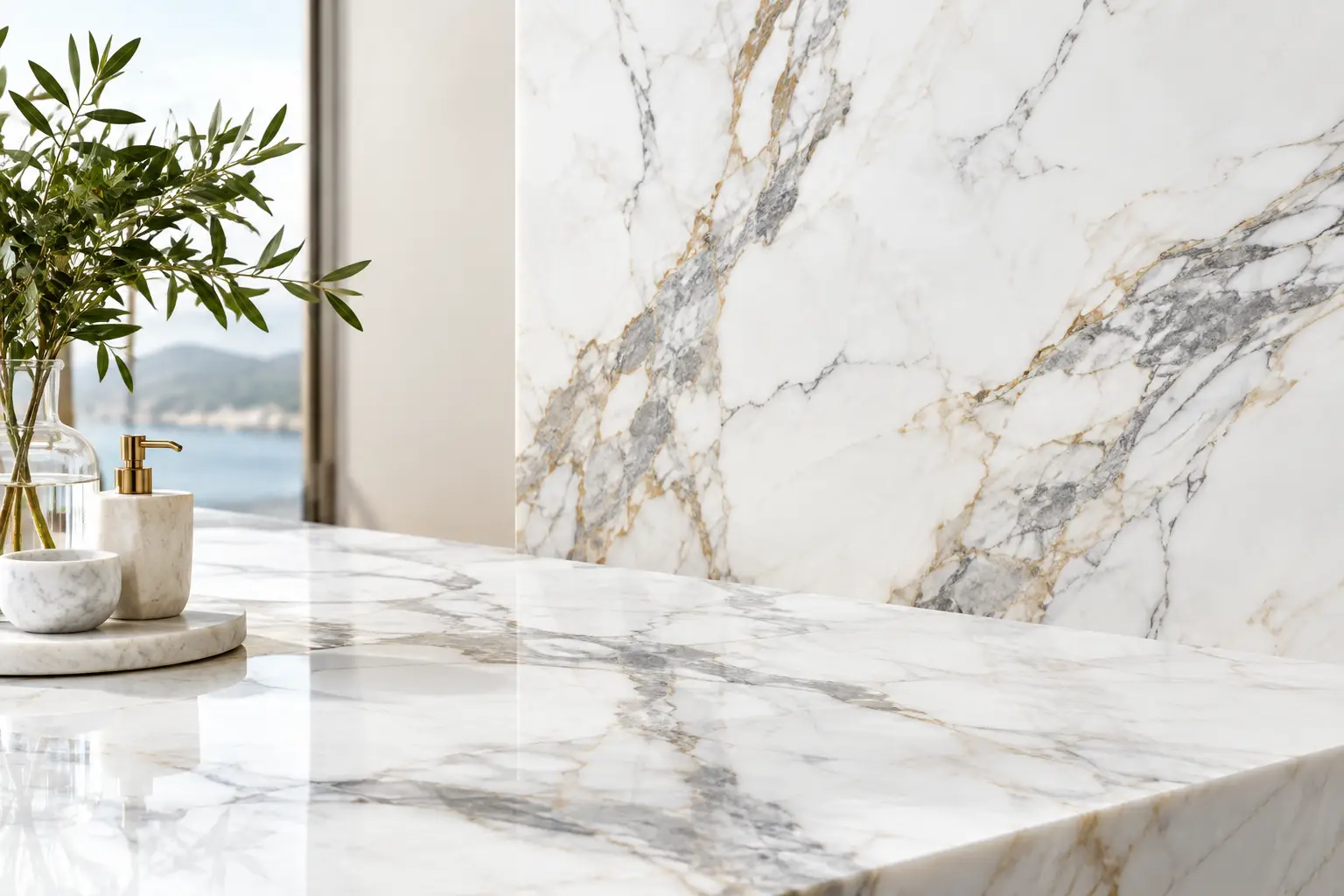
A Calacatta marble surface can alter the entire atmosphere of a room before a single furnishing is placed. Its pale ground catches the light; its decisive veins introduce movement, depth and a sense of permanence. But what is Calacatta marble, precisely? It is a prized Italian marble celebrated for a luminous white to warm ivory field and bold, often sweeping veining in grey, gold, taupe or soft brown.
Unlike a uniform manufactured surface, Calacatta is a record of geological time. Every block, and every slab cut from it, carries its own composition. This individuality is the source of its distinction, but it also means that choosing Calacatta demands a considered eye, technical knowledge and respect for the material as nature has made it.
What Is Calacatta Marble?
Calacatta marble is traditionally associated with the Apuan Alps of Tuscany, the celebrated marble district near Carrara. It is a metamorphic stone: limestone transformed under immense pressure and heat until it becomes a dense crystalline material, rich in calcite and capable of taking an exceptional polish.
Its defining feature is contrast. Where many Carrara marbles show a cooler grey ground with fine, diffuse veining, Calacatta tends towards a clearer, brighter background crossed by more pronounced veins. These may appear as broad rivers, delicate branches or dramatic mineral clouds. Gold-toned accents are particularly sought after, lending the stone warmth without diminishing its architectural gravity.
The name is sometimes used broadly in the international stone trade. A slab described as Calacatta may vary considerably in origin, appearance and quality, while engineered materials may imitate its familiar white-and-gold pattern. For a project where authenticity matters, the name alone is not enough. The individual slab, quarry provenance and intended application should guide the decision.
A Marble Defined by Variation
Calacatta does not offer repetition, and that is precisely its luxury. One selection may have a quiet ivory field with fine grey tracery; another may feature powerful veining in amber, graphite and pale green. Some slabs feel serene and architectural, others almost painterly.
This variation has practical implications. A small sample can introduce the family of colour and movement, but it cannot represent a full kitchen island, a bookmatched bathroom wall or a grand entrance floor. Significant surfaces should be selected slab by slab, with the proposed cuts planned before fabrication begins. The placement of a vein can make the difference between a competent installation and a composed work of interior architecture.
Bookmatching is especially effective with expressive Calacatta. Two adjoining slabs are opened like the pages of a book, creating a mirrored pattern that can frame a fireplace, form a headboard wall or give a shower enclosure a ceremonial presence. It is not automatically the right choice, however. In a restrained setting, vein matching with a continuous directional flow may feel more natural and less theatrical.
Calacatta, Carrara and Statuario
These names are often grouped together, yet each suggests a different visual language. Carrara marble is generally greyer and more softly veined, making it an elegant choice for broad fields of flooring or classical interiors where quiet rhythm is desired. Statuario is typically very white, with distinctive grey veining and a long association with sculpture and formal architectural detail.
Calacatta occupies a more dramatic register. Its warmer white ground and broader veins make it particularly compelling where stone is intended to become the visual centrepiece. Still, no category should replace direct inspection. Natural stone resists rigid labels: a particular Calacatta slab may be subtler than an expressive Statuario, and that may be exactly what a project requires.
Where Calacatta Marble Belongs
Calacatta marble is often chosen for surfaces that reward close attention: bespoke kitchen worktops, vanity tops, fireplace surrounds, staircases, reception desks and wall cladding. In a private residence, it can lend a bathroom the calm of a spa while retaining the character of a lived-in home. In a hospitality or commercial setting, it can establish a memorable first impression without resorting to ornament for its own sake.
Its use is not limited to interiors. With the correct assessment of the selected stone, detailing and exposure conditions, marble may also contribute to exterior architecture. Yet exterior applications require greater caution. Weather, pollutants, thermal movement and water management all influence long-term performance, and a beautiful stone should never be specified without considering the realities of its setting.
For floors, Calacatta creates an unusually refined foundation, particularly in entrance halls, galleries and principal bathrooms. A honed finish can give the material a soft, contemporary tactility, while a polished finish heightens its reflectivity and visual depth. The choice is not only aesthetic. Honed stone may be more forgiving of everyday marks, whereas polished marble often demands more attentive care to preserve its lustre.
From Slab to Finished Work
The finest Calacatta can be diminished by poor fabrication. Before cutting, a stone specialist studies the slab for vein direction, fissures, tonal changes and the areas best suited to edges, sink openings, corners and joins. Natural fissures are not necessarily faults. In marble, they may be stable features of formation, professionally treated where needed, and part of the material's authentic expression.
Thickness, substrate preparation and edge profile should be resolved according to the application. A kitchen island with a substantial mitred edge may appear monolithic, while a slender wall lining calls for different engineering and fixing methods. Wet areas demand carefully designed falls, waterproofing and joints. These details are mostly invisible when the work is complete, but they determine whether stone will age with dignity.
At Torchio Marmi, this process is understood as more than fabrication. The stone is selected and worked in relation to the architecture, the light and the life that will unfold around it. Such care is particularly valuable when a project calls for continuous veining across several elements or when historic materials must be approached with sensitivity.
Is Calacatta Suitable for Kitchens and Bathrooms?
Yes, provided its character is welcomed rather than treated as a flaw. Marble is softer than granite and more vulnerable to acids than quartz-based surfaces. Lemon juice, wine, vinegar and certain cleaning products can etch a polished finish, leaving a duller mark. Oils and strongly coloured liquids may stain if allowed to remain on an unprotected surface.
A quality sealer helps reduce absorption, but it does not make marble impervious. Daily care is straightforward: wipe spills promptly, use a pH-neutral stone cleaner and avoid abrasive pads or acidic household products. Over time, a well-used Calacatta worktop may acquire a gentle patina. For many owners, this is part of its appeal, evidence of meals prepared, flowers arranged and daily life lived against a remarkable material.
Those seeking a pristine, unchanging work surface may prefer another stone for the busiest preparation area, while using Calacatta for an island, splashback, pantry or adjoining dining surface. There is no lesser choice in this approach. Designing with natural stone means balancing beauty, performance and the particular habits of the people who will use it.
Choosing the Right Calacatta
Begin with the role the stone must play. Should it be a quiet backdrop to timber, bronze and plaster, or the defining gesture of the room? Consider the natural and artificial light, as warm illumination can draw out golden veins while cooler light may emphasise grey and blue undertones. Consider scale as well: a bold slab may be magnificent on a tall wall but overpowering in a compact cloakroom.
Then view full slabs under good light and reserve the exact material intended for the work. Confirm the layout of veins, the direction of cuts, the position of joints and the finish. For larger projects, mock-ups or detailed stone drawings can prevent uncertainty and allow the design to be resolved before installation begins.
Calacatta marble is not valued because it is flawless or identical from one slab to the next. It is valued because it makes permanence visible: a material formed over millennia, shaped by human hands, and given a place in everyday life. Chosen with discernment and cared for with simplicity, it can become one of those rare architectural elements that grows more personal as the years pass.