
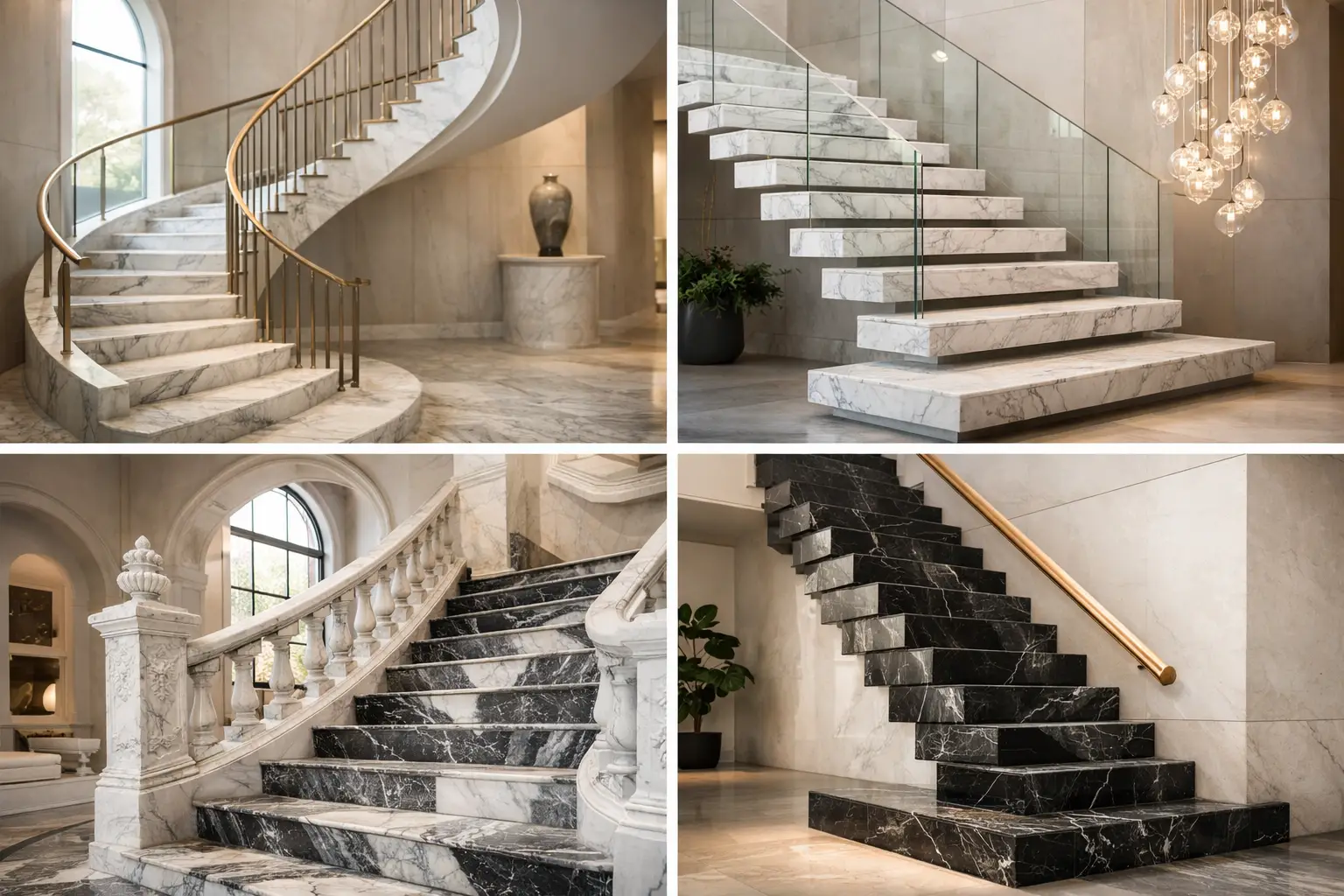
A marble stair is never merely a route between floors. It sets the tempo of an arrival, catches the changing light, and gives a house or public interior a sense of permanence. The finest marble staircase design ideas begin not with a catalogue image, but with the proportions of the space, the character of the stone, and the life that will unfold across each step.
For a private residence, a hotel entrance or a restored historic building, marble can be composed with remarkable restraint or theatrical presence. Its value lies in that range. A carefully chosen slab may read as quietly architectural; a boldly veined block can become the central gesture of an interior.
Begin with the stair's architectural role
Before selecting a marble, establish what the staircase must express. A sweeping stair in a double-height hall can support broad treads, a generous landing and sculptural balustrades. In a townhouse, a slimmer flight may need to bring light through the building while preserving a feeling of intimacy. The same material will look entirely different when the geometry changes.
The relationship between rise, going and landing deserves particular attention. Comfortable proportions are essential, but they also determine the visual rhythm of the stone. Long, shallow treads reveal veining dramatically and suit a ceremonial approach. More compact steps can feel precise and metropolitan, particularly when paired with a fine metal handrail or a minimal stone skirting.
A bespoke survey should also consider the structure beneath the finish. Marble is substantial, and existing buildings may require a considered technical solution before cladding, solid treads or cantilevered elements are specified. Beauty lasts when the engineering is given the same care as the visible surface.
1. Let a single veined marble lead the composition
For a stair with unmistakable presence, use one expressive marble across treads, risers and landings. Arabescato, Calacatta or a richly veined Breccia can create a continuous visual field, especially where each piece is cut and positioned to follow the movement of the veins.
This approach is most successful when the stone is selected slab by slab. Veins can be bookmatched at a landing, aligned through a riser, or allowed to move diagonally for a more natural effect. Continuity should not mean uniformity. Natural variation is precisely what prevents a marble staircase from feeling manufactured.
2. Pair pale marble with a darker border
A framed tread is one of the most enduring marble staircase design ideas, particularly for classical villas and formal entrance halls. A pale central field in Bianco Carrara or Botticino gains definition from a narrow Nero Marquina, Bardiglio or deep green border. The edge gives each tread a crisp outline while creating a measured, almost ceremonial rhythm.
The contrast must be judged in relation to the surrounding floor. If the landing includes a geometric inlay, repeating one of its darker tones at the stair edge can unite the composition. In smaller interiors, a restrained border is often more convincing than an elaborate pattern.
3. Use a honed finish for understated luxury
Polished marble reflects light with great clarity, lending grandeur to a reception stair or a luminous contemporary hall. Yet a honed surface often offers a quieter, more tactile refinement. It softens reflections, allows mineral detail to emerge, and can be more forgiving of everyday marks.
Finish is also a matter of use. A highly polished stair may need discreet anti-slip treatment in busy domestic settings, hospitality spaces or entrances exposed to moisture. Honing, brushing or finely worked inserts can improve traction without compromising the integrity of the design. A specialist should assess the specific marble, slope, lighting and expected footfall rather than applying a generic solution.
4. Create depth with open risers and floating treads
A contemporary marble stair need not be heavy in appearance. Cantilevered treads or open risers can make stone appear to hover, particularly when a concealed structural support and a clear glass balustrade allow the edges to remain visible.
This is a demanding detail. The thickness of the marble, reinforcement, fixing method and wall construction must be resolved together from the outset. When properly engineered, the result has remarkable poise: a material associated with antiquity presented in a distinctly modern language.
5. Give the riser its own material voice
Using marble only on the treads is one option, but a contrast between tread and riser can give a stair greater depth. Pale marble treads above dark timber risers bring warmth to an otherwise formal scheme. Bronze-toned metal risers introduce a subtle gleam, while hand-finished plaster creates an atmospheric backdrop for a more pronounced stone.
This is often the right choice where marble is intended as a precious accent rather than an enveloping surface. It also allows the stair to speak to other materials already present in the interior, from oak joinery to aged brass door furniture.
6. Make the landing a composed stone carpet
A landing should not be treated as leftover floor area. It is the pause between movements, and an ideal place for an inset border, a radial pattern or an understated central motif. In grander schemes, a landing can echo the geometry of a ceiling rosette or the outline of a chandelier overhead.
There is a practical advantage as well. A carefully designed landing clarifies circulation and offers a visual point of rest within a long flight. The most successful patterns respect the scale of the space. Fine inlay can be exquisite, but it needs room to be read from a distance.
7. Bring light to the edge of every tread
Concealed lighting beneath the nosing or within the adjacent wall can turn a staircase into an evening feature without resorting to spectacle. Warm, low-level illumination draws attention to the depth of each step and makes veining legible after dark.
The fittings must be planned before fabrication, with channels, access points and heat management accounted for. Light should reveal the marble's surface, not flatten it. A soft wash along a flanking wall is often more elegant than a visible line of bright LEDs.
8. Consider a sculpted stone balustrade
A marble balustrade gives a staircase a monumental, almost architectural solidity. It may take the form of shaped balusters, a smooth parapet, or a hand-carved profile that recalls the language of an existing period building. In restoration work, matching the grain, profile and ageing of original stone calls for both historical sensitivity and technical knowledge.
For contemporary interiors, a simple stone stringer or parapet can achieve the same sense of permanence with fewer decorative gestures. The decision depends on whether the project calls for continuity with the past or a deliberate contrast.
9. Temper marble with timber, metal or glass
Marble gains character from companionship. Dark oak can make white stone feel more lived-in; bronzed metal adds depth and a crafted edge; glass preserves lightness and extends sightlines. These combinations work best when junctions are deliberate. A poorly resolved trim can reduce the effect of even exceptional stone.
Consider the handrail as a tactile detail rather than an afterthought. Leather-wrapped timber may suit a private home, while patinated bronze has a natural affinity with warm-toned marble. The hand meets the material every day, so its comfort matters as much as its appearance.
10. Choose stone for its real conditions, not only its photograph
A marble's beauty in a showroom is only part of the decision. Daylight orientation, artificial light temperature, adjacent wall colours and the scale of the slab can all alter its appearance. A cool white marble may become silvery in north-facing light; a warmer stone may acquire an almost golden presence beneath evening lamps.
Maintenance should also be discussed honestly. Marble is durable, but it is a natural calcareous stone and can be marked by acidic substances, abrasive dirt or neglected spills. Entrance stairs may benefit from matting zones and a suitable maintenance routine. In heavily trafficked settings, granite or another harder natural stone may be the more appropriate choice, while marble can be reserved for protected internal flights.
11. Honour original fabric in historic interiors
When restoring an older staircase, the aim is rarely to make every surface look new. Existing wear, softened edges and subtle shifts in tone form part of the building's memory. Replacement pieces should be selected and worked to sit respectfully beside surviving material, while repairs must address stability and safety without erasing the stair's history.
This work requires close reading of the original construction. The appropriate quarry source, joint profile, finish and fixing technique may be as significant as the marble itself. Heritage is sustained through accuracy, patience and the willingness to let authentic material remain visible.
12. Treat every detail as part of the whole
The finest stone staircases are composed at every scale: the broad gesture of the flight, the thickness of a nosing, the line of a skirting, the quiet precision of a joint. Torchio Marmi approaches these decisions as a single work, bringing material selection, fabrication and installation into dialogue with the architecture.
A marble staircase rewards this level of attention over decades rather than seasons. Let the stone be chosen in person, let its variations guide the design, and let the final composition belong unmistakably to its setting. Then each ascent becomes more than a passage through the house: it becomes an encounter with material, light and enduring Italian craft.