
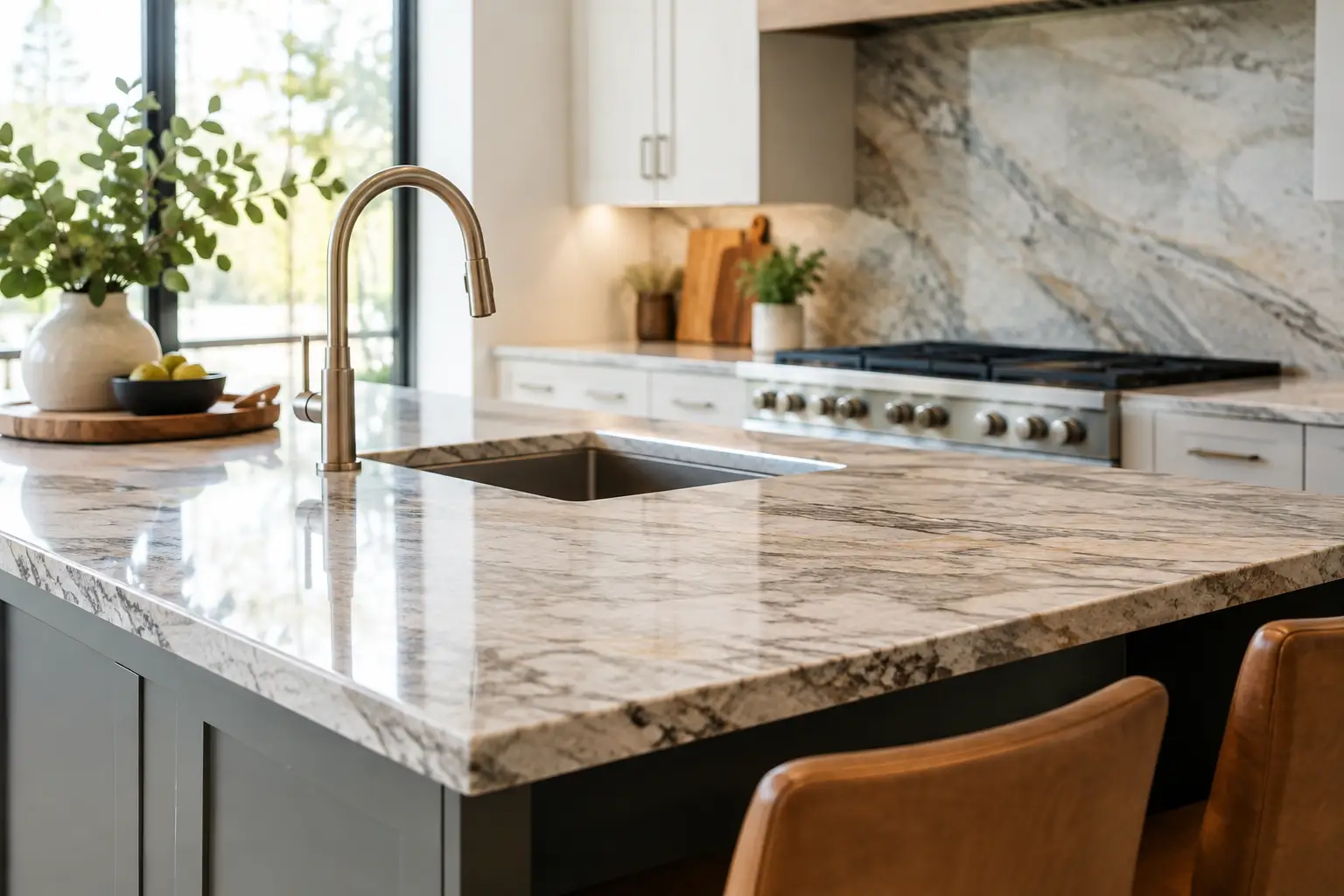
A kitchen worktop is where the life of a home becomes visible: the first coffee of the morning, a bowl of lemons left in sunlight, the preparations for a long table of guests. Custom stone kitchen worktops give these daily rituals a material presence that no manufactured surface can fully imitate. Each slab carries its own veining, mineral depth and movement, then becomes something entirely personal through considered design and precise workmanship.
For a private residence, a country house or a refined urban kitchen, stone is not simply a finish to be selected at the end of a project. It can establish the room's atmosphere from the beginning. The quiet grey of a honed limestone, the dramatic depth of dark granite, the warmth of travertine or the luminous character of marble each suggest a different way of living with a space.
A worktop shaped around the room
A bespoke worktop begins well before fabrication. It starts with proportion: the dimensions of the island, the relationship between cabinetry and architecture, the position of windows, and the route through which the finished piece will enter the property. In a finely detailed kitchen, a few millimetres can alter the visual balance of an edge, a reveal or a junction with timber.
Standard worktops are made to fit a familiar range of units. Custom stone kitchen worktops are developed for the particular room and the people who use it. They may continue upwards as a full-height splashback, form a monolithic island with waterfall ends, frame a cooking range, or extend into a breakfast table with a softened, sculptural profile.
This freedom calls for discipline. A generous island in richly veined marble may be extraordinary, but only if the slab is selected and cut so that its natural drawing remains coherent across the visible faces. A small kitchen may benefit more from a quieter stone with a honed finish, allowing light and cabinetry to carry the composition. Bespoke work is not about adding detail for its own sake. It is about making every line feel inevitable.
Choosing stone for beauty and daily use
The right material is never chosen on appearance alone. Every natural stone has its own density, porosity, hardness and response to acids, oils, heat and water. Understanding these qualities is central to a kitchen that will remain beautiful in real use.
Marble and natural stone
Marble has an unmistakable delicacy. Its veining can make a worktop feel like a work of art, particularly in pale, light-filled interiors or kitchens conceived as part of a larger architectural scheme. Yet marble is a calcareous stone, which means acidic ingredients such as lemon, wine and vinegar can leave etching - a soft change in the surface rather than a conventional stain.
For some owners, this gentle evolution is part of marble's appeal. A kitchen is allowed to record a life lived within it, acquiring a patina that feels settled rather than imperfect. For others, particularly those seeking a pristine surface with minimal maintenance, marble may be better reserved for a pantry, serving area or less intensive section of the kitchen.
Limestone and travertine offer a warmer, more tactile expression. Their open texture and muted colours bring an architectural calm to both contemporary and traditional interiors. They require appropriate sealing and thoughtful use, but can be deeply rewarding where the desired effect is natural, restrained and timeless.
Granite, quartzite and other resilient choices
Where the kitchen will work hard every day, granite and many quartzites offer greater resistance to scratching, staining and heat. Their strength makes them particularly suited to large preparation areas, family kitchens and hospitality-inspired spaces where performance matters as much as visual distinction.
Granite is often associated with dark, highly polished surfaces, but its range is far broader. It can be pale, softly mottled, richly coloured or almost architectural in its uniformity. Quartzite, meanwhile, can offer the movement associated with marble while providing a more durable surface, although each variety should be assessed individually rather than assumed to behave in the same way.
Onyx is a more specialised choice. Its translucency makes it compelling for backlit features, bar counters or panels where light can reveal its inner landscape. It is rarely the practical answer for the busiest preparation zone, but in the right location it creates a moment of genuine theatre.
The detail that distinguishes bespoke stonework
The character of a worktop is often determined by elements that are noticed only subconsciously. Thickness, edge profile, joint placement and finish all influence how the stone sits within the room.
A slim, finely honed worktop can create a precise contemporary line. A deeper built-up edge lends weight and permanence, particularly when paired with hand-finished joinery or traditional architectural elements. The edge itself may be square and restrained, lightly chamfered, softly rounded or more classically profiled. Each decision changes the way light meets the stone and how the surface feels beneath the hand.
Joints deserve equal attention. In large islands, joints may be necessary because of slab dimensions, structural considerations or site access. They should be planned with the material's veining, the arrangement of appliances and the principal viewpoints in mind. A well-considered joint does not interrupt the design. It becomes almost imperceptible within it.
Cut-outs for sinks, taps, hobs and pop-up sockets are also technical moments. Undermounted sinks create a clean, uninterrupted plane but require careful support and sealing. Drainer grooves may be cut directly into the stone, and integrated sink bowls can be fabricated in a matching material for a composed, monolithic effect. These details demand experience, because beauty in stone depends on accuracy beneath the surface as much as visible finish above it.
From slab selection to installation
A distinguished result begins with the slab itself. Natural stone cannot be specified only by a small sample. A sample can indicate colour and texture, but it cannot reveal the full scale of a vein, the transition of tone across a slab or the singular marks formed over geological time.
Whenever possible, the selected slabs should be viewed as a whole. This is particularly important for strongly veined marble, quartzite and onyx. The fabricator can then map the cuts before work begins, deciding where the most expressive movement should appear and whether adjacent pieces should be bookmatched, vein-matched or deliberately composed with contrast.
Fabrication follows a detailed site measure, usually after cabinetry is installed and before the final fitting. Templates capture walls that may not be perfectly straight, openings that require tolerances and complex intersections around columns, windows or existing architecture. This stage protects the integrity of the finished work, avoiding the compromises that occur when a valuable material is asked to correct for inaccurate dimensions.
Installation is the final act of a longer process. The substrate must be level and properly supported, especially for substantial stone sections or projecting breakfast bars. Once fitted, the worktop should feel calm and effortless. Its technical achievement remains largely invisible, allowing the material and the architecture to speak.
A surface that matures with the home
Natural stone is often described as durable, but durability should not be confused with indifference. A worktop will last for generations when it is chosen honestly and cared for intelligently. Sealers help limit absorption in more porous stones, but they do not make every material immune to misuse. Prompt cleaning, mild pH-neutral products and a simple respect for the surface are usually sufficient.
It is also wise to consider the kind of beauty desired. A flawless, high-performance surface may lead towards granite or a carefully chosen quartzite. A marble worktop may ask more of its owner, but offer a softness and emotional depth that many find irreplaceable. Neither choice is inherently superior. The best choice is the one that aligns material character with the rhythm of the household.
For Torchio Marmi, this conversation belongs at the centre of every commission. With stone, lasting value comes not from resisting time completely, but from selecting a material whose ageing will remain graceful and true to the home it serves.
The finest kitchen worktops do more than support the tasks of the day. They become part of the house's memory: a surface polished by use, illuminated by changing seasons, and made to endure with quiet Italian dignity.