
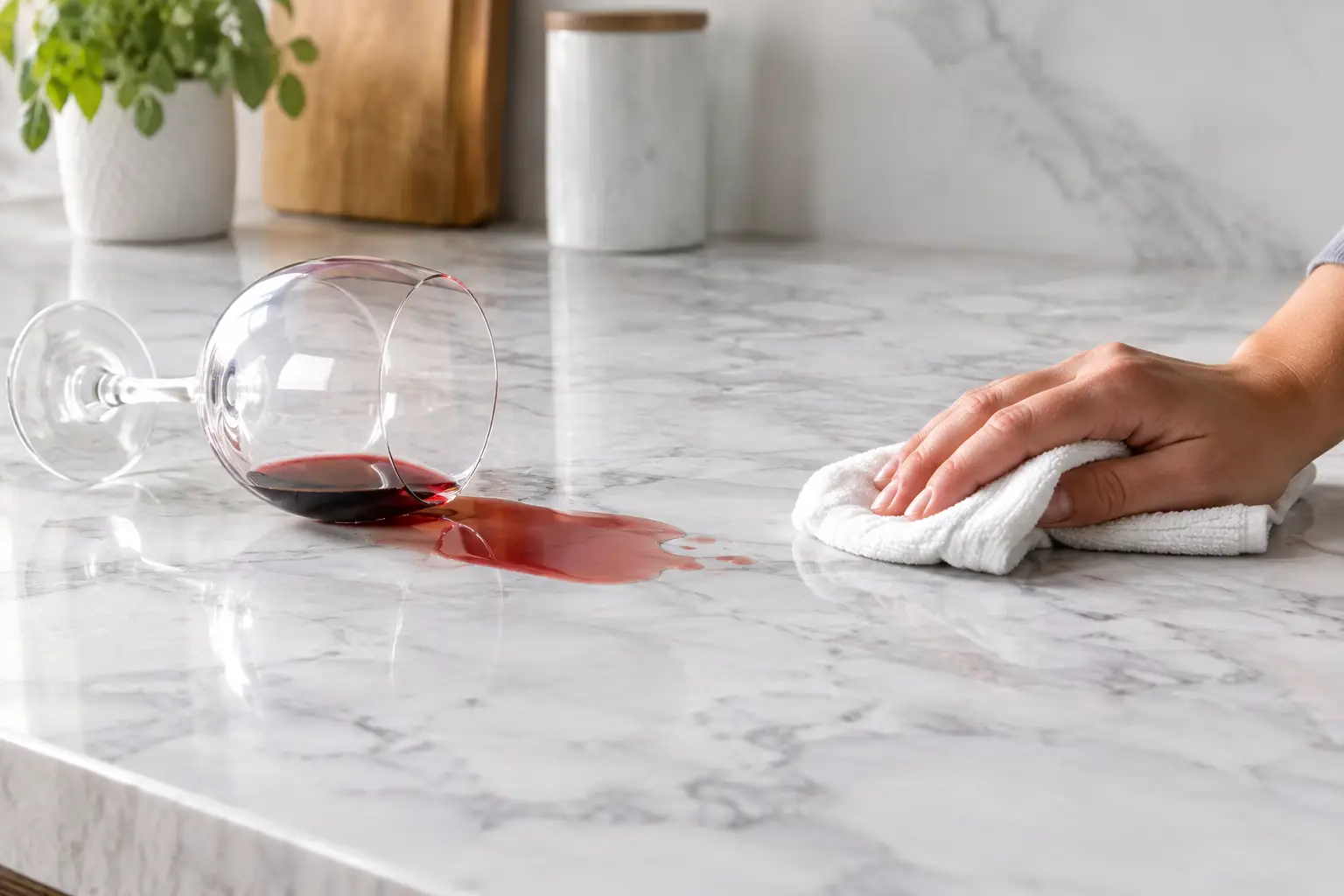
A glass of red wine left beside a pale marble worktop, a splash of lemon on a bathroom vanity, a bottle of perfume on an antique console: these are the small moments that prompt a serious question. Does marble stain easily? Marble can absorb liquids and mark if it is left unprotected, but that is only part of the story. With the right stone selection, finish, fabrication and care, marble remains one of architecture’s most enduring and expressive materials.
Its beauty is not the perfection of a manufactured surface. Marble carries veins, fossils, tonal movement and the quiet record of geological time. A well-considered project respects this character while addressing the practical demands of the room, the way it will be used, and the kind of life it is intended to accompany.
Does marble stain easily in everyday interiors?
Marble is a natural, calcite-based stone. Unlike glazed ceramic or engineered surfaces, it has microscopic pores. These pores can draw in coloured or oily substances, particularly when a surface is unsealed, poorly sealed or left wet for too long. Cooking oil, coffee, tea, red wine, berries and richly pigmented cosmetics are among the common causes of staining.
Yet absorption is not the same as inevitability. A quality impregnating sealer slows the passage of liquids into the stone, giving the owner time to wipe a spill away before it leaves a trace. It does not form a plastic film over the marble or make it invulnerable. Rather, it preserves the natural appearance and breathability of the material while improving its resistance to everyday use.
The practical answer, then, depends on the marble itself and its setting. A honed Calacatta used for a family kitchen island faces very different conditions from a polished Arabescato wall in a powder room or a floor in a formal entrance hall. In a carefully planned interior, each can be entirely appropriate.
Staining and etching are not the same thing
Many marks described as stains are actually etches. This distinction matters because the remedies are different. Acidic substances such as lemon juice, vinegar, tomato, wine and some cleaning products react with calcium carbonate in marble. They can leave a dull, lighter patch or a change in sheen, especially on polished stone. This is chemical corrosion at the surface, not a coloured deposit absorbed into the pores.
An oil stain may darken the marble. A wine stain may introduce colour. An etch usually alters the finish. None of these possibilities should be dismissed, but neither should they be confused. Correct diagnosis allows a specialist to choose the right treatment, from a gentle poultice for an absorbed stain to refinishing or re-polishing for an etched area.
For many owners, a soft patina acquired over time is part of marble’s appeal. In a busy kitchen, however, a honed finish is often the wiser choice. Its matte surface makes subtle changes of sheen less conspicuous than a mirror-polished finish, allowing daily life to leave a quieter signature.
Porosity varies from one marble to another
“Marble” is often spoken of as if it were one uniform material. In reality, each quarry, block and slab has its own density, structure, veining and mineral composition. Some marbles are relatively compact; others are more open and more absorbent. Natural fissures and dramatic veins may contribute greatly to visual depth, while also requiring experienced fabrication and considered installation.
Colour can influence perception as well. On very pale marble, a dark oil mark is more visible. On a richly veined or darker stone, the same incident may recede into the movement of the surface. This is not a reason to choose stone by colour alone. It is a reason to view full slabs, understand the proposed finish, and discuss the intended use before a material is specified.
A knowledgeable stoneworker will also consider the direction of the veins, the placement of joints, the edge profile, the location of sinks and hobs, and the detailing around taps and splashbacks. These decisions are not merely decorative. They help ensure that a beautiful piece of marble performs with dignity over decades.
The finish shapes both appearance and maintenance
Polished marble has a luminous, reflective quality that suits formal bathrooms, reception spaces, decorative wall cladding and refined furniture. The polish enriches colour and reveals the depth of the veining, but it can make etching easier to see because the affected area loses its gloss.
Honed marble has a satin or matte surface. It is often favoured for kitchen worktops, flooring and rooms where tactile warmth matters as much as visual brilliance. Honing does not prevent etching or staining, but it disguises minor wear more gracefully and gives the stone a more relaxed, architectural presence.
Brushed, antiqued and other textured finishes offer further possibilities, particularly in country houses, hospitality spaces and restoration projects. Their texture can be forgiving in high-traffic settings, though cleaning must be attentive because relief and open texture can retain dirt. The best finish is not the most resistant in abstract terms. It is the one that belongs to the design and to the habits of those who will live with it.
How sealing protects marble, and where it does not
Professional sealing is one of the most valuable safeguards for marble surfaces, especially in kitchens, bathrooms and dining areas. A suitable impregnating sealer is selected according to the stone’s absorption rate and the exposure it will receive. It should be applied to a clean, dry surface and renewed when testing shows that water no longer beads briefly at the surface.
Sealing is not a licence to leave spills unattended. Nor does it protect against acidic etching, scratches, heat shock or impact. A hot pan can damage more than the stone: it may affect adhesives or supports beneath it. Heavy objects can chip an edge, particularly around sinks and corners. These are matters of material stewardship, not a failure of marble.
For bespoke work, protection begins before the sealer is applied. Proper substrate preparation, accurate joints, secure fixing systems and carefully selected adhesives all affect the longevity of an installation. In historic settings, the approach must be even more sensitive, balancing preservation, reversibility and compatibility with original materials.
Daily care for a surface that ages well
Marble does not ask for complicated rituals. It rewards restraint. Wipe spills promptly with a soft cloth and clean with warm water or a pH-neutral cleaner made for natural stone. Dry the surface afterwards, particularly around taps, where mineral residue can build up over time.
Avoid acidic, abrasive and highly alkaline products. Household vinegar, descaling sprays, bleach, scouring powders and generic bathroom cleaners can dull or damage marble. Use chopping boards for food preparation, coasters beneath drinks and trivets for hot cookware. In a bathroom, place trays beneath perfume bottles and cosmetics, both to protect the stone and to create a composed, uncluttered arrangement.
If a stain appears, resist improvised treatments involving lemon, bicarbonate mixtures or aggressive chemicals. They may enlarge the problem or change the finish. A stone-care professional can identify whether the mark is organic, oily, metallic or chemical, then recommend an appropriate poultice or restoration process.
Choosing marble with confidence
For a client, architect or designer, the question is rarely whether marble is flawless. It is whether the chosen marble is right for the project. A serene, low-traffic cloakroom may invite a highly polished white marble with delicate veining. A lively family kitchen may call for a denser variety, a honed finish, a thoughtful edge detail and an honest expectation that the surface will develop a gentle patina.
This is where material knowledge becomes indispensable. At Torchio Marmi, the work begins with the character of the slab and the atmosphere a project seeks to create, then joins beauty to technical judgement. The aim is not to make stone behave like an industrial imitation, but to make its natural qualities serve the architecture beautifully.
Marble may stain or etch when neglected, but it also offers something less replaceable: a surface that can be cared for, restored and handed forward. Choose it with clear eyes, specify it with expertise, and let its evolving character become part of the memory of the place.