
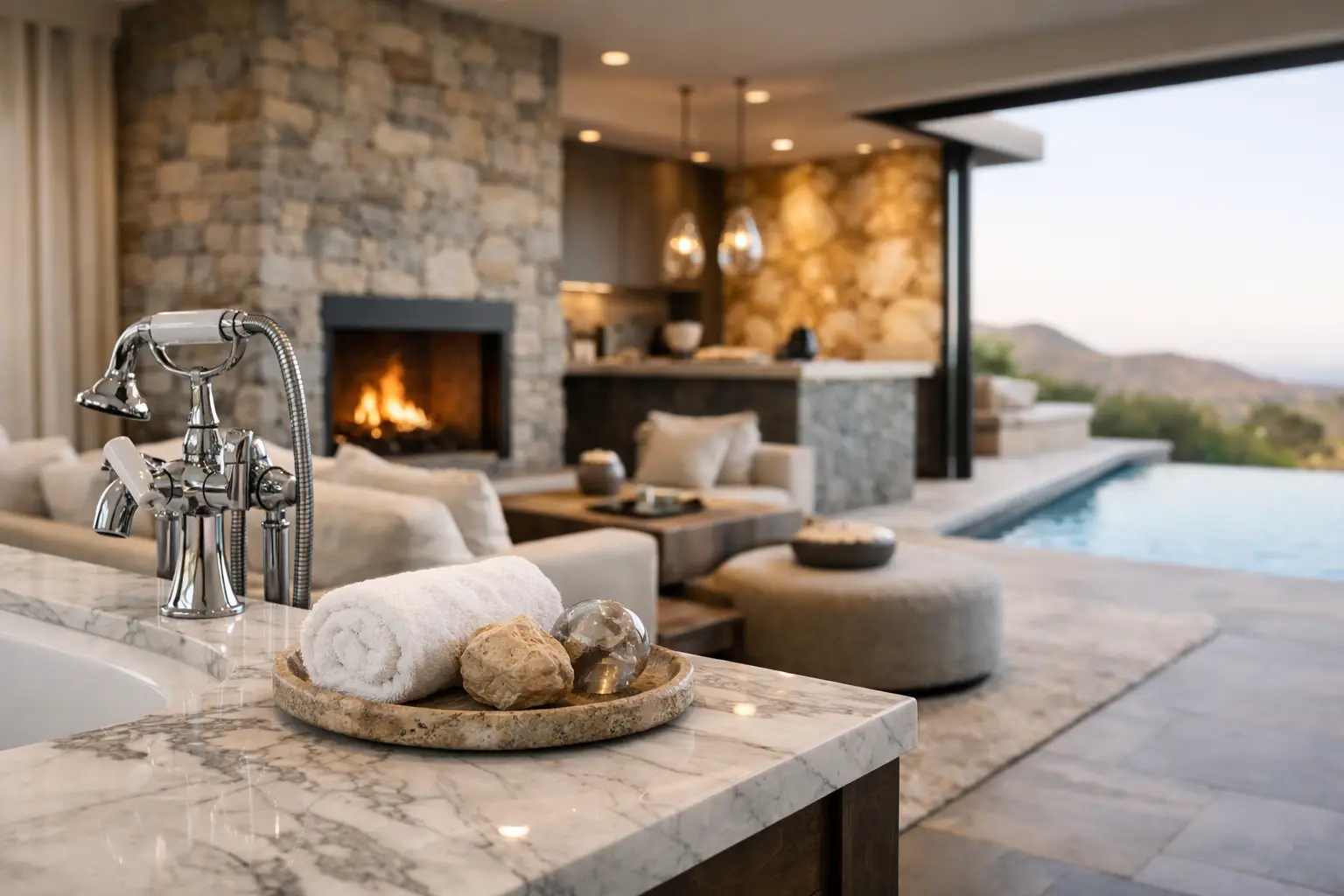
A veined fireplace surround that anchors a drawing room. A staircase whose treads seem to have been carved from a single, continuous gesture. An entrance floor that acquires more character with every passing year. Luxury stone features do not merely furnish a property: they establish its atmosphere, giving architecture weight, light and a sense of permanence that few other materials can equal.
For a private residence, hospitality setting or landmark restoration, the most successful stonework is never selected from a catalogue alone. It begins with the space, the natural light, the intended use and the character of the material itself. Marble, granite, travertine and onyx each carry their own history in their veining, porosity, crystalline structure and tonal variation. Fine craftsmanship gives that history a precise place within contemporary life.
Luxury Stone Features Begin With the Block
Natural stone is not uniform, and this is its distinction. Two slabs taken from the same quarry may differ in movement, ground colour and mineral detail. In a luxury project, these variations are not flaws to be concealed. They are studied carefully, then composed so that the finished surface has balance, rhythm and presence.
This is especially important where a feature occupies a central visual position. A bookmatched marble wall behind a bed, for example, relies on the mirrored opening of two adjacent slabs. The result can resemble a landscape, a cloud formation or an abstract work of art. Yet the effect depends on decisions made long before installation: where to cut the block, how to orient the slabs and which sections deserve prominence.
Material choice should also respond to the architecture rather than fashion alone. Calacatta marble may bring luminous drama to a formal bathroom or reception room, while the quiet linearity of travertine can suit a restrained contemporary interior. Granite offers exceptional density and resilience for heavily used surfaces. Onyx, often backlit, creates a more theatrical effect and is best reserved for locations where its translucency can be appreciated rather than overwhelmed.
A stone's appearance is only one part of the decision. Its absorption, hardness, finish and maintenance requirements must be considered with equal care. A honed surface may be more forgiving underfoot than a highly polished one; an exterior threshold demands different technical judgement from a decorative wall panel. Lasting beauty is achieved when aesthetic ambition and material suitability are treated as one discipline.
The Architectural Places Where Stone Matters Most
Stone has the greatest impact when it is allowed to define an architectural moment. This does not always mean covering a room from floor to ceiling. Often, a single perfectly resolved element is more compelling than abundant decoration.
Entrances and staircases
The entrance introduces the pace and character of a home. A floor in limestone, marble or granite immediately conveys a sense of arrival, particularly when its proportions align with doorways, wall panelling and the sightline into adjoining rooms. Borders, inset details and carefully chosen joints can lend formality without becoming ornate.
Staircases demand both visual assurance and technical rigour. Treads, risers, landings and skirting must be measured and fabricated with exacting precision, while the finish must provide appropriate grip. The beauty of a stone staircase lies in its quiet continuity: each element belongs to the next, and the structure feels as though it has always been part of the building.
Fireplaces and living spaces
A bespoke fireplace is among the most enduring luxury stone features because it gathers people around a natural focal point. Its design may be architectural and minimal, with broad planes of lightly veined marble, or more classically composed with moulded profiles and a substantial hearth.
Scale matters. A dramatic stone can appear magnificent on a generous chimney breast but oppressive in a compact room. Conversely, a pale and subtle material may need a stronger profile or deeper reveal to hold its presence. The fireplace should belong to the room's proportions, not simply display the most expensive slab available.
Kitchens, bathrooms and private wellness areas
Stone surfaces in kitchens and bathrooms must work hard while appearing effortless. A monolithic island in quartzite or granite can provide remarkable resistance to daily use, whereas marble worktops require an owner who accepts that gentle etching and patina are part of the material's life. Neither choice is inherently superior. The right choice depends on how a space will be lived in.
In bathrooms, stone can extend from vanity tops to walls, shower enclosures and window reveals, creating a composed, restorative environment. Large-format slabs reduce visual interruption from joints, but they require careful handling, substrate preparation and installation. In steam rooms and wellness spaces, the detailing behind the surface is just as important as the stone that is seen: waterproofing, movement allowances and correct adhesives protect the work for decades.
Light, Finish and Detail Create the Difference
The same material can feel entirely different according to its finish. Polished marble reflects light and intensifies colour, bringing ceremonial refinement to formal interiors. Honed surfaces offer a softer, more contemporary appearance. Brushed, flamed or sandblasted finishes may be appropriate for exterior paving and poolside areas, where tactility and slip resistance are essential.
Edges and junctions deserve the same attention. A finely eased edge may suit a modern vanity; a more generous bullnose can lend softness to a family kitchen. Mitred returns can make a thick stone element appear carved from a solid mass, while a visible shadow gap may give a wall cladding a lighter, more architectural expression.
Lighting should be designed with the stone, not added afterwards. Raking light can reveal texture and fossil detail in travertine or limestone. Backlighting can transform onyx into an illuminated feature of remarkable depth. Strong spotlights, however, may exaggerate natural surface irregularities or create unwanted reflections on highly polished finishes. Mock-ups and sample viewing in the intended light are invaluable, particularly for richly veined or translucent materials.
Bespoke Work Requires a Complete View of the Project
A fine stone feature cannot be judged only by the finished photograph. Its success depends on surveying, templating, fabrication, transport, fixing methods and coordination with every adjoining trade. The most elegant line in a drawing room can be lost if it meets a timber panel, metal frame or plaster finish without care.
This is why bespoke stonework benefits from early involvement in the design process. Decisions about slab sizes, joint placement and structural support affect the final composition. In a large wall installation, a well-placed joint can follow a natural vein and disappear into the design; a poorly placed one can interrupt it permanently. For exterior cladding, drainage, fixing systems and resistance to weathering must be resolved before the first panel is cut.
Heritage settings bring another level of responsibility. A replacement threshold, repaired cornice or restored memorial must respect the original material and construction while meeting current technical expectations. The work calls for material knowledge, patience and an understanding that restoration is an act of stewardship, not imitation. Torchio Marmi has carried this approach through generations of architectural, decorative and commemorative stonework.
Permanence Does Not Mean Absence of Care
Natural stone is durable, but it is not indifferent. Proper care protects its finish without stripping away its character. Neutral cleaning products, prompt attention to acidic spills and periodic professional assessment are generally preferable to aggressive household chemicals. Exterior stone should be reviewed for staining, movement, frost exposure and drainage performance, particularly in areas subject to seasonal weather.
There is also a more considered way to understand maintenance. A lightly marked marble worktop in a much-loved kitchen may record a family's life rather than signal failure. The question is whether the client desires an immaculate surface or welcomes a living patina. Establishing that expectation at the outset prevents disappointment and leads to more honest material choices.
The most memorable interiors are rarely those with the most finishes. They are the ones where a few materials have been chosen with conviction and brought together with restraint. Let stone take its rightful place: not as an accessory, but as an enduring part of the architecture, shaped for the life and memories that will unfold around it.