
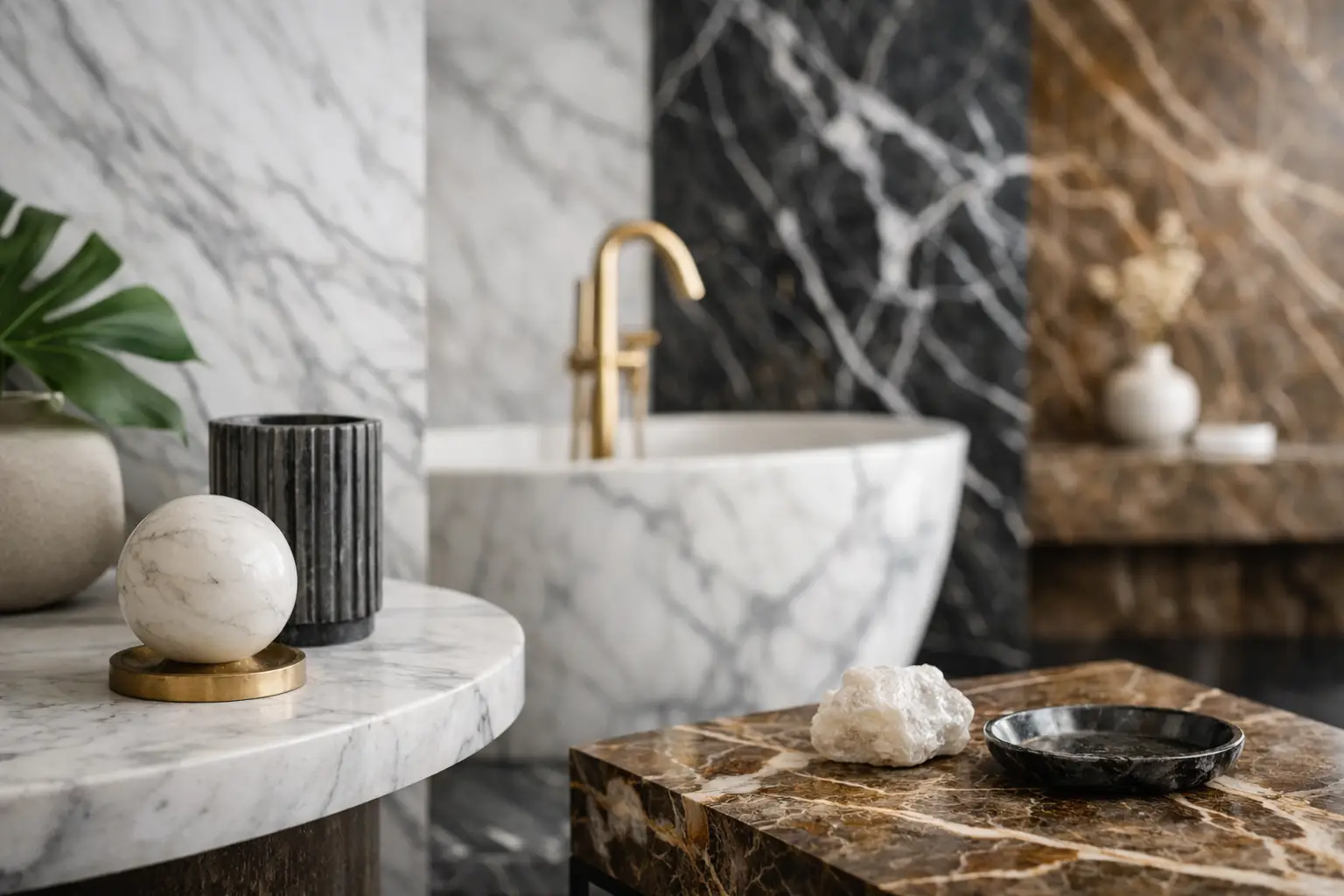
Marble design trends are moving away from the cold, anonymous perfection once associated with luxury interiors. The most compelling projects now allow the material to speak: a dramatic vein is positioned rather than hidden, a honed surface invites touch, and a carefully selected slab becomes the starting point for an entire room. For private residences, hospitality spaces and distinguished restorations alike, marble is valued not as a passing decoration, but as a material with presence, memory and permanence.
This does not mean that every richly veined stone belongs everywhere. The enduring approach is more discerning. It begins with the architecture, the light and the life of the space, then considers how a particular marble can give that setting a singular identity.
Marble design trends: character over uniformity
For many years, a quiet and highly consistent surface was treated as the safest choice. It remains appropriate in certain architectural settings, particularly where proportion, joinery and light are intended to take precedence. Yet a growing number of designers and clients are choosing stones with visible movement: sweeping grey lines, warm mineral clouds, brecciated fragments and deep, graphic contrasts.
This preference reflects a broader desire for authenticity. Natural variation is no longer treated as an imperfection to be managed away. It is the evidence that the material comes from the earth and that no two installations will be identical. A bookmatched wall behind a basin, for example, can read almost like a landscape or a work of abstract art. In a fireplace surround, a bold vein can establish a calm, formal centre for the room.
The distinction lies in control. Expressive marble requires expert selection and dry laying before fabrication. The cut direction, the relationship between adjacent pieces and the placement of joints all determine whether the final composition feels intentional. A remarkable slab carelessly divided can lose its force; a quieter stone, handled with sensitivity, can become quietly unforgettable.
Warmer palettes and the return of depth
Cool whites and blue-greys retain their rightful place in classical and contemporary interiors, but the current palette is broadening. Cream, tobacco, honey, sage, burgundy and soft terracotta tones are being specified with greater confidence. Travertine, richly coloured marbles and stones with fossil detail bring visual warmth without resorting to ornament for its own sake.
This is especially evident in homes where interiors are intended to feel collected rather than newly assembled. A warm stone floor can connect oak, bronze, linen and plaster with a natural ease. In a bathroom, a muted green or brown marble brings depth and enclosure, creating an atmosphere closer to a private retreat than a conventional sanitary room.
The choice should respond to available daylight. A dark, dramatic marble can appear majestic in a generous hall or dining room with carefully considered illumination, but may overwhelm a compact or poorly lit space. Conversely, a pale stone is not automatically restrained: fine veining, a textured finish and precise detailing can give it great richness.
Vein matching as architectural composition
Vein matching is becoming more ambitious, particularly on large-format walls, shower enclosures and kitchen islands. Bookmatching creates a mirrored pattern from two adjoining slabs; vein matching continues the direction of the stone across separate pieces. Both techniques can produce extraordinary results, though they should not be applied automatically.
A symmetrical composition suits formal spaces and strongly figured materials. A continuous, directional arrangement can feel more natural in long wall cladding, flooring or a monolithic island. Some marbles are more beautiful when allowed to remain irregular, with quiet joints that acknowledge the construction rather than forcing a pattern the stone does not possess.
The best decision is made while viewing the actual slabs, not only a small sample. A sample communicates colour and general character, but it cannot reveal the scale, movement or particular markings that will define a finished surface.
Sculptural stone in everyday rooms
Another defining direction is the use of marble as volume, not merely cladding. Thick-edged worktops, carved washbasins, freestanding plinths, generous hearths and integrated benches give stone a physical authority. The object appears formed from a single mass, even when its construction requires complex technical planning beneath the visible surface.
This sculptural language is particularly persuasive in kitchens. Instead of treating the worktop, upstand and island as separate elements, designers are creating continuous compositions in which the stone folds, returns or drops to the floor. A waterfall end can be striking, but it is not the only answer. A softly profiled edge, a recessed base or a finely detailed junction with timber may suit the architecture better.
In bathrooms, carved basins and monolithic shower thresholds offer a sense of permanence. Here, practical requirements remain central. Drainage falls, access for maintenance, substrate movement and the appropriate sealing treatment must be resolved from the outset. Luxury is not a matter of visual effect alone; it is the confidence that a beautiful detail will perform well for years.
Honed, brushed and tactile finishes
Polished marble still has a place, particularly in ceremonial interiors, formal entrances and settings that welcome reflection and light. However, honed and tactile finishes are increasingly favoured for residential spaces. Their softer lustre reveals the depth of the stone without creating glare, while leathered, brushed or lightly textured surfaces add a more intimate, architectural quality.
Finish is never simply an aesthetic choice. A bathroom floor, external threshold or busy kitchen requires a different assessment from a decorative wall panel. Slip resistance, porosity, cleaning habits and exposure to acidic foods or cosmetics must all shape the specification. Some marbles develop a gentle patina through use, which many owners consider part of their charm. Others prefer a stone with greater resistance for demanding family kitchens or commercial settings.
There is no single correct answer. The most successful projects are honest about how a space will be used, then select the material and finish accordingly.
Marble alongside timber, metal and plaster
The current preference is for material conversations rather than rooms entirely wrapped in one surface. Marble is being paired with darkened bronze, aged brass, natural oak, lime plaster and hand-finished lacquer. These combinations temper the mineral precision of stone and allow its colour to resonate more fully.
A marble fireplace may become more compelling beside textured plaster than against a highly decorative wall covering. A pale stone kitchen can gain warmth from timber cabinetry and bronze details. In historic settings, the dialogue is more delicate: new stonework must respect existing fabric, original proportions and the marks of time without resorting to imitation.
This is where craftsmanship becomes a form of interpretation. The fabricator must understand not only how to cut and install stone, but how its finish, thickness and edge profile will relate to every adjoining material. At Torchio Marmi, this attention to material harmony has long informed work ranging from bespoke interiors to the restoration of significant architectural and sacred places.
Smaller gestures, greater distinction
Large marble surfaces create immediate impact, but some of the most refined uses are smaller and more personal. A window sill in a rare stone, a tailored coffee table, a niche shelf, a door threshold or a hand-carved basin can introduce material depth without dominating the room. These elements reward close attention and often become the details a visitor remembers.
This approach is valuable where budgets or spatial constraints make full cladding unnecessary. Rather than spreading stone thinly across a project, it can be concentrated where touch, light and daily ritual give it meaning. A single exceptional piece, selected with care, often has more lasting power than many generic applications.
Designing beyond the trend cycle
The finest marble design trends are less about fashion than renewed material intelligence. They encourage architects and owners to choose real variation over printed imitation, thoughtful construction over quick visual effect, and forms that will age with dignity. Marble has survived changing tastes for centuries because it can be classical, minimal, expressive or serene without ceasing to be itself.
The right stone should feel inevitable in its setting. When its colour belongs to the light of the room, its veining has been composed with care and its workmanship honours the material, marble becomes more than a finish. It becomes part of the life, memory and character of the architecture.