
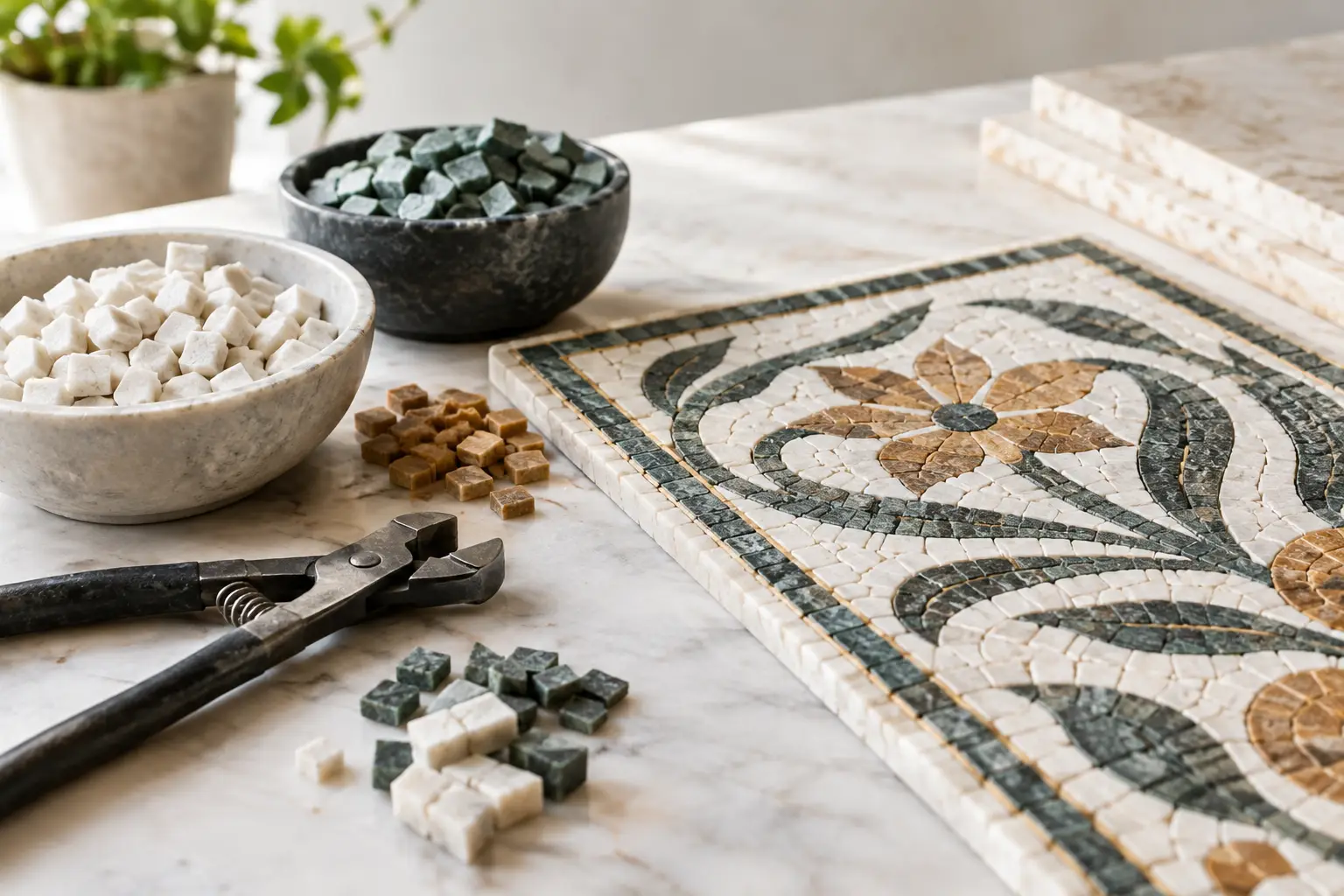
A marble mosaic is often measured in square metres, yet its true value is rarely created by surface area alone. Marble mosaic costs are shaped by a sequence of decisions: the origin and character of the stone, the scale of the design, the precision of each cut, and the expertise required to compose an enduring whole. For a private residence, a hospitality setting or a heritage interior, the mosaic becomes not simply a finish, but an architectural gesture with its own rhythm, memory and permanence.
The first question, therefore, should not be only, “What is the cost per square metre?” It should be, “What role must this mosaic play in the space?” A calm, monochrome floor in a bathroom has different technical and artistic demands from an entrance medallion, a figured wall panel or a restoration faithful to an historic decorative scheme. Understanding this distinction helps clients and design professionals establish a budget that honours both the material and the intended result.
Why marble mosaic costs vary so widely
A mosaic may appear simple from a distance: a field of small tesserae, perhaps in pale Carrara marble, arranged in an even geometric pattern. Up close, however, every element reveals a decision. The proportions of the pieces, the direction of the veins, the consistency of colour, the width of the joints and the relationship between border and central field all influence the final character.
Standard mosaic sheets, cut in regular formats and mounted on mesh, can offer an efficient solution for straightforward walls and floors. They are appropriate where repetition, speed of installation and a restrained visual language are the priority. Bespoke work belongs to a different category. It may require hand-selected slabs, individually cut tesserae, a drawing developed for the room, samples to test colour and finish, and careful preparation of the setting-out before installation begins.
The difference in price reflects this difference in authorship. A custom mosaic is not merely assembled; it is composed. This is particularly apparent where a project includes curves, inscriptions, figurative elements, complex borders or a transition between several stones.
The marble itself is only the beginning
The selected material has a direct influence on marble mosaic costs, but rarity is not the sole consideration. A stone must also be suitable for the proposed use. Its density, porosity, sensitivity to acids, consistency across the available blocks and ability to be cut into small pieces all matter.
Carrara and other classic white marbles may suit luminous, understated interiors, although even within a single variety there can be marked differences in background tone and veining. Calacatta, Arabescato, Verde Alpi, Rosso Verona, Nero Marquina and onyx can introduce stronger contrast or a more theatrical presence. When a design calls for several colours, the task becomes one of harmony as much as procurement: each stone must speak clearly without overwhelming the composition.
Sourcing also affects the budget. A project requiring a precise vein direction, unusual colour range or a substantial quantity from closely matched material may involve more selection at the quarry or supplier stage. Natural stone does not behave like a printed surface. Variation is part of its beauty, but it must be curated with knowledge and judgement when visual continuity is essential.
Design complexity is a cost driver
A small, intricate mosaic can demand more labour than a far larger field of regular tesserae. The more exacting the geometry, the more time is required to cut, sort, dry-lay and adjust the pieces. This is especially true for radial patterns, interlocking borders, circles, floral motifs and designs that must align with doors, columns, fireplaces or other architectural features.
A palette of two marbles arranged in a simple checkerboard will generally be more economical than a polychrome composition of five or six stones. Yet simplicity should never be mistaken for lack of refinement. A well-proportioned monochrome mosaic can possess exceptional presence when the scale of the tesserae, finish of the stone and framing detail have been considered in relation to the room.
Customisation can include more than pattern. It may involve adapting the dimensions to avoid narrow perimeter cuts, incorporating brass or stone inlays, responding to an existing historic floor, or designing a central motif that gives a room its identity. These choices create distinction, but they should be agreed early. Revisions after cutting has begun can increase both material waste and workshop time.
Tessera size and cutting method
Smaller tesserae are not automatically more expensive, but they often require greater precision. Fine pieces are particularly useful for curves and detailed imagery, while larger pieces can give a floor a calmer, more architectural reading. Waterjet cutting may be appropriate for highly accurate repeated forms, whereas hand cutting allows an artisan to respond to the movement of the stone and the subtleties of a bespoke drawing.
The most convincing work may use both approaches. Technology can provide accuracy; trained hands provide sensitivity. The correct method depends on the design rather than fashion.
Installation is where the design becomes architecture
A beautiful mosaic can fail if the substrate beneath it is not properly assessed and prepared. Installation costs should therefore be considered as part of the work, not as an afterthought. The existing floor or wall may require levelling, waterproofing, crack isolation, reinforcement or removal of previous finishes before the mosaic can be laid safely.
Wet areas demand particular care. Showers, spas and bathrooms require appropriate waterproofing systems, compatible adhesives and grout selected for the stone and expected use. A polished marble surface may be suitable for a decorative wall but less appropriate for a heavily used entrance, where honed or textured finishes can offer a more practical balance between elegance and slip resistance.
The setting-out phase is equally significant. An experienced installer establishes centre lines, checks levels and plans the position of cuts so that the composition feels intentional from every approach. A border that ends awkwardly at a threshold, or a central motif that sits fractionally off-axis, can disturb an otherwise fine interior. These details are invisible in a basic price comparison, yet they are visible every day in the finished space.
Budgeting for a bespoke commission
A considered quotation should distinguish between material, fabrication, design development, site preparation, installation, grouting, sealing and any specialist transport or access requirements. This clarity enables the client, architect or contractor to understand where investment is being made and where adjustments are possible without compromising the essential idea.
There are several intelligent ways to manage a budget. A rare marble may be reserved for a border or focal medallion, with a more readily available stone forming the principal field. A complex inlay can be concentrated in an entrance or fireplace surround rather than extended throughout an entire floor. The scale of a pattern can be simplified while preserving its proportions and atmosphere.
What should not be reduced without careful thought is substrate preparation, material suitability or installation expertise. These are the quiet foundations of longevity. A mosaic designed to last generations deserves a technical execution equal to its visual ambition.
For historic settings, budgeting may also need to allow for surveys, samples, approval processes and the conservation of adjacent finishes. Restoration work is rarely predictable in the way new construction can be. Once an existing floor is opened or cleaned, hidden conditions may emerge. Contingency is not a sign of uncertainty; it is a responsible acknowledgement of the building’s history.
Value beyond the initial price
Marble is chosen because it acquires character over time. A well-made mosaic can withstand decades of use, develop a gentle patina and remain integral to the architecture long after more temporary finishes have been replaced. Its value lies in this durability, but also in the singularity it gives a place.
Unlike a decorative product selected from a catalogue, a bespoke mosaic can respond to the particular light of a hall, the height of a ceiling, the tone of surrounding joinery and the story of a property. It can be quiet and ceremonial, contemporary and rooted in tradition, or deliberately expressive. In each case, the investment is not only in stone, but in a composition made for that one setting.
For more than a century and a half, Torchio Marmi has approached natural stone as material with both technical demands and cultural presence. That perspective remains essential when evaluating a mosaic: the best decision is rarely the least expensive one, but the one that allows design, craftsmanship and lasting performance to belong together.
Before requesting figures, bring the floor plan, photographs, intended use and any reference imagery into the conversation. A precise brief does more than clarify marble mosaic costs. It gives the artisan the means to shape stone into an enduring part of the life of the building.