
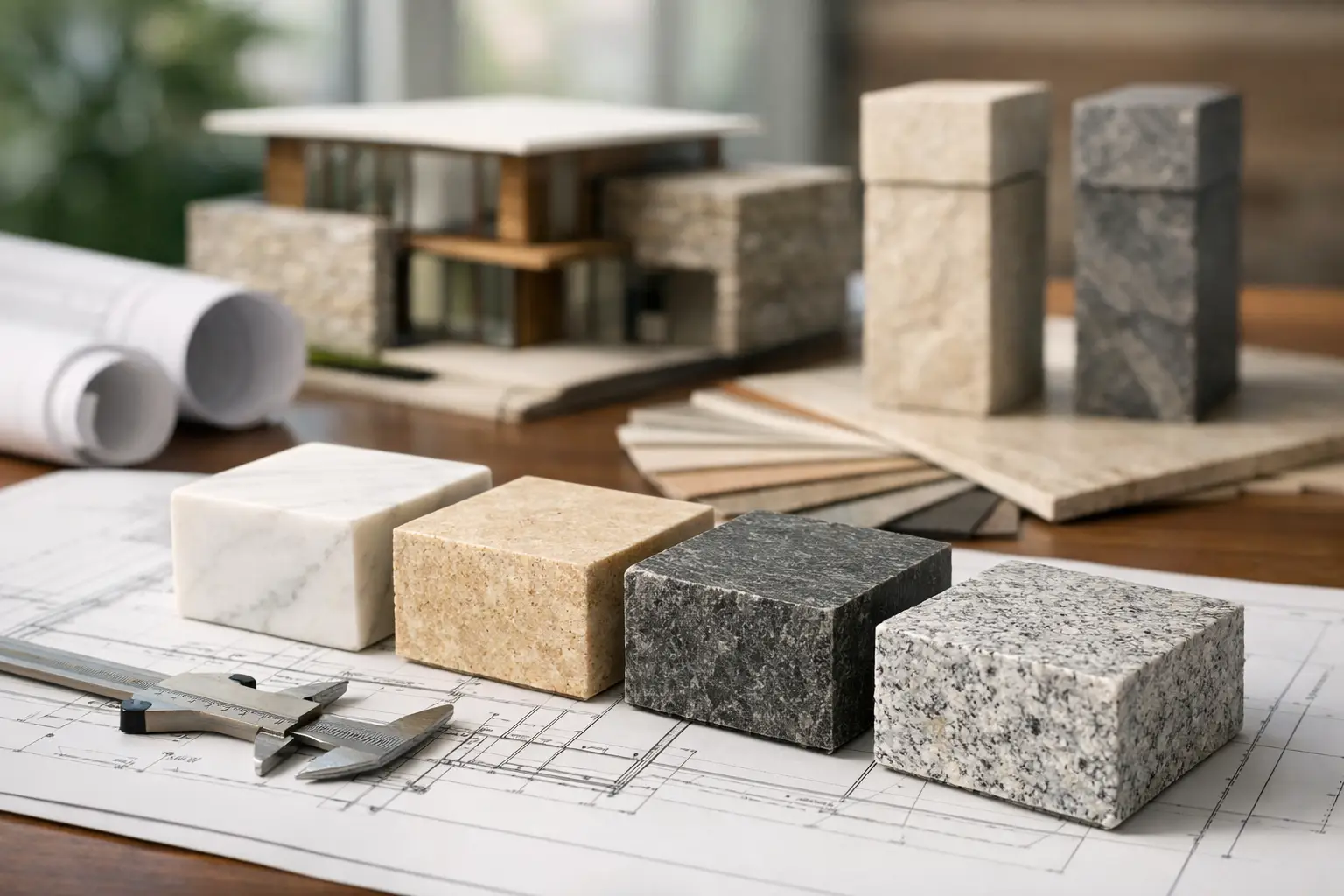
A stone surface can appear effortless only when its specification has anticipated every detail beneath that appearance: the vein that turns at a corner, the finish under bare feet, the movement of a façade in changing weather, and the tolerance between a bookmatched slab and a bronze inlay. This architectural stone specification guide is intended for projects where natural material is not an afterthought, but a defining part of the architecture.
Stone is formed over geological time, yet its success on site depends on decisions made with great precision. Marble, granite, travertine, limestone and onyx each carry distinct visual and technical characters. Selecting well means considering more than a sample board. It means understanding the source block, intended use, fabrication method, installation conditions and the life the surface will lead after handover.
Begin with the stone’s purpose
The first question is not simply which stone is most beautiful. It is what the stone must do. A honed marble floor in a private residence may be chosen for its soft luminosity and intimate atmosphere. The same marble, used in a busy hotel entrance, may require a different finish, a more considered maintenance plan, or a less delicate alternative in the areas of greatest traffic.
For exterior work, climatic exposure changes the conversation. Frost, driving rain, pollution, solar gain and thermal movement all affect the appropriate material and fixing strategy. A stone with an open structure may perform beautifully in a sheltered internal wall but demand specialist assessment before it is used in an exposed façade. Density alone is not a complete measure of suitability; water absorption, mineral composition, bedding direction and the character of the individual quarry all matter.
In historic settings, the purpose may include continuity as well as performance. Replacement stone should respect the original architecture in colour, grain, tooling and weathering behaviour, while meeting present-day structural and conservation requirements. This is where material knowledge becomes a form of cultural care.
Architectural stone specification guide: select the right material
Natural stone should be selected from an approved range that reflects the variation inherent to the material. A small sample can suggest colour, but it cannot fully describe movement, veining, fossil presence or the subtle shifts between slabs. For projects where visual continuity is central, it is wise to approve larger control samples or view selected slabs before cutting begins.
Marble brings depth, reflection and a sense of ceremony. It is often the natural choice for bathrooms, staircases, fireplaces, wall cladding and finely detailed interiors. Yet many marbles are sensitive to acids, staining and scratching, which should be addressed honestly where kitchens, bars or heavily used bathrooms are concerned. A protective treatment can help, but it does not make a calcareous stone indifferent to careless use.
Granite is generally harder and more resistant to abrasion, making it well suited to demanding worktops, public floors and external architecture. Its visual language is often more granular than marble, with crystalline depth rather than flowing veining. Travertine offers a warm, ancient character and may be filled or left more open according to the design. Its pores and cavities are part of its identity, not necessarily imperfections to be erased.
Onyx offers another kind of presence. When backlit, it can become a luminous architectural feature, rich with colour and movement. Its translucency requires careful design of the support, lighting, adhesive and access for future maintenance. It is not a material to specify by appearance alone.
Define the finish as carefully as the stone
The finish determines both the visual reading of the stone and its everyday performance. Polished surfaces amplify depth and colour, making them particularly expressive in marble and onyx. Honed surfaces are quieter, with a satin quality that suits contemporary interiors and offers a more forgiving appearance in daily use.
For exterior paving and steps, texture is often essential. Flamed, bush-hammered, brushed, sandblasted and split-face finishes each create a different relationship with light, water and touch. Slip resistance must be assessed in relation to the exact stone, finish, slope, drainage and anticipated conditions. A finish that performs well when dry may not be suitable near a pool, entrance or public stair.
The specification should also describe edge treatments and tactile details. A square edge may suit a precise, architectural language, while a lightly eased edge can make a substantial worktop more comfortable to use. On stair treads, the nosing profile, visible grain direction and consistency of risers deserve as much attention as the main floor field.
Design the layout before fabrication
A strong stone scheme is composed, not merely installed. Joint lines, module sizes, threshold positions, corners and alignment with joinery or lighting should be resolved in drawings before production. This avoids the familiar compromise of a narrow, unconsidered cut appearing at the edge of an otherwise generous floor.
Veined materials require particular discipline. The specification should state whether slabs are to be bookmatched, slip-matched, vein-matched or laid in a more random composition. These choices are aesthetic, but they have practical implications for yield, slab allocation, programme and cost. Bookmatching can create a powerful mirrored composition, though it may reveal a bolder visual rhythm than expected across a large wall.
Where possible, set out full-height elevations for bathrooms, reception walls, fireplaces and other focal points. Indicate the position of sanitaryware, switches, access panels, shadow gaps and metalwork. A concealed access panel may be achievable, but only if its joints are planned as part of the composition rather than introduced after the stone has been cut.
Specify thickness, support and movement
Stone thickness should never be selected by convention alone. A 20 mm internal wall lining, a 30 mm kitchen surface and a ventilated stone façade panel each place very different demands on the material. Thickness, panel dimensions, reinforcement, substrate and fixing method must work together.
For floors, establish the substrate condition, adhesive system, bed thickness and movement joints at an early stage. Natural stone is less forgiving than many manufactured finishes when a screed is uneven or insufficiently cured. Moisture migration can cause staining or distortion in sensitive materials, particularly pale marbles. The installation sequence should therefore protect the stone from avoidable site risks, including prolonged wet trades and unplanned storage.
For vertical cladding, distinguish between bonded applications and mechanically fixed systems. Larger or heavier panels may require kerf, undercut or concealed mechanical fixings designed for the project’s loads and substrate. External façades require allowance for thermal movement, wind loading, drainage and ventilation behind the panels. These are engineering decisions, not decorative extras.
A well-prepared specification records the following information clearly:
- stone name, quarry or approved origin, and acceptable visual range;
- finish, thickness, panel or tile sizes, edge profiles and joint treatment;
- layout drawings, vein direction, matching requirements and sample approval process;
- substrate preparation, adhesive or fixing system, sealants and movement joints;
- protection, cleaning and maintenance requirements through practical completion.
Allow for natural variation and responsible procurement
A specification that demands absolute uniformity from natural stone can create disappointment, waste and unnecessary delay. Variation should be managed, not denied. Define what must remain consistent, such as overall tone, finish and technical performance, while allowing the material’s individual marks to give the completed work life.
Procurement should begin early for rare materials, large format slabs and projects requiring selective quarrying. The available block may influence panel size, vein direction and quantity of reserve material. Ordering an appropriate attic stock of matching stone is prudent for future repairs, especially in hospitality, heritage and high-value residential work where an exact replacement may not be readily available years later.
Ethical sourcing is also inseparable from quality. Traceable origin, sound quarry practice and skilled processing support both the integrity of the material and the continuity of the craft. At Torchio Marmi, more than a century and a half of work with natural materials has taught a simple lesson: stone rewards patience at every stage.
Plan for care as part of the design
Natural stone does not ask to be treated as fragile, but it does ask to be understood. Specify pH-neutral cleaning products, avoid indiscriminate acidic cleaners on marble and limestone, and ensure cleaning teams receive guidance appropriate to the surface. Sealers can reduce absorption, particularly on porous stones, but they are not a substitute for suitable material selection or regular care.
In commercial settings, maintenance should account for entrance matting, cleaning frequency and the likely effects of grit underfoot. In private homes, the greatest value often lies in allowing stone to age gracefully. A lightly worn step, a softened patina or the quiet change of a honed surface can become part of the home’s memory rather than a defect to be feared.
The finest stonework begins with a specification that leaves room for nature while demanding precision from every human hand involved. Choose the material with care, draw its journey through the space, and give it the technical support to remain beautiful for generations.