
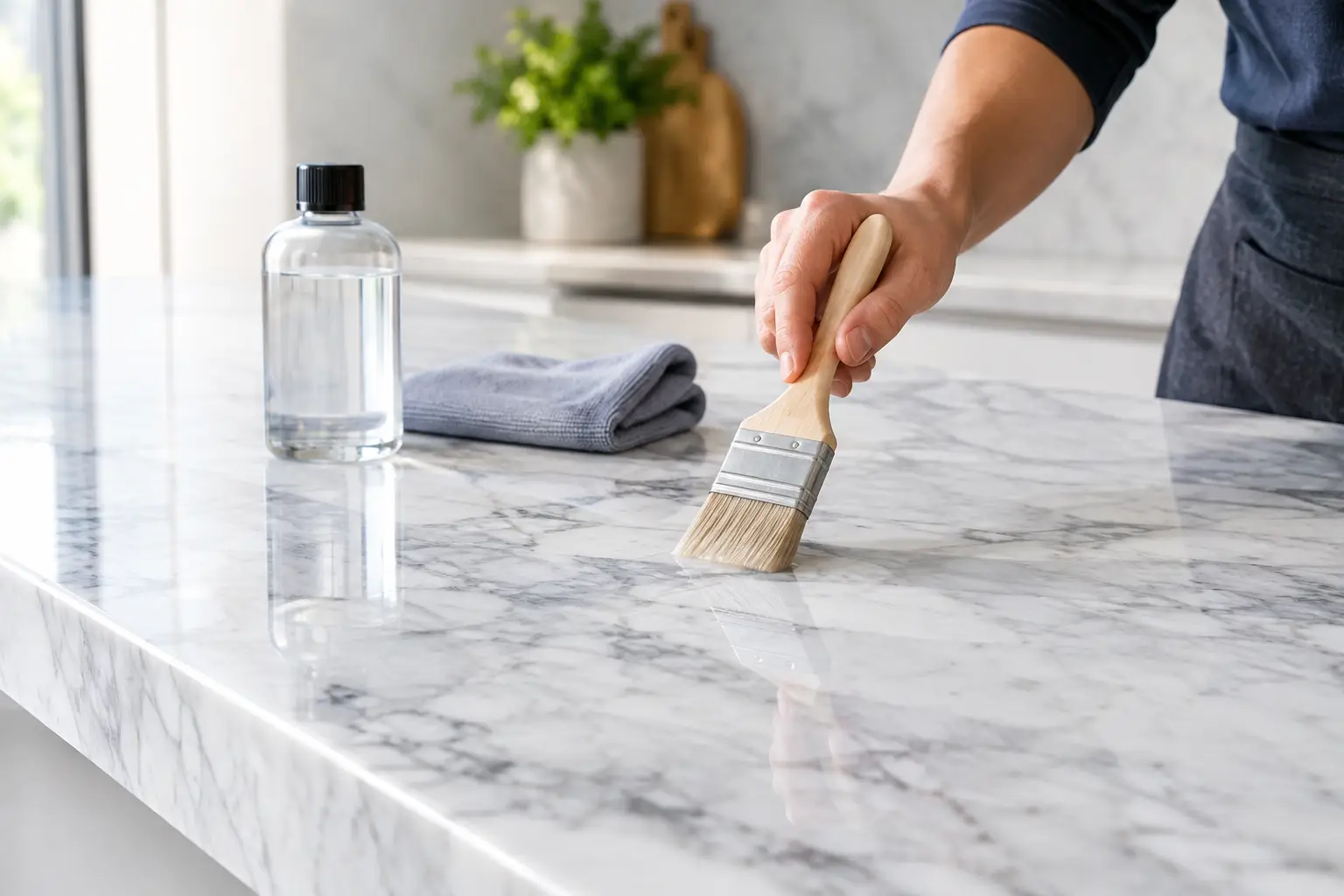
A marble surface is never merely a surface. Light gathers differently across its veins, its mineral depth changes with the hour, and even a quiet kitchen worktop or bathroom floor can carry the presence of a carefully chosen work of nature. Knowing how to seal marble preserves that character while offering sensible protection against the marks of daily life.
Sealing is not a substitute for care, nor should it create a visible film over the stone. Done correctly, it is a discreet measure: one that helps the marble resist the absorption of oils, coloured liquids and everyday residues, while allowing its natural finish to remain central.
Why marble needs a considered approach
Marble is formed largely from calcite, a mineral prized for its luminosity and soft, living appearance. It is also naturally porous to varying degrees. Honed marble, open-pored white marbles and richly veined varieties may absorb moisture or oil more readily than a tightly polished surface. A suitable sealer reduces this absorption time, giving spills a better chance of being removed before they become stains.
It cannot, however, make marble invulnerable. Wine, lemon juice, vinegar, many bathroom products and harsh descalers may etch marble rather than stain it. Etching is a change to the stone's surface caused by acid, often seen as a dull or lighter mark. No conventional sealer prevents this reaction. This distinction matters, particularly in kitchens, bathrooms and hospitality settings where the beauty of natural stone must be paired with realistic expectations.
For a rare, antique or historically significant surface, the decision requires even greater care. Stone used in restoration has its own history, previous treatments and condition. In such cases, sealing should form part of a wider conservation assessment, not become an automatic maintenance task.
How to seal marble with an impregnating sealer
For most interior marble, choose a high-quality impregnating sealer, also called a penetrating sealer. Rather than forming a coating on top, it enters the microscopic pores of the stone and leaves a water- and oil-repellent treatment beneath the surface. This is generally the right choice for polished and honed marble because it preserves the material's tactile quality and visual clarity.
Avoid topical sealers intended to create gloss, colour enhancement or a protective film unless they have been specifically specified for the particular stone and setting. On marble, such coatings can alter the intended finish, trap moisture, wear unevenly and become difficult to remove. A surface that looks protected on the day of application may later appear plastic, cloudy or patchy.
Begin with a clean, completely dry surface
Remove dust and loose grit with a soft, dry microfibre cloth. Then clean the marble using a pH-neutral cleaner made for natural stone, following the manufacturer's dilution guidance. Household multipurpose sprays, vinegar, bleach and abrasive creams have no place in this process. They can damage the finish or leave residues that interfere with the sealer.
Allow the stone to dry fully before proceeding. This is essential. Moisture held in the pores prevents proper penetration and can lead to inconsistent results. Depending on the stone, room temperature, ventilation and recent cleaning, this may take 24 to 72 hours. Newly installed marble, particularly where adhesive, grout or moisture may still be curing below the surface, should be assessed by the installer before any treatment is applied.
Test in a discreet area first
Natural stone is individual. Even slabs from the same block can differ in density, mineral composition and absorbency. Apply the chosen sealer to a small, inconspicuous area and allow it to cure as directed. Check for any change in tone, sheen or feel, especially on highly polished, dark or dramatically veined marble.
A test also confirms whether the marble needs sealing at all. Some polished marbles are sufficiently dense that they accept little product. Applying more sealer than the stone can absorb does not improve protection. It merely raises the risk of residue drying on the surface.
Apply sparingly and evenly
Work in manageable sections, using a clean, lint-free cloth, applicator pad or soft roller suitable for stone treatment. Apply a thin, even layer of impregnating sealer, taking care to cover the entire area without flooding joints, edges or adjacent materials.
Leave the product on the marble only for the dwell time stated by its manufacturer. This period may be a few minutes, but instructions vary and should be followed precisely. During this time, keep the surface visibly wet where necessary, rather than allowing isolated areas to dry prematurely.
Remove every trace of excess product
This is the stage most likely to determine the quality of the result. Before the sealer begins to dry, buff away all excess with fresh, dry cloths. Look across the stone from a low angle to make sure no glossy smears, tacky patches or pooled product remain. Change cloths frequently.
If excess sealer dries on marble, it can leave a haze or streaking that is far more conspicuous than the protection it was meant to provide. Do not assume it will disappear with ordinary cleaning. Removal may require a specialist sealer remover and careful re-treatment.
Allow adequate curing time
Keep the surface dry, clean and free from heavy use for the full curing period specified by the product manufacturer. Although a treated worktop may feel dry quickly, full resistance commonly takes longer. Do not place wet objects, cosmetics, oils or food directly on it until curing is complete.
A second coat is occasionally appropriate for more absorbent honed marble, but only if the first coat has been accepted by the stone and the product instructions permit it. Again, wipe away all surplus material. The goal is protection within the marble, not a build-up on it.
Where sealing matters most
Not every marble element carries the same practical demands. A decorative wall in a formal entrance hall may require far less frequent treatment than a kitchen island used daily for cooking and entertaining. Honed bathroom vanity tops are exposed to soap, cosmetics and water, while flooring must contend with foot traffic and the fine grit that arrives from outdoors.
Kitchen worktops, splashbacks and dining surfaces benefit from prompt attention to oils, sauces and richly coloured foods. Bathroom surfaces need regular removal of toiletries and standing water. Floors should be protected first by good entrance matting and then by regular dust removal, as grit can gradually abrade even a carefully finished surface.
Exterior marble presents a separate set of questions. Weather, frost, moisture movement and environmental deposits make product selection more technical. A breathable treatment compatible with the particular stone, substrate and exposure is essential. Historic facades, memorials and sacred architecture should always be entrusted to conservators or experienced stone specialists, as an unsuitable treatment can compromise both appearance and long-term behaviour.
How often should marble be resealed?
There is no responsible universal timetable. Resealing may be needed every one to three years on a frequently used honed kitchen worktop, while a polished decorative surface may remain protected for considerably longer. Usage, cleaning routine, stone density and the original sealer all influence the interval.
A simple water test can offer a useful indication. Place a few drops of water on a clean, dry, inconspicuous area. If they remain beaded for several minutes, the existing protection is likely still performing. If the stone darkens quickly as it absorbs the water, it may be time to clean, dry and reseal. This test is a guide rather than a diagnosis, particularly on marble with naturally varied colouring.
Do not reseal simply because a calendar says so. Over-treatment can leave residue and alter the clarity of the finish. The best maintenance is measured: pH-neutral cleaning, immediate care of spills, soft cloths and the avoidance of acidic or abrasive products.
When to call a stone specialist
Sealing is appropriate for a sound, clean surface. It is not the answer to rings caused by etching, chips, cracks, deep staining, failing grout or a finish made uneven by previous coatings. These conditions need a different response, which may involve poulticing, honing, polishing, repair or carefully matched restoration.
This is particularly true where marble is part of a bespoke architectural composition. The scale of a fireplace surround, staircase, bathroom scheme or historic floor calls for technical judgement as well as practical skill. At Torchio Marmi, material knowledge is treated as part of the craft itself: each stone is understood in relation to its finish, setting, age and intended life.
A well-sealed marble surface should never announce the treatment. It should simply continue to reveal what made the stone worth choosing in the first place: depth, movement, light and a beauty that becomes more personal with time.