
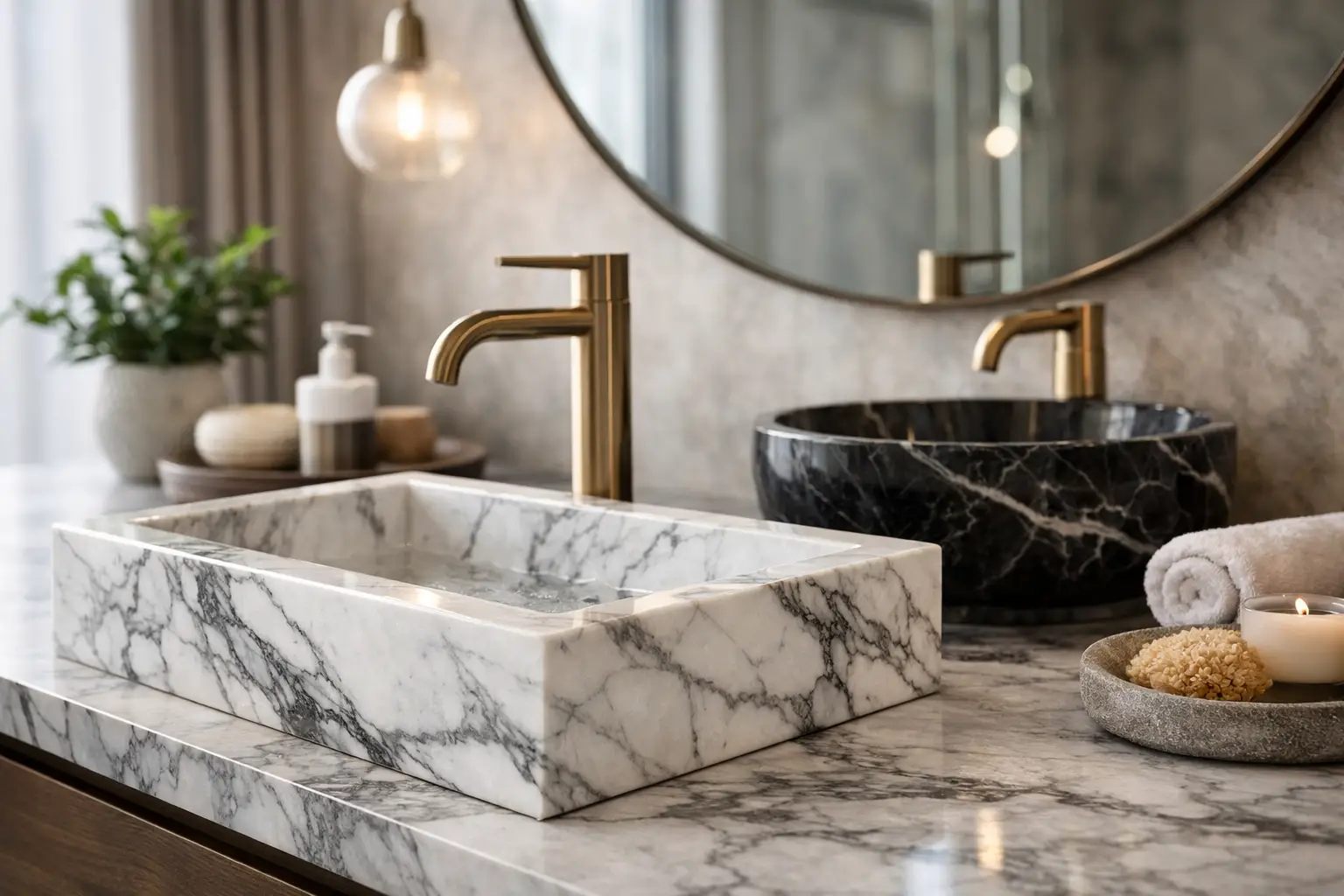
A basin is often the first object encountered in a bathroom: the surface touched on waking, the place where water, light and daily ritual meet. Marble sinks turn this practical point into an architectural presence. Their value lies not merely in their colour or polish, but in the singular veining, depth and quiet permanence of a material formed over millennia.
For a private residence, boutique hotel or considered hospitality project, a marble basin can establish the entire atmosphere of the room. It may be monolithic and restrained, delicately carved from a lighter stone, or paired with richly veined walls and flooring to create a more theatrical composition. The right choice depends on the proportions of the space, the intended use and, above all, the character of the stone itself.
Why marble changes the character of a bathroom
Unlike a factory-made basin, marble carries natural variation. A fine grey line, a cloud of warm mineral colour or a more decisive vein becomes part of the design. No two blocks are identical, which means no two finished sinks can be identical either. This is precisely where the material acquires its distinction.
Marble also responds beautifully to light. Honed surfaces soften reflection and lend a calm, velvety appearance; polished surfaces bring greater luminosity and can make a compact bathroom feel more expansive. In rooms with carefully planned natural light, the stone changes gently throughout the day, moving from a quiet morning presence to a more expressive evening surface.
This visual quality should never be separated from proportion. A generously sized double basin may suit a principal suite, where it can read as a continuous sculptural element. In a cloakroom, a smaller vessel basin or wall-mounted block can provide the same material richness without overwhelming the room. Bespoke work allows the thickness of the stone, depth of the bowl, position of the waste and relationship to taps to be resolved as one composition.
Choosing the right marble sinks for the project
The most successful marble sinks begin with an honest discussion about how the room will be used. A rarely used guest bathroom allows greater freedom for a highly expressive, delicate stone. A busy family bathroom calls for practical detailing, an appropriate finish and a clear care routine. Natural stone rewards attention; it is not intended to imitate an indestructible synthetic surface.
Colour, veining and visual balance
White marbles with grey veining remain enduring choices for elegant bathrooms, offering freshness without appearing cold. Warmer varieties can bring softness to traditional interiors and pair naturally with timber, aged brass and plaster finishes. Deep green, burgundy or black marble makes a more dramatic statement, particularly where the basin is conceived as a focal object against quieter surrounding materials.
It is wise to select from the actual slab or block wherever possible. Small samples communicate colour, but not the full movement of a vein or the placement of a natural feature. In a made-to-measure basin, the fabricator can consider how the veining travels across the countertop, into the bowl and down a front apron. That continuity can make the difference between a stone surface and a complete architectural piece.
Form, installation and drainage
A marble basin may be carved as an integrated sink within a vanity top, made as a freestanding vessel, or formed as a wall-hung trough. Each approach has a different visual weight and technical requirement.
An integrated basin offers a composed, minimal appearance, especially when the waste is concealed and the bowl slopes discreetly towards it. A vessel basin displays the full thickness of the material and gives the stone a more object-like quality. Wall-mounted designs can create a feeling of lightness, but the supporting structure must be designed for the considerable weight of natural stone.
Drainage deserves particular care. A well-made marble sink needs sufficient fall to prevent standing water, accurately cut openings and edges finished to feel comfortable in use. Tap choice matters too. Wall-mounted fittings preserve an uncluttered deck, while deck-mounted taps can work beautifully when their placement respects the veining and leaves room for everyday use.
Finish is a practical decision
A polished finish is luminous and formal, making it especially suited to refined powder rooms and lower-use bathrooms. Honed marble is more understated, with a satin touch that can make water marks and minor etching less visually insistent. Neither option is universally superior. The intended atmosphere, stone type, lighting and maintenance expectations should guide the decision.
A brushed or textured exterior can add tactile contrast while the inside of the bowl remains smooth and easy to clean. Such details are small, but they are where craftsmanship becomes tangible.
What to know about durability and daily life
Marble is durable, yet it is not indifferent. As a calcareous stone, it can react to acidic products, including some bathroom cleaners, descalers, perfumes and cosmetics. The resulting etching is not always a stain: it is a slight change in the surface itself, often visible as a duller mark on polished stone.
For some owners, this gradual record of use is part of marble's beauty. In a family home with a relaxed approach to patina, the stone can become more personal over time. For projects requiring an immaculate, highly polished appearance, a more cautious maintenance routine or a less reactive natural stone may be preferable. This is not a limitation to conceal, but a material truth to understand before specifying it.
Professional sealing helps reduce absorption and gives valuable time to remove splashes, but it does not make marble impermeable. The right sealer depends on the stone and finish, and should be applied and renewed as advised by the specialist. A well-designed basin also supports longevity: carefully formed drainer areas, sensible tap positions and clean joints reduce the places where moisture and residue can collect.
Daily care is uncomplicated. Wipe water and toothpaste away with a soft cloth, clean with a pH-neutral stone cleaner when needed, and avoid abrasive pads, bleach and acidic products. Do not leave cosmetics, fragrance bottles or metal containers sitting on the surface for prolonged periods, particularly where moisture may be trapped beneath them.
Bespoke fabrication makes the difference
The apparent simplicity of a marble sink can disguise considerable technical work. The stone must be assessed for colour, vein direction and structural soundness before cutting begins. Bowl depths, wall thicknesses and internal curves need to balance elegance with strength. Edges must be refined by hand, and the finished piece must accommodate plumbing, support and the tolerances of the site.
This is why a bespoke sink should be considered alongside its wider setting, rather than selected in isolation. The same marble may continue into a splashback, shower threshold or floor detail, allowing the bathroom to feel composed rather than decorated. Conversely, a single exceptional basin can be set against limewash, timber or metal to give the stone its own quiet space.
At Torchio Marmi, this relationship between material knowledge and design has been cultivated since 1860. Each commission is approached as a particular response to place, use and proportion, with the stone selected and worked to preserve the beauty inherent in its natural movement.
A material made for rooms with a sense of permanence
Trends favouring visual excess can make a bathroom date quickly. Marble has endured because it can be adapted without losing its identity. It belongs as naturally in a restrained contemporary interior as it does in a classical residence, and it can bring dignity to both a compact cloakroom and a generous spa-like suite.
The essential question is not whether marble is fashionable, but whether it belongs to the life of the building and the people who will use it. Choose a stone whose markings invite continued attention, specify a form that serves the room with ease, and allow expert fabrication to give the material the precision it deserves. Then the basin becomes more than a fitting: it becomes a daily encounter with timeless Italian style.